Introduction
Manufacturing faces supply chain instability, rising costs, and precision challenges. Traditional methods and single-function machines struggle to meet demands for integrated, lightweight, and high-strength products. This article explores how CNC turning-milling centers and advanced materials offer an integrated solution for precision, efficiency, and cost control in high-volume production.
What Precision Engineering Trends are reshaping the CNC turning field in 2026?
H3: The Rise of Intelligent, Connected Manufacturing
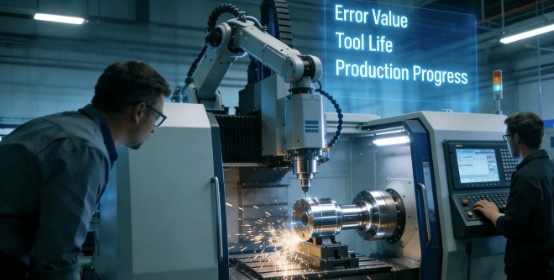
One major macro-trend is the convergence of Internet of Things (IoT) and data analytics with machine tools, transcending basic automation to intelligent systems. This development is a pillar of modern Precision Engineering Trends.
Data-Driven Decision Making
The value of connectivity is in transforming sensor data into actionable insights to deliver better results for CNC turning applications.
- Enabling Predictive Maintenance
The Cause-Based Monitoring system analyses the spindle load level and the vibration level of the tool and chuck and predicts possible machine failures in advance, contributing to the prevention of unplanned stops and to the improvement of operation stability.
- Facilitating Real-Time Adaptive Control
Intelligent CNC systems utilise machining result information in real-time to adapt the cutting conditions automatically. That results in uniform quality, less tool wear, and it’s a vital CNC Machining Innovation to fulfil tight tolerances.
Progressive manufacturers such as JS Precision harness these connected systems to maximise production and competitiveness.
How can a CNC Turning and Milling Center become the core of a one-stop solution for complex parts?
For complex components, traditional multi-machine workflows create efficiency and accuracy bottlenecks. The CNC turning and milling center is a revolutionary one-stop solution, embodying a key CNC machining innovations through its “complete in one setup” principle . This technology enables full machining without transferring the workpiece, eliminating cumulative errors from repeated re-clamping and ensuring precise feature relationships critical for complex CNC turning milling parts .
This integration drastically shortens production cycles by removing secondary setups and transport time. Furthermore, these centers bridge Rapid Prototyping Developments and full-scale production, allowing prototypes validated on the production machine to ensure a seamless, accelerated transition to market .For a deeper dive into the technical advantages for high-volume scenarios, consider exploring this resource on High-Volume CNC Turning Solutions.
How can Advanced Material Science optimize the cost and performance of Wholesale Aluminum CNC Turning Parts?
The Science of Aluminum Alloy Selection
A science-based approach rooted in material science is key to high performance and low cost in bulk aluminium CNC turning. Selection of the alloy is the basis: 6061 is general utility and weldable, 7075 is high strength for high-demand applications, and 5052 is superior corrosion resistance. This accurate selection avoids over-engineering and keeps costs under control.
DFM and Cost Synergy for Business Solutions
Combining material science with Design for Manufacturability (DFM) forms the core of effective business manufacturing solutions, creating significant cost benefits for high-volume orders.
- Structural Optimization for Efficiency
DFM analysis enables engineers to optimise the part geometry, applying methods such as topology optimisation to minimize weight and material consumption while maintaining the necessary strength of the part.
- Designing for Manufacturing Efficiency
Adding machining-friendly features, such as appropriate radii, common angles, and standard sizes, reduces cycle times, tool wear, and scrap rates. This synergy, like the choice of an easy-to-machine grade, improves machining time by more than 20%, giving excellent cost-competitiveness.
Why do Aerospace CNC Turning and Medical CNC Turning have such stringent requirements for certification and tolerances?
Components for aerospace CNC turning and medical CNC turning are subject to extreme requirements driven by their critical applications, where failure is not an option .
Aerospace parts must perform reliably under extreme conditions like high pressure and vibration.A micron-level deviation could lead to catastrophic outcomes, necessitating tolerances within ±0.005 mm or finer. To ensure this, standards like AS9100 are mandatory, providing a framework for rigorous process control, full traceability, and a culture of zero-defect manufacturing .
The medical field imposes its own extreme demands. medical CNC turning produces implants and surgical instruments that interact with the human body, requiring not only extreme dimensional accuracy but also absolute biocompatibility, flawless surface finishes, and guaranteed sterility. Compliance with standards like ISO 13485 is essential, demonstrating a manufacturer’s commitment to producing safe and effective medical devices . Similarly, a semiconductor CNC turning supplier must meet stringent clean room and contamination control standards to prevent microscopic defects .
These certifications are not just entry tickets but fundamental systems guaranteeing product safety and lifecycle integrity. Manufacturers adhering to these standards provide the necessary assurance for these high-risk industries.For high-standard turning needs, you can learn more about specialized CNC turning services that hold relevant certifications.
How will Rapid Prototyping Developments deeply integrate with high-volume manufacturing over the next five years?
The distinction between prototyping and production is increasingly less clear. Fast Prototyping Solutions Prototyping is moving past design validation to be involved in the manufacturing process, delivering agile Business Manufacturing Solutions. A more advanced stage of integration in prototyping technology with high-volume production is deep integration.
More and more people have the “prototype as product” idea in mind today. Both prototyping and production are possible with the advanced CNC technologies, in particular turning-milling centres, with one and the same equipment and one and the same process. They argue that a prototype part is a first-article production part that exercises the entire manufacturing process and saves the cost of retooling after scale-up. This process dramatically speeds up time-to-market.
Further on, the integration will become even deeper, with digital twins and artificial intelligence. The digital twin enables users to virtually simulate and optimise machining strategies without cutting any physical material. AI can also predict the best parameters for mass production based on prototyping data to achieve maximum efficiency and quality. Such rapid prototyping advances provide a dynamic manufacturing model that lets companies get high-quality products to market more quickly.
Conclusion
In short, taking advantage of the latest trends in the precision engineering industry, utilizing advanced CNC machining processes, using new or improved materials and combining RP technology with mass production, suppliers are now better positioned to meet concerns of efficiency, cost and quality. Choosing a partner with the technical know-how, rigorous quality certifications, and a proven track record is the key to turning these into realities.
If you want to know more about how to implement such advanced solutions on particular projects, delve further into case studies and technical white papers.
Author Bio
This article was authored by a precision manufacturing expert with over 15 years of experience, specialising in the forefront of CNC machining technology and its industrial applications.
FAQs
Q1: What accuracy levels are typically achievable in high-volume CNC turning?
A1: Modern CNC turning can continuously hold the dimensional tolerances of ±0.01 mm for mass production. With a turning and milling centre and high-precision measurement equipment, critical features can be held to ±0.005 mm or better to satisfy the requirements of such harsh industries as aerospace and medical.
Q2: What are the main advantages of aluminum compared to other materials in bulk CNC turning?
A2: Aluminum alloys are a very common material for high-volume CNC turning on account of the great strength to weight ratio, good machinability and relatively low cost. By means of the optimization of cutting conditions and design, high cost-performance and quick production can be realised.
Q3: What are the primary benefits of a turning-milling center compared to traditional standalone machines?
A3: The underlying advantage is the “all-in-one clamping” method. This gets rid of stacking errors due to multiple clampings, dramatically reduces the manufacturing lead time, and increases the accuracy and repeatability of complicated work pieces (such as a work piece requiring milling features on a turning body).
Q4: What key points should be considered when transitioning from prototyping to high-volume manufacturing?
A4: Attention in this step shall be devoted to the DFM (Design for Manufacturability) optimization to make sure the design is applicable for mass production with good yield. It is also important to verify the stability of supply, to take measures for cost control and to confirm uniformity of large lots by strict quality control.
Q5: Which certifications should be prioritized when selecting a high-volume CNC turning supplier?
A5: ISO 9001 is the foundation for a quality management system. For industry-specific requirements, AS9100D (aerospace) and ISO 13485 (medical devices) are critical. These certifications demonstrate a supplier’s capability for reliable process control and adherence to industry standards.