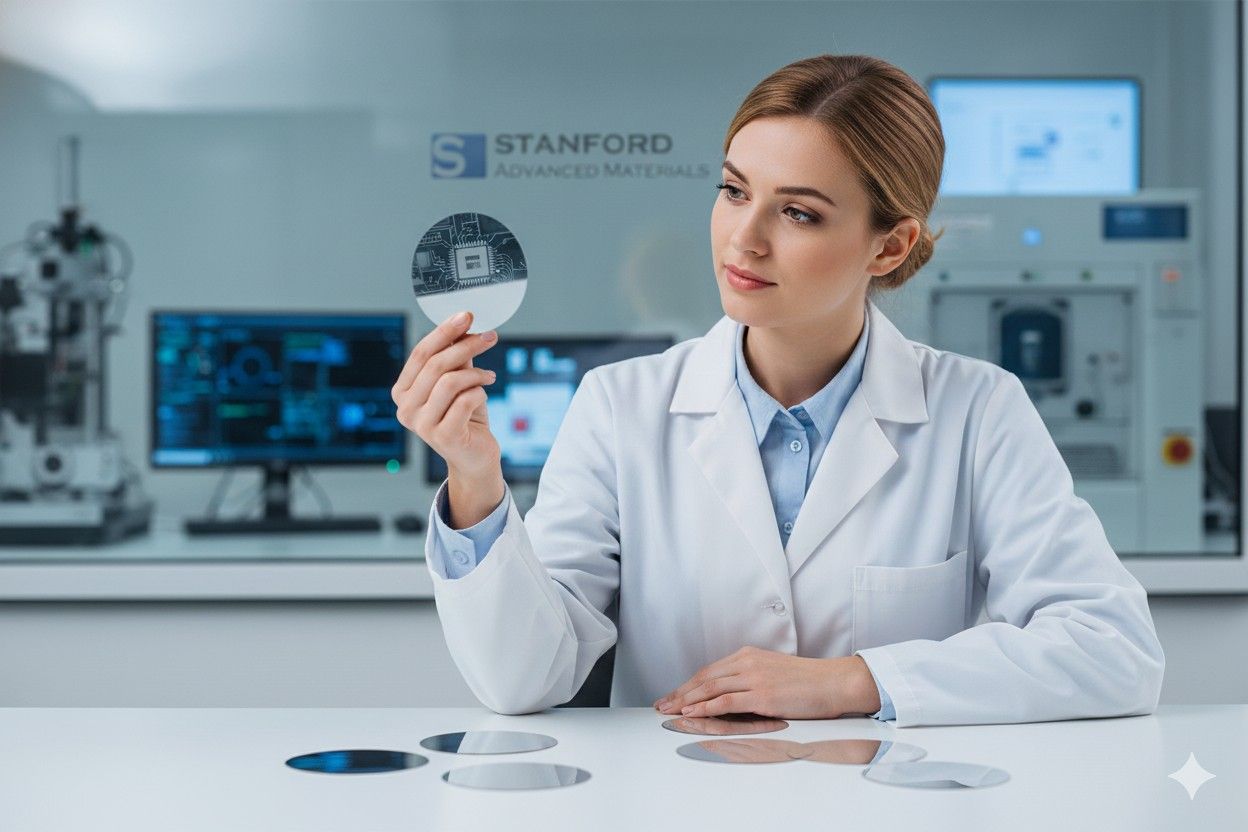
Silicon wafers form the basis of the entire semiconductor industry. Some of the devices we use daily, like smartphones, laptops, and solar cells, rely on silicon wafers. But you might be surprised to learn that silicon wafers are not a homogeneous material, meaning that they have varying physical properties in different directions in a crystal lattice structure. This property is known as crystal orientation, which is crucial in the fabrication of fast electronic devices.
What Are the Common Crystal Orientations for Silicon Wafers?
The structure of silicon is diamond cubic. The three most frequent orientations of crystals of silicon are:
- <100> orientation: In this orientation, the cutting plane is normal to the primary crystal axis. Currently, this orientation has widespread use in the semiconductor market.
- <111> orientation: The cutting plane is perpendicular to the direction of the body diagonal. It is applied in specific devices.
- <110> orientation: The cutting plane is oriented perpendicularly to the face diagonal. This orientation is mostly utilized in Micro-Electro-Mechanical Systems.
In addition to these, other orientations like <112> and <113> also exist but are not very common.
Ways to Determine Crystal Orientation
There are many ways in which, in practical production, the crystal orientation of a silicon wafer can be established:
- Orientation Flats or Notches: Silicon wafers contain one or more ‘flats’ or ‘notch’ points on the edge of the wafers. These points represent the orientation and conductivity type, which may be N-type or P-type. The first prominent flat indicates the orientation of the crystal, and another may show the conductivity type.
- X-ray Diffraction (XRD) Analysis: This is the most accurate method used in the laboratory. The method consists of determining the angle of diffraction of X-rays on the crystal face.
- Anisotropic Etching: In anisotropic etching, a property that varies from one crystal plane to another is used. The anisotropic etch removes the crystal lattice material selectively in accordance with the crystallographic plane orientation of that material.
- Optical Reflection Technique: Each crystal has a unique reflection pattern of light depending on its orientation.
What Are the Differences Between Different Orientations?
- Carrier Mobility
The mobility of the electrons and holes within the silicon lattice is affected by the orientation of the crystals.
<100> orientation has the greatest electron mobility, so it is the preferred option for MOSFET technology. And then, <110> orientation has the highest hole mobility. Its mobility value is twice as high as that for the <100> orientation. <111> orientation, however, has relatively lower carrier mobility.
Those devices requiring a high electron mobility, such as high-speed microprocessors, normally prefer <100> wafers. In PMOS technology, <110> wafers could possibly be considered in order to increase the hole mobility.
- Oxidation
The oxidation rates for silicon vary with the crystallographic orientation:
- <111> orientation: This oxidizes the fastest as there is the highest atomic density on the surface plane.
- <100> orientation: Oxidizes at the slowest rate.
- <110> orientation: Lies between in terms of oxidation rates.
This leads to variations in the thickness of the gate oxide and the resulting device characteristics.
- Anisotropic
Among the most conspicuous distinctions are anisotropic etching, especially with Potassium Hydroxide (KOH). KOH etches the <100> and the <110> planes much faster than the <111> plane, with the etch rate ratio being as high as 100:1. This allows to accurately produce V-shaped grooves or vertical sidewalls on <100> wafers. Notably, the <111> plane is relatively inert to KOH and thus serves as an effective “etch-stop” layer. Meanwhile, the <110> orientation can be etched to yield true vertical sidewalls, making it highly suitable for manufacturing Micro-Electro-Mechanical Systems (MEMS) components.
- Surface State Density and Interface Properties
A lower surface state density means higher stability and reliability of the device.
<100> orientation: It has the lowest surface state density and few interface states for silicon dioxide(SiO2). This is yet another major factor that contributed largely to its success in MOS devices.
<111> orientation: Has a higher surface state density.
Summary
The orientation of a silicon wafer does not occur randomly but depends on the requirements of the semiconductor. In recent semiconductor technology, <100>-oriented wafers prevail because of superior electrical characteristics and a lower interface state density. Nevertheless, with enhanced diversification of devices and emerging applications, and especially with the evolution of MEMS and three-dimensional integration technology, studies and applications of <110>- and <111>-oriented silicon wafers are already being explored extensively. The next time you use an electronic device, you might reflect on the fact that the small silicon chip in the device could very well be working in a manner determined by its crystal orientation, behind the scenes, running the whole show.
Go to NewsLyra for more in-depth articles and updates on semiconductor technology, materials science, and advanced electronics.