


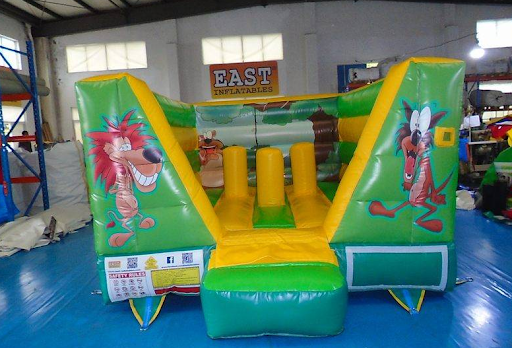
If you’ve been browsing the UK market for an inflatable, you’ve likely experienced “price shock.” On one tab, a high-street retailer is offering a colourful bouncy castle for £199. On another tab, a specialist manufacturer lists a similar-looking model for £2,000.
Is the higher price just a result of fancy branding? Or is the cheaper version a hidden bargain? To help you make an informed investment, we’ve broken down the anatomy of an inflatable to show you exactly what that £1,800 difference buys you.
1. Material Integrity: Oxford Cloth vs. PVC Vinyl
The single biggest factor in the price gap is the “fabric.”
- The £200 Version: These are usually made from Oxford Cloth (nylon). It is thin and porous, but light and easy to roll. Slowly but surely, the fibre of children’s bouncing is stretched by perpetual rubs, and they start to leak air.
- The £2,000 Version: Professional models are built from heavy-duty PVC Vinyl (often 0.55mm or 18oz). This material is puncture-resistant, waterproof, and flame-retardant.
If you are looking for a long-term investment, browsing a professional collection of bouncy castles will reveal that the weight and texture of the material are worlds apart from domestic toys. Commercial-grade PVC is designed to withstand hundreds of children over several years, rather than just a few summer weekends in a private garden.
2. Safety Standards: The BS EN 14960 Compliance
In the UK, safety isn’t just a preference—it’s a legal and insurance requirement. A budget £200 castle is designed for “domestic use only.” This means it hasn’t undergone the rigorous testing required for public hire or large events.
Conversely, a £2,000 model is engineered to meet BS EN 14960 standards. This involves:
- Height of walls: Ensuring children cannot fall out even during high-energy play.
- Anchor points: Providing massive force resistance so the castle doesn’t lift in the wind (crucial for the unpredictable British weather).
- Impact areas: Sufficient foam density in the “step” and “bed” to prevent children from hitting the hard ground underneath.
If you are starting a business, you cannot legally insure a domestic castle for public hire. Professional inflatables come with the structural integrity required for PIPA or ADIPS testing.
3. Engineering and Stitching: The Invisible Strength
Have you ever wondered why a cheap castle looks “wrinkly” while an expensive one looks “solid”? It’s all in the stitching and internal engineering.
- Home-use models often use single or double stitching with thin thread.
- Commercial models use quadruple stitching at high-stress points (like the corners, the entrance, and the slide transitions).
Furthermore, professional castles feature internal baffles—the hidden walls inside the inflatable that keep the jumping surface flat and firm. Cheap models often lack these, leading to “bulging” which makes it difficult, and sometimes dangerous, for children to jump safely.
4. ROI: Is the Expensive Castle Actually “Cheaper”?
For entrepreneurs and hire businesses, the initial price tag is less important than the Return on Investment (ROI).
| Feature | £200 Home Version | £2,000 Commercial Version |
| Lifespan | 1 Season (if lucky) | 5–8 Years with proper care |
| Resale Value | Almost Zero | 40–60% of original price |
| Hire Revenue | Not suitable for hire | £80–£150 per day in the UK |
| User Weight | Max 30-35kg per child | Can often support adults/teens |
A £2,000 castle that lasts 6 years costs you roughly £333 per year. A £200 castle that rips after one summer costs you £200 per year but offers zero safety and zero rental income. When you source from a reputable manufacturer like East Inflatables, you are paying for a machine that generates profit, not just a toy that takes up space in the garage.
5. The Blower and Accessories
That also includes the “engine” of your castle. A budget model comes with a tiny plastic blower that’s noisy, and it has a tendency to overheat. Commercial-Grade Castle – Your professional-level castle comes with a commercial-grade centrifugal blower, capable of running 8+ hours a day without batting an eye, even in moist weather.
Conclusion: Which One Should You Buy?
If you simply want a small gift for a toddler to use three times a year in a private garden, the £200 version is a fine toy.
However, if you want an inflatable that is safe, durable, insurance-compliant, and capable of generating income, the £1,800 difference is a necessary investment in quality. Don’t let the price tag fool you—in the world of bouncy castles, you truly get what you pay for. By choosing a supplier that understands the UK’s rigorous safety expectations, you ensure your investment stays inflated for years to come.