



Why I Built The Rank Check: A 30-Question SEO Quiz for Beginners
Why I Created The Rank Check
For my first eighteen months in SEO, I often found myself nodding through meetings while quietly taking notes on unfamiliar terms like canonical tags and crawl budget. After every call, I’d search for the concepts, watch YouTube videos, read blog posts, and learn through trial and error, sometimes on websites I wasn’t experienced enough to manage.
Over time, the pieces came together, but the learning process was far slower than it needed to be. The biggest challenge wasn’t finding information. It was knowing what I truly understood versus what I merely recognized.
That distinction matters. Recognizing a term after reading about it isn’t the same as understanding it well enough to explain it, troubleshoot real problems, or apply it confidently. You can study canonical tags repeatedly and still struggle when a client asks why their product pages are competing against each other in search results.
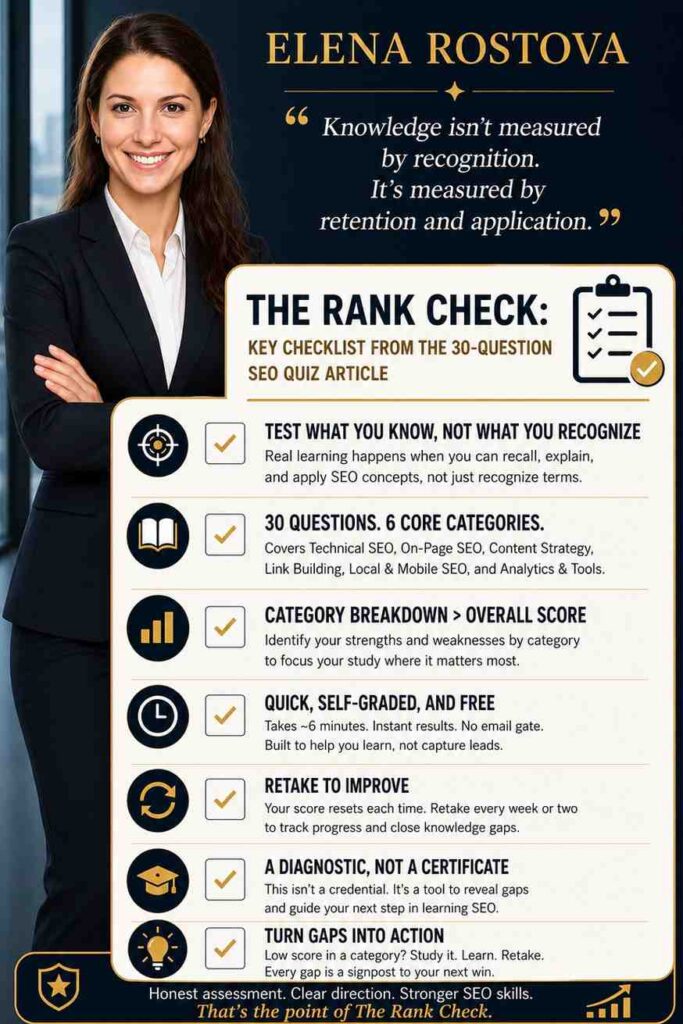
Knowledge isn’t measured by recognition. It’s measured by retention and application.
That’s the problem The Rank Check was built to solve.
The problem with how most people “learn” SEO
Most beginner SEO resources follow a familiar formula: listicles, glossaries, or checklists that get bookmarked and rarely revisited. Many of them are valuable. Google’s SEO Starter Guide, for example, remains one of the best resources for newcomers, and I still recommend it to new hires. The challenge isn’t the quality of the content. It’s how people consume it.
Passive reading often creates the illusion of understanding. You recognize a definition, assume you’ve learned it, and move on. Real learning happens when you have to recall and apply what you’ve read.
That’s where quizzes make a difference. You can’t skim through a multiple-choice question about the difference between a 301 and a 302 redirect. You either know the answer or you don’t, and that immediate feedback exposes knowledge gaps far more effectively than passive reading.
The Rank Check is built on that idea. It includes 30 questions covering technical SEO, on-page SEO, content strategy, link building, local SEO, mobile SEO, and analytics, reflecting the core knowledge every SEO professional should be able to apply with confidence.
Why thirty questions, and why self-graded
Thirty questions proved to be the right balance after I tested shorter versions with junior marketers I mentor. Ten questions were too limited to measure real understanding, while fifty felt overwhelming and led to drop-offs. Thirty provides enough coverage across the core pillars of SEO without feeling like an exam.
I also chose to make The Rank Check free and self-graded, with no email gate. Too many educational quizzes are designed primarily to capture leads rather than help people learn. If a resource is genuinely useful for beginners, it should be accessible without requiring personal information.
The category breakdown is more valuable than the overall score. Someone might excel at technical SEO but struggle with local search, or understand content strategy while missing key analytics concepts. Identifying those strengths and weaknesses gives learners a clear direction for what to study next instead of leaving them with a single score that offers little context.
What the thirty questions actually cover
| Category | Questions | What it tests |
|---|---|---|
| Technical SEO | 5 | Crawling, indexing, redirects, status codes, crawl budget |
| On-Page SEO | 5 | Title tags, meta descriptions, keyword placement, canonical tags, alt text |
| Content Strategy | 5 | Search intent, keyword cannibalization, evergreen content, E-E-A-T, thin content |
| Link Building | 5 | Backlinks, nofollow, anchor text, toxic links, guest posting |
| Local & Mobile SEO | 5 | Google Business Profile, NAP consistency, mobile-first indexing, Core Web Vitals, page speed |
| Analytics & Tools | 5 | CTR, bounce rate, Google Search Console, domain authority metrics, A/B testing |
Even split, on purpose. I didn’t want the quiz to quietly favor technical SEO just because that’s the part most content creators find intimidating and therefore over-index on. A beginner who only ever studies robots.txt directives while ignoring search intent ends up with a lopsided skill set, and the category breakdown at the end is designed to surface exactly that kind of imbalance.
Who this is actually for

I built The Rank Check for three types of people: beginners learning SEO on their own, junior marketers who inherited SEO responsibilities without formal training, and small business owners who want to understand what their SEO agency or freelancer is actually doing. None of them need another lengthy guide. They need a quick, honest assessment of what they truly know, not what they think they know.
The quiz isn’t designed to earn certifications or enhance a résumé. It’s a diagnostic tool, not a credential. Its purpose is to reveal knowledge gaps and provide a clear starting point for improvement.
The ranking labels and audit-themed scores add a touch of personality without distracting from the learning experience. SEO can be overly serious, so titles like “Page 2 (Nobody Clicks Page 2)” keep the quiz engaging while reinforcing an important message: every score highlights an opportunity to improve.
The bigger point behind the quiz format
SEO rewards people who understand why a practice matters, not just what it’s called. That principle is reflected in Google’s guidance on creating helpful, people-first content, which emphasizes delivering genuine value over surface-level optimization. Knowing how to define E-E-A-T isn’t enough. If you can’t explain why a thin, AI-generated article fails to demonstrate experience, expertise, authoritativeness, and trustworthiness, you’ve memorized the term rather than understood it.
The same principle applies across SEO. Effective optimization requires understanding how crawling, indexing, and ranking work together as a system, not as isolated concepts. Because SEO spans technical implementation, content strategy, link building, local search, analytics, and user experience, beginners need a practical way to measure what they truly understand before applying advice to a live website.
That’s the purpose of The Rank Check. It isn’t a certificate or a badge. It’s an honest 30-question assessment that highlights your strengths, reveals knowledge gaps, and helps you focus your next study session on what will improve your SEO skills the most. Readers seeking broader SEO and digital publishing insights can also explore the Pantheonuk.org platform for additional educational resources.
The Rank Check is a free 30-question SEO assessment designed to help beginners and marketers evaluate their practical SEO knowledge. Discover your strengths, identify knowledge gaps, and focus your learning with category-based scoring.
Download the free SEO Assessment Guide and Blogging Master Handbook (PDFs) to master every topic before taking the challenge.
SEO_2026_Handbook_Part1_Foundations (1)
Frequently asked questions
Do I need to give my email to see my results?
No. There’s no email gate, no signup form, and no “we’ll send your results to your inbox” trick. Your score and category breakdown appear on screen the moment you finish, and that’s the end of it.
How long does the quiz actually take?
Most people finish in around six minutes. It’s built to move fast: pick an answer, get instant feedback with a short explanation, move to the next question. There’s no timer forcing you along, so it can take longer if you’re reading the explanations carefully, which I’d actually recommend.
Is my score saved anywhere?
No. Nothing is stored or tracked between visits. If you close the tab, your result is gone, and retaking the quiz always starts fresh at zero. That’s intentional. This is a study tool, not a leaderboard.
What does the score actually mean?
It’s a snapshot of where your SEO knowledge stands today, broken down by category, not a certification or a formal skill assessment. Treat a low score in one category as a to-do list item, not a judgment.
Can I retake it?
Yes, as many times as you want. I’d actually encourage retaking it every week or two while you’re actively studying, since watching a weak category improve is a much better motivator than a single one-time score.
Is this meant to replace real SEO training?
No. It’s a diagnostic, not a curriculum. Think of it as the thing you do before or after reading a proper resource like Google’s SEO Starter Guide, not a replacement for it.
Where to go from here

If you take the quiz and land somewhere humbling, that’s not a bad outcome. It’s the whole point. Go back to whichever category scored lowest, read one solid resource on it, and come back in a week to retake it. The score resetting to zero every time isn’t a bug. It’s the nudge to keep showing up until the gaps close for real.