Reclaiming land that mowers gave up on
Across the United States, untended ground does not stay open for long. Abandoned pastures, fence lines, ditch banks, and woodland edges fill within a few seasons with saplings, briars, and woody brush that a lawn mower cannot touch. Landowners managing acreage in the Southeast and the Plains know that once cedar and locust seedlings take hold, the field is on its way back to scrub. Public agencies face the same battle keeping rights-of-way and trailheads open.
A heavy rotary brush cutter exists for exactly this work, where the vegetation has grown past what any finishing mower can handle.
The difference between the two machines is not horsepower alone. It comes down to the physics of the spinning blade itself.
Why mass, not just speed, cuts through wood
A finishing mower blade is thin and light because it only needs to slice soft grass. Drive that same blade into a finger-thick sapling and it stalls, because the stem absorbs the blade’s energy faster than the engine can restore it. The blade slows, jams, or bounces off.
A heavy cutter blade behaves differently because it carries momentum. A thick, massive blade spinning at speed stores real rotational energy, the same way a heavy flywheel keeps turning once it is up to speed. When that blade meets a woody stem, its stored inertia drives straight through the cut before the impact can slow it appreciably. The mass is the tool, with engine power merely keeping the blade spinning.
Picture chopping with a light hatchet versus a heavy splitting axe. The heavy head does not move faster, but its weight carries it through wood that would bounce a lighter blade right back. A brush cutter applies that same principle thousands of times a minute, letting accumulated momentum rather than sheer engine output do the cutting.
This is also why a heavy blade recovers so well from impact. When it does meet a stem too thick to sever in one pass, the stored inertia keeps it turning rather than stalling, so the next pass finishes the cut. A light mower blade, by contrast, sheds its small store of energy almost instantly and stops dead, which is the stall an operator feels when a finishing deck wanders into brush.
- Light blades stall when woody stems steal their energy
- Heavy blades carry inertia straight through the cut
- Mass and momentum do the work, not raw speed
Sorting cutting machines by blade mass and purpose
These tools are best classified by blade design and what each is built to cut, because that determines whether a job ends in a clean pass or a stalled engine. A finish mower carries light, fast blades meant only for maintained grass and a manicured result, and woody growth defeats it immediately.
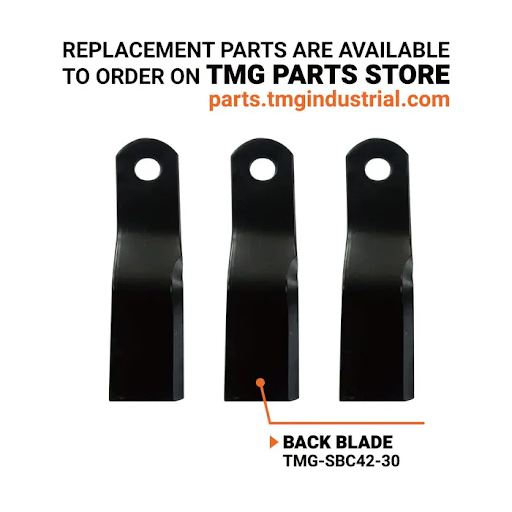
A rotary brush cutter sits at the heavy end, swinging a thick blade or a stout pivoting blade that shrugs off impacts with saplings, brush, and stems up to a few inches across. Its goal is reclamation, not appearance, so it leaves a coarse stubble rather than a lawn. A flail mower takes a middle path, spinning many small hinged knives on a horizontal drum that fold back on contact, producing a finer, safer cut on lighter brush and trimming the risk of thrown debris, though it tires against true woody growth.
Read together, the three form a ladder of capability: grass to the finish mower, light mixed growth to the flail, and serious woody overgrowth to the heavy rotary unit.
Matching the machine to a compact carrier
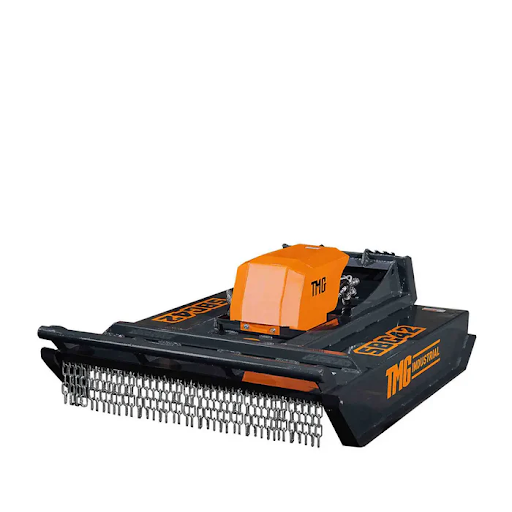
A forty-two-inch rotary cutter built for a mini skid steer pairs reclamation power with a machine small enough to work tight lots, wooded trails, and ground too soft for a full-size tractor. Driven by the carrier’s hydraulics and controlled from the operator station, this kind of brush cutter brings heavy cutting into places a large mower deck cannot follow.
The compact carrier also changes how the work feels. Because the operator stays back from the spinning blade and steers the whole machine into the brush, the cut stays controlled even on uneven ground and slopes where a tractor would be uneasy.
Treating thrown debris with respect
The same momentum that powers the cut can hurl a stick or stone with dangerous force, so a brush cutter demands a wide, cleared safety zone with no bystanders in line with the discharge. Walking the area first to remove wire, metal, and large rocks protects both the blade and everyone nearby, and eye and ear protection are basic requirements.
Understood as a momentum tool rather than a faster mower, a heavy rotary brush cutter turns reclaiming overgrown ground into steady, manageable work as part of modern land clearing solutions.