


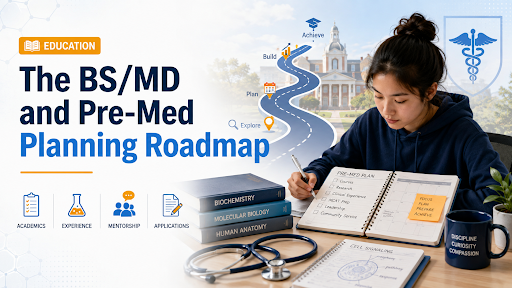
For students who are serious about becoming doctors, the biggest question is not always, “Which college should I attend?” Sometimes it is, “How early do I want to commit to medicine?”
The bachelor’s-MD dual degree program and the traditional pre-med track can both take you to medical school, but they result in very different undergrad experiences. The Association of American Medical Colleges (AAMC) keeps capacity-based data on guaranteed programs as well as a list of combined baccalaureate-MD programs, with that length and structure varying according to institution.
That variation matters. Students should not expect that all combined programs will have the same academic requirements, conditions for progression, or sets of undergraduate courses.
Key Takeaways
An integrated BS/MD type track may appeal to students who have an early exploration of medicine under their belt and are confident in a large commitment at the time of application from high school. The traditional pre-med route offers more flexibility to explore majors, schools and career interests prior to applying to medical school.
Your statement should be rewritten: “Neither pathway eliminates the necessity to acquire the skills and attributes that medical schools look for.” According to the AAMC, there are currently 17 pre-med competencies that are used to characterise concepts relevant for students entering medicine.
A Quick Comparison
| Question | Combined BS/MD pathway | Traditional pre-med |
| When is the medical pathway chosen? | Very early, typically around undergraduate admission | Medical-school application comes later |
| Structure | Often more prescribed | Usually more flexible |
| College options | Connected to specific participating programs | Broad range of undergraduate institutions |
| Application planning | Begins during high school | Develops throughout college |
| Good fit for | Students with well-tested early commitment | Students wanting more time to explore |
Understand What Early Commitment Really Means
It should go without saying that desiring to be a doctor is not the same as knowing what being a doctor entails.
Students considering the combined track should actively look for substantive experiences in health care, service, science, and work with people before applying. They’re not aiming to acquire activities to fill a list because ”they might look good.” It’s to ask a serious question: Do I still want to be a doctor once I’ve found out a little bit more about what the work and training are like?”
Students considering highly selective combined programs may research a bs/md admission consultant when they want structured assistance with positioning, program selection, written materials, activities or interviews. Solomon’s BS/MD page lists those areas among the components of its consulting package. Outside guidance can organize the process, but it cannot replace genuine motivation or experiences the student can discuss honestly.
Compare Program Conditions Carefully
“BS/MD” is just a handy shorthand term, but there are no comparative combined programs. The AAMC’s list as it stands now features programs of varying lengths and suggests that students inquire within concerning the details of any given program.
Look into the undergrad curriculum and majors offered, the progression rules, how closely linked the school is to the med school, the financial side of things, and what happens if the kid decides to go in a different direction. Verify any testing or academic benchmarks directly with the school rather than by an ancient discussion-board post.
Think About What You Want From College
A student may be dedicated to the field of medicine but also want to have the opportunity to study philosophy, engineering, public policy, music, or computer science.
There is generally more flexibility with the traditional pre-med track since medical schools set their own expectations for prerequisite coursework and competencies, rather than everyone being required to take one standardised undergraduate major. The AAMC has put up a resource that guides students to each individual med school’s required premedical coursework and competencies.
So the question you should be asking is not “Which path sounds more impressive?” It is, “Where am I most likely to grow?”
Plan Traditional Pre-Med Around Development, Not Just Checkboxes
Students on the traditional route sometimes focus on required sciences and later discover that preparation is broader.
AAMC’s 17 pre-med competencies cover professional, thinking-and-reasoning and science domains, reflecting the broader range of qualities considered relevant to readiness for medical education. Coursework, research, clinical exposure, service, employment, teamwork and sustained responsibility can all contribute different forms of evidence about a student’s development.
Thoughtful pre-med application planning can therefore begin well before the medical-school application itself. Solomon’s pre-med planning service is specifically aimed at undergraduates and addresses areas including research, clinical experience, volunteering, positioning and eventual application preparation.
A college freshman does not need a finished medical-school personal statement. It is more useful at that stage to understand prerequisite planning, explore interests, develop relationships with faculty and begin learning what medicine actually demands.
Do Not Choose a Route Simply Because It Feels Safer
The apparent certainty of a combined pathway can be attractive, particularly to families worried about a later medical-school application. But early certainty has value only when the student genuinely wants the commitment and structure involved.
Traditional pre-med contains more uncertainty, but that flexibility can give students time to deepen a research interest, discover another health profession, change academic direction or decide medicine is not the right career.
Changing direction after learning more about yourself is not evidence that the earlier exploration was wasted.
Final Thoughts
BS/MD and traditional pre-med are not better and worse versions of the same plan. They are different approaches to timing, commitment and flexibility.
Students who have explored medicine seriously and want an early structured pathway may find combined programs worth investigating. Students who prefer wider undergraduate freedom can prepare for medical school through the traditional route.
In either case, the better decision is grounded in current program requirements, meaningful experiences, academic development, and honest self-assessment. Medicine is a long path. Choosing an educational route that genuinely fits the student matters more than choosing the one that sounds most impressive.