


FOR IMMEDIATE RELEASE
Global Architectural Glass Market Experiences 18% Annual Growth as Building Energy Codes Drive Adoption of High‑Performance Glazing
August 24, 2026 – The global architectural glass industry is experiencing unprecedented demand for energy‑efficient glazing products, driven by increasingly stringent building energy codes, corporate sustainability commitments, and rising energy costs. Industry analysts report that the high‑performance glass segment—including Low‑E coatings, insulated glass units, and advanced laminated products—is growing at 18% annually, significantly outpacing the 6‑8% growth rate of standard architectural glass.
This market shift reflects a fundamental transformation in how developers, architects, and building owners approach facade design. What was once treated as a commodity specification decision—choosing the cheapest glass that met minimum code requirements—has become a strategic choice with direct implications for building energy performance, tenant comfort, operating costs, and asset valuations.
Market Drivers Accelerating Demand
Several converging factors are driving the surge in high‑performance glass adoption across commercial, institutional, and residential construction sectors.
Tightening Building Energy Regulations
Government energy codes have evolved from broad efficiency recommendations to prescriptive requirements that effectively mandate high‑performance glazing for most commercial construction. The International Energy Conservation Code (IECC), adopted in modified form by most U.S. jurisdictions, now requires window and curtain wall U‑factors below 0.40‑0.45 Btu/(hr·ft²·°F) in most climate zones—performance achievable only with double‑glazed Low‑E insulated glass units.
European Union member states have adopted even more aggressive standards. The EU’s Energy Performance of Buildings Directive mandates that all new buildings achieve “nearly zero‑energy” performance by 2030, with envelope thermal performance requirements that necessitate triple‑glazed facades with U‑factors below 0.25. Similar regulations are being implemented across Asia, with China’s updated building energy standards requiring Low‑E glass for commercial buildings in major urban centers.
The regulatory trend extends beyond prescriptive codes to outcome‑based requirements. Increasingly, jurisdictions require whole‑building energy modeling demonstrating that proposed designs will achieve energy consumption targets. These performance‑based codes give designers flexibility in how they meet targets but make high‑performance glazing economically essential—the alternative of compensating for poor envelope performance through oversized HVAC systems proves more expensive than specifying better glass.
LEED and Green Building Certification Requirements
Several converging factors are driving the surge in high‑performance glass adoption across commercial, institutional, and residential construction sectors.
Tightening Building Energy Regulations
Government energy codes have evolved from broad efficiency recommendations to prescriptive requirements that effectively mandate high‑performance glazing for most commercial construction. The International Energy Conservation Code (IECC), adopted in modified form by most U.S. jurisdictions, now requires window and curtain wall U‑factors below 0.40‑0.45 Btu/(hr·ft²·°F) in most climate zones—performance achievable only with double‑glazed Low‑E insulated glass units.
European Union member states have adopted even more aggressive standards. The EU’s Energy Performance of Buildings Directive mandates that all new buildings achieve “nearly zero‑energy” performance by 2030, with envelope thermal performance requirements that necessitate triple‑glazed facades with U‑factors below 0.25. Similar regulations are being implemented across Asia, with China’s updated building energy standards requiring Low‑E glass for commercial buildings in major urban centers.
The regulatory trend extends beyond prescriptive codes to outcome‑based requirements. Increasingly, jurisdictions require whole‑building energy modeling demonstrating that proposed designs will achieve energy consumption targets. These performance‑based codes give designers flexibility in how they meet targets but make high‑performance glazing economically essential—the alternative of compensating for poor envelope performance through oversized HVAC systems proves more expensive than specifying better glass.
LEED and Green Building Certification Requirements
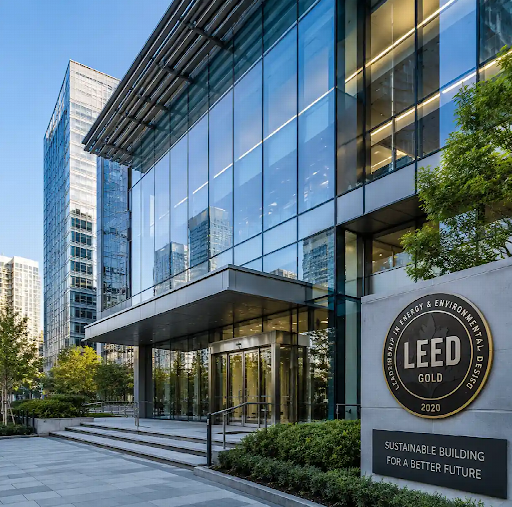
Private sector sustainability commitments amplify regulatory pressures. Leadership in Energy and Environmental Design (LEED) certification has become the de facto standard for institutional and corporate real estate, with over 100,000 projects certified globally and thousands more in the pipeline. LEED’s energy performance credits strongly incentivize envelope optimization, with points awarded for exceeding baseline energy code requirements by 10%, 20%, or 30%.
Achieving these performance thresholds almost invariably requires high‑performance glass. Energy modeling for commercial buildings consistently shows that upgrading from code‑minimum to advanced glazing delivers the most cost‑effective energy savings—superior to adding rooftop solar, upgrading lighting systems, or implementing advanced HVAC controls. This positions high‑performance glass not as a luxury specification but as a practical necessity for projects targeting LEED certification.
Beyond LEED, other green building frameworks including BREEAM (UK), Green Star (Australia), and WELL Building Standard emphasize envelope performance and daylight access. Each framework’s specific requirements differ, but all create market pull for glazing products that minimise heat transfer, control solar gain, and maximise visible light transmission—precisely the attributes advanced Low‑E coatings deliver.
Corporate Sustainability Commitments
Major corporations have announced net‑zero carbon targets for their real estate portfolios, creating direct demand for high‑performance building systems. Technology companies including Microsoft, Google, and Amazon have committed to operating carbon‑neutral campuses, necessitating maximum energy efficiency in new construction and major retrofits. Financial institutions managing billions in real estate assets face increasing pressure from investors to demonstrate ESG (Environmental, Social, Governance) performance, with building energy intensity serving as a key metric.
These corporate commitments translate into specification requirements that exceed minimum code standards. Developer requests for proposals increasingly specify target energy use intensities (EUI) of 25‑30 kBtu/sf/year—performance requiring comprehensive envelope optimization including premium glazing systems. The specifications reflect recognition that operational energy costs over a 20‑30 year holding period dwarf the incremental first costs of high‑performance building systems.
Technology Innovations Expanding Performance Boundaries
Market demand has spurred rapid innovation in glazing technologies, with manufacturers introducing products that would have been technically impossible or economically impractical just five years ago.
Triple‑Silver Low‑E Coatings
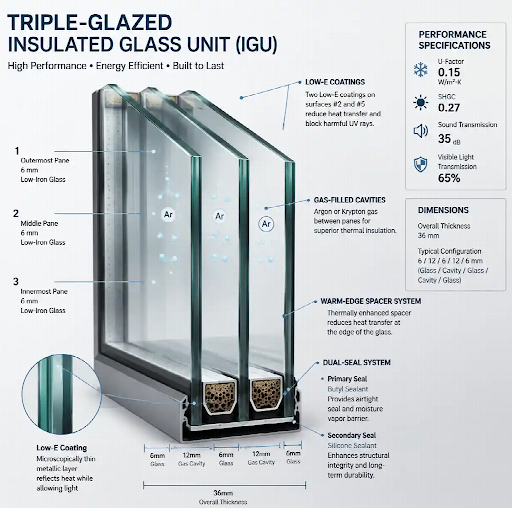
Low‑emissivity coatings have evolved through multiple generations, with each iteration improving the balance between thermal insulation, solar control, and visible light transmission. Current triple‑silver Low‑E coatings—featuring three microscopically thin silver layers separated by dielectric materials—achieve unprecedented spectral selectivity. These advanced coatings can deliver U‑factors below 0.25 while maintaining visible light transmission above 60% and solar heat gain coefficients below 0.25.
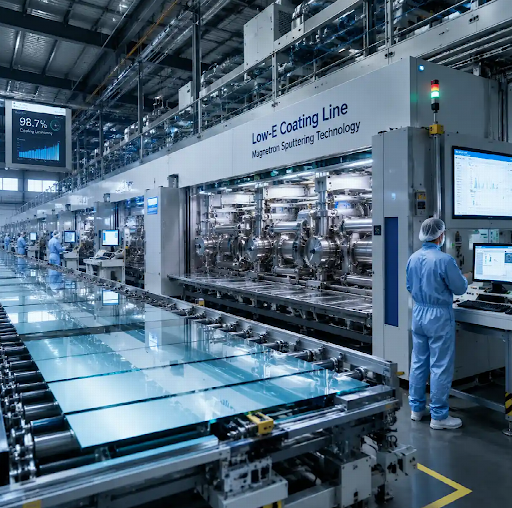
Leading Low‑E glass manufacturers in China have made substantial investments in magnetron sputtering equipment capable of applying these complex multi‑layer coatings with precise thickness control. The manufacturing sophistication required represents significant entry barriers—successful triple‑silver production demands clean room conditions, precisely controlled deposition rates, and real‑time monitoring to ensure coating uniformity across large glass panels.
The performance improvements prove substantial. Buildings specified with triple‑silver Low‑E glass typically achieve 15‑25% lower envelope‑related HVAC loads compared to earlier double‑silver products, despite the older coatings themselves representing significant advances over first‑generation Low‑E technology. This continuous performance improvement cycle creates replacement markets as building owners retrofit existing facades with current‑generation products to maintain competitive energy performance.
Warm‑Edge Spacer Systems
While coatings attract attention, spacer technology—the components separating glass panes at insulated unit perimeters—significantly impacts overall thermal performance. Traditional aluminum spacers create thermal bridges conducting heat around the insulating cavity, degrading center‑of‑glass performance by 15‑20% at the edges.
Warm‑edge spacers using stainless steel, thermoplastic materials, or composite constructions minimize edge conductance. Combined with triple‑silver Low‑E coatings, these spacers enable window U‑factors approaching 0.20—thermal performance approaching insulated walls. The improved edge performance also reduces condensation risk, improving occupant comfort and preventing moisture damage to window frames and surrounding construction.
Gas Fill Optimization
The insulating cavity in high‑performance units is filled with argon or krypton gas rather than air. Both gases are denser than air and feature lower thermal conductivity. Argon, more economical and widely used, improves insulating performance by approximately 25% compared to air‑filled units. Krypton, though more expensive, enables superior performance in narrower cavities—particularly important for triple‑glazed units where excessive overall thickness creates installation challenges.
Gas retention depends critically on edge seal integrity. Modern dual‑seal systems—combining a primary butyl seal that blocks moisture migration with a secondary silicone seal providing structural strength—maintain gas concentrations above 90% for 20‑30 years. Quality control during manufacturing proves essential; even small seal defects can allow gas leakage that gradually degrades thermal performance over time.
Regional Market Analysis
Energy‑efficient glass adoption varies significantly across geographic markets, reflecting differences in climate, energy costs, construction practices, and regulatory environments.
North America: Commercial Retrofit Surge
The North American market for high‑performance glass divides into distinct new construction and retrofit segments. New construction increasingly specifies advanced glazing as standard, driven by energy codes and LEED requirements. The more dynamic growth, however, comes from retrofit and facade replacement projects.
Many commercial buildings constructed in the 1980s‑2000s feature single‑glazed or basic double‑glazed curtain walls that significantly underperform current standards. Building owners face choices: accept competitive disadvantages as tenants increasingly demand energy‑efficient spaces, invest in HVAC system upgrades to compensate for envelope deficiencies, or replace facades with modern high‑performance systems.
Economic analysis increasingly favors facade replacement. Comprehensive curtain wall upgrades—stripping existing systems to structural framing and installing new high‑performance facades—typically cost $120‑180 per square foot. While substantial, these investments deliver 40‑50% envelope energy savings, eliminate comfort complaints near windows, support increased rental rates, and improve building asset values. With energy costs exceeding $2.50/sf annually in many markets, payback periods run 12‑18 years—acceptable for institutional owners with long‑term holding strategies.
Europe: Net‑Zero Building Mandates
European markets lead globally in high‑performance glass adoption, driven by the most aggressive building energy regulations and highest energy costs. The EU’s near‑zero energy building requirements effectively mandate triple glazing for most commercial construction, with some Nordic countries requiring U‑factors below 0.15—achievable only with specialized quadruple‑glazed units or vacuum glazing technologies.
The stringent requirements create challenges and opportunities. Manufacturers that develop products meeting ultra‑high performance thresholds while managing costs, weight, and thickness constraints access premium market segments. The technical demands accelerate innovation—many emerging glazing technologies demonstrate initial commercial viability in European markets before broader global rollout.
European retrofit markets also prove dynamic, though the challenge involves upgrading heritage buildings with historic preservation requirements. Modern high‑performance glass must often match the appearance of original single‑glazed windows while delivering contemporary thermal performance—a technically demanding specification requiring thin triple‑glazed units or vacuum glazing that didn’t exist when original facades were designed.
Asia‑Pacific: New Construction Boom
The Asia‑Pacific region represents the largest volume growth market for architectural glass, driven by unprecedented urban construction. China alone adds approximately 2 billion square feet of commercial floor space annually—more than the entire existing stock of many European countries. This new construction overwhelmingly specifies insulated Low‑E glass as standard, reflecting evolved building codes and developer recognition that energy‑efficient facades command premium rents and sales prices.
The market dynamics differ from Western markets. Rather than gradually retrofitting existing building stock, Asian developers build new inventory incorporating current technologies from the outset. This creates massive demand for high‑performance glass manufacturing capacity. Chinese glass manufacturers have responded with substantial capacity investments, with several producers now operating Low‑E coating lines that rank among the world’s largest and most technologically advanced facilities.

Supply Chain Developments Reshaping Competition
Manufacturing capacity expansions and supply chain reconfiguration are altering competitive dynamics in global architectural glass markets.
Chinese Manufacturing Scale‑Up
Chinese glass manufacturers have transitioned from cost‑focused commodity producers to technology‑capable suppliers of high‑performance products. Major Chinese producers now operate coating facilities with technical capabilities matching or exceeding Western competitors, producing triple‑silver Low‑E coatings, ultra‑low iron glass for maximum transparency, and oversized panels for landmark architectural applications.
The scale advantages prove formidable. Chinese manufacturers benefit from vertical integration controlling everything from float glass melting through coating application and fabrication into insulated units. This vertical integration enables costs 20‑30% below Western competitors while increasingly matching quality and performance specifications. For international projects not restricted by domestic content requirements, Chinese suppliers win growing specification share based on value propositions that no longer require quality compromises.
Export volumes from China have grown 25‑30% annually over the past three years, with high‑performance glazing representing the fastest‑growing segment. This export surge creates competitive pressure on established Western manufacturers, forcing defensive responses including technology upgrades, manufacturing cost reductions, and emphasis on service capabilities and local presence that Chinese exporters struggle to match.
Regional Manufacturing Investments
Simultaneously, Western manufacturers invest in regional production capacity to defend market positions. Saint‑Gobain, Guardian Glass, and AGC have announced major coating line investments in North America and Europe, specifically targeting triple‑silver Low‑E production to serve local markets with short lead times and close technical support.
These investments reflect recognition that while Chinese manufacturers threaten commodity segments, opportunities persist in premium markets valuing technical support, rapid customization, and supply chain reliability. Regional manufacturers emphasize services Chinese exporters cannot easily replicate: on‑site energy modeling support, custom coating development for specific project requirements, rapid prototype production, and inventory programs enabling just‑in‑time delivery to construction schedules.
Suppliers of laminated insulated glass report particularly strong demand for products combining safety, security, and energy performance. These multi‑functional products—integrating impact resistance, UV protection, sound attenuation, and thermal performance—command premium pricing that partially offsets cost pressures from Chinese competition. The technical complexity of producing large laminated insulated units with consistent quality creates competitive advantages for manufacturers with deep process expertise and quality control capabilities.
Industry Expert Perspectives
Market participants across the value chain report fundamental shifts in how architectural glass is specified and procured.
“We’re seeing a complete transformation in how developers approach facade design,” notes Sarah Chen, Vice President of Commercial Development at a major U.S. real estate firm. “Five years ago, glass was a cost optimization decision—we’d hit minimum code and move on. Today, it’s a value creation opportunity. Premium glazing delivers measurably better energy performance, supports higher rents, and improves tenant retention. The business case has shifted decisively in favor of high‑performance products.”
Architects report similar changes in client priorities. “Clients now lead conversations about envelope performance,” observes Michael Rodriguez, Principal at a large international architecture firm. “They arrive with target EUI numbers and ask what glazing systems enable those targets while achieving design intent. The technical sophistication has increased dramatically—we’re having detailed discussions about g‑values, spectral selectivity, and thermal bridging mitigation with clients who wouldn’t have known those terms existed a few years ago.”
Manufacturing executives emphasize the innovation imperative driving their R&D investments. “Standing still means falling behind,” states James Thompson, CTO of a European glass manufacturer. “We’re investing 5‑6% of revenue in coating development, spacer optimization, and manufacturing process improvements. The performance bar keeps rising—products that were cutting‑edge three years ago are mainstream today. Manufacturers that can’t maintain innovation pace will lose specification share to competitors who can.”
Future Outlook and Growth Projections
Industry analysts project continued strong growth for high‑performance architectural glass, with market size forecasts reaching $85‑90 billion by 2030, up from approximately $58 billion in 2025. The growth drivers supporting this expansion remain robust: building codes continue tightening, corporate sustainability commitments accelerate, and the economic case for energy‑efficient construction strengthens as energy costs rise.
Emerging technologies including electrochromic smart glass, photovoltaic glazing, and vacuum insulation promise to expand performance boundaries further. While these advanced products currently serve niche applications, declining costs and improving performance will drive mainstream adoption over the next 5‑10 years. The architectural glass industry appears positioned for an extended period of technology‑driven growth as buildings evolve from passive enclosures to active, intelligent building systems.