

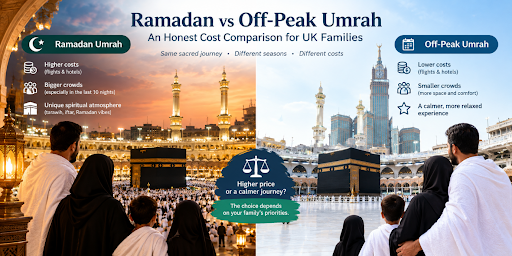
Two families from the same street in Birmingham perform Umrah in the same twelve months. One goes in the last week of Ramadan and pays a little over £4,000. The other goes in December and pays around £2,600. Both stay seven nights, both perform the same rites, both come home changed.
The difference is not that one family was better advised. They bought different products. A last 10 nights Ramadan Umrah package and a December trip are not the same holiday at two prices, and the honest comparison is not about which is cheaper but about what the extra money actually buys. Here is that comparison, laid out for a family working to a fixed budget.
The headline gap
Working with a family of four, two adults and two children, seven nights, four-star hotels, everything included:
| Travel period | Typical package cost, family of four |
|---|---|
| December | around £2,400 to £2,900 |
| Easter holidays | around £2,900 to £3,400 |
| First Ashra of Ramadan | around £3,000 to £3,500 |
| Last ten nights of Ramadan | around £3,800 to £4,400 |
Figures are indicative and move with demand and exchange rates, but the shape holds year after year. The last ten nights cost roughly half as much again as December for the equivalent standard.
That gap is not the whole story, though, because the standard is not equivalent. Which brings us to the part that matters.
What the extra money is actually paying for
Not a better hotel. This surprises people. A four-star hotel in the last ten nights of Ramadan and a four-star hotel in December are frequently the same building. You are paying more for the same room.
Proximity, indirectly. Because the close hotels sell out first in Ramadan, the same budget places you further from the Haram than it would in December. A family that could afford three hundred metres in an off-peak month often finds itself at a kilometre in Ramadan.
Access to Laylatul Qadr and the atmosphere of the final nights. This is the real purchase, and for many pilgrims it is worth every penny. It should just be named honestly, because it is what the premium buys.
What off-peak buys instead
The December and Easter trips are not consolation prizes, and families who have done both often report the quieter month was the better trip in ways they had not anticipated.
The rites performed properly. In Ramadan, and especially at the end of it, tawaf and sa’i are governed by the crowd. The mataf is often closed to new entrants and pilgrims are routed to the upper levels, where a circuit is considerably longer. In December most families complete the circuits at their own pace and stop where they like to make du’a. For a first Umrah, and for children, this matters enormously.
A closer hotel for the same money. The single biggest quality-of-life factor on any Umrah trip is the walk, and off-peak the same budget buys a materially shorter one.
A longer stay. The Ramadan premium on a seven-night trip would fund ten or eleven nights in December. More time in both cities, less rushing.
Madinah without the scramble. Rawdah slots, booked through Nusuk, are in heavy demand throughout Ramadan. Off-peak they are far more straightforward to secure, which for many pilgrims is a significant part of the journey.
Children who cope. Ramadan crowds are hard on young children, and the inverted schedule of the final nights is harder still. December suits families with primary-age children considerably better.
Elderly parents who can actually attend. For a pilgrim with limited mobility, the difference between an off-peak walk and a last-ten-nights walk can be the difference between praying in the Haram and praying in the hotel room.
What off-peak costs you
Being even-handed about it:
The reward specific to Ramadan. The well-known narration on Umrah in Ramadan is not something an off-peak trip replicates, and pilgrims who care about it should not be talked out of caring about it.
The atmosphere. Iftar on the floor of the Haram, Tarawih behind the imams, the last ten nights. There is no off-peak equivalent, and people who have experienced it generally say so.
Weather. December and February are the comfortable months. Easter is warm and the summer is severe, which matters for elderly travellers.
School. December and Easter trips generally mean travelling in the holidays with everyone else, which affects flight prices. Term-time absence for a religious observance is a matter for your school, and policies differ.
The question underneath the question
For a good number of families, the real question is not which Umrah to book but whether the money should be going to Umrah at all this year.
If Hajj is outstanding and within your means, that is worth sitting with before committing several thousand pounds to a Ramadan trip. Hajj is the fifth pillar, due once in a lifetime from every Muslim with the health and the means. The narration that Umrah in Ramadan carries the reward of Hajj concerns the reward and not the obligation, and scholars are consistent on that point. It is a distinction that gets blurred every year, sometimes in marketing.
Hajj costs several times a Ramadan Umrah, so this is rarely a straight swap. But a family running an instalment plan for Ramadan every year for four years is a family that could have been running one towards ATOL protected Hajj packages UK operators offer instead. Whether that is the right call depends on circumstances nobody else can assess.
The timing for 2027 is worth checking either way. With Ramadan beginning in February, Dhul Hijjah is expected around early May, putting the days of Hajj in mid-May, roughly ten weeks after Eid al-Fitr. Doing both in one spring means two absences and two substantial payments in short order.
Which off-peak month, though
“Off-peak” covers most of the year, and the months are not interchangeable.
December is the most popular off-peak choice for UK families, and with good reason. The weather in Makkah and Madinah is mild, the school holidays line up, and prices sit at or near the bottom of the annual range. The trade-off is that everyone else has noticed, so December is now the busiest of the quiet months and needs booking a couple of months ahead rather than a couple of weeks.
Easter costs more than December because the school holidays drive demand, but the weather is still comfortable and it splits the year neatly for families who cannot travel in winter.
Late spring and autumn, outside the school holidays, are the genuinely cheap windows. Prices are at their lowest, hotels near the Haram are freely available, and the crowds are the lightest of the year. The obstacle is school. Term-time absence is a matter for the headteacher and policies vary considerably between schools and academy trusts, so ask before you book rather than after.
Summer is inexpensive for a reason. Temperatures in Makkah are severe, and while the mosque itself is cooled, the walk to it is not. Families with elderly relatives or young children should think carefully.
One further point on timing: the days immediately after Ramadan, once Eid has passed, are among the calmest and best-value of the year. Pilgrims who want a quiet Umrah but like the idea of travelling close to the month sometimes find this window suits them well.
How to decide
A few questions that tend to settle it.
Is this your first Umrah?
If so, off-peak or the first Ashra is usually the better trip. Learning the rites in a manageable crowd is worth more than atmosphere.
Who is travelling?
Young children, elderly parents or anyone with mobility limits tilts the decision strongly towards off-peak.
Is Laylatul Qadr the point?
If the honest answer is yes, book the last ten nights and book in the autumn. If the honest answer is that it is what everyone does, look at December.
What does the budget buy in each month?
Price the same family, same nights, both periods, and compare the walking distance you would get for the money. That number is often more persuasive than the price.
Is Hajj outstanding?
If it is, and it is affordable, it is the prior claim.
The short version
Ramadan Umrah for a family of four costs roughly half as much again as an equivalent December trip, and the premium buys the atmosphere of the month rather than a better hotel. If Laylatul Qadr is what you are going for, that is a fair price and you should book early enough to be near the mosque. If it is not, off-peak buys a closer hotel, a longer stay, calmer rites and a considerably easier week for children and grandparents.
Neither answer is more devout than the other. They are just different trips, and the useful thing is to choose deliberately rather than by default.