


Plantar fasciitis can be a real pain in the heel, quite literally. This common condition, affecting about 10% of the general population and even more runners (8-10%), is a leading cause of heel pain. The sharp, burning, or throbbing sensation, often worst with the first steps out of bed, can severely impact daily life. As someone who understands the complexities of musculoskeletal health, I know that effective management goes beyond just resting the foot. It requires a strategic, consistent approach, with exercises at its core.
In this extensive guide, I will delve into everything you need to know about plantar fasciitis exercises. We’ll explore what causes this persistent pain, the most effective stretches and strengthening routines, how often to perform them, and how they compare to other treatments. My aim is to provide you with actionable steps and insights to help you navigate your journey to relief and recovery, empowering you to take control of your foot health.
Before diving into exercises, it’s crucial to understand what plantar fasciitis is and what contributes to its development.
What is Plantar Fasciitis?
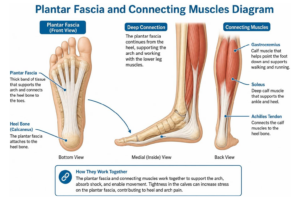
Historically referred to as plantar fasciitis, recent understanding often prefers the term plantar fasciopathy. This distinction highlights that the condition is not primarily an inflammatory process (indicated by ‘-itis’), but rather a degenerative condition of the plantar fascia tissue. It involves disorganised fibres, fluid retention, and sometimes new blood vessels and nerves within the fascia, primarily due to changes in loading. The plantar fascia is a thick band of connective tissue running along the bottom of your foot, connecting your heel bone to your toes. It plays a vital role in supporting the arch of your foot and absorbing shock during movement. When this tissue is subjected to excessive or repetitive stress, tiny tears can develop, leading to pain and discomfort.
Common Causes
Plantar fasciitis is often considered an overuse injury. Several factors can contribute to its development:
- Repetitive Microtrauma: Activities that place high stress on the heel and arch, such as long-distance running, prolonged standing, or occupations requiring frequent walking, can lead to micro-tears in the fascia.
- Tight Calf Muscles: This is a significant factor. Tightness in the gastrocnemius and soleus muscles (the calf muscles) can alter the biomechanics of the foot and ankle, increasing tension on the Achilles tendon, which in turn pulls on the heel bone and subsequently the plantar fascia. Many people with plantar fasciitis also have tight calf muscles.
- Foot Structure: Flat feet (pes planus) or high arches (pes cavus) can both contribute by altering the distribution of weight and stress on the foot.
- Inadequate Footwear: Shoes that lack proper arch support, cushioning, or have worn-out soles can fail to adequately support the foot, leading to increased strain on the plantar fascia. High heels can also exacerbate the issue.
- Increased Body Weight: Excess weight places additional stress on the plantar fascia, especially during weight-bearing activities.
- Age: While it can affect anyone, plantar fasciitis most commonly presents in men and women between 40 and 60 years of age.
- Sudden Increase in Activity: A rapid increase in the intensity, duration, or frequency of physical activity without proper conditioning can overload the fascia.
Recognizing the Symptoms
The hallmark symptom of plantar fasciitis is pain at the bottom of the heel. This pain typically presents in specific ways:
- Morning Pain: The pain is usually worst with the first steps out of bed in the morning, or after a period of rest. This is because the fascia contracts and tightens overnight or during inactivity, and then stretches abruptly with the first weight-bearing steps.
- Pain After Rest: Similar to morning pain, discomfort often returns after sitting for a while.
- Pain During/After Activity: While it might ease slightly during activity, the pain can worsen after prolonged standing, walking, or exercise.
- Deep Aching or Burning Sensation: The pain is often described as a deep ache, sharp, burning, or throbbing sensation, usually localized at the bottom of the heel, though it can extend into the arch.
- Tenderness: The bottom of the heel, particularly where the fascia attaches to the heel bone, may be tender to the touch.
Relevant Statistics
Understanding the scope of plantar fasciitis can offer perspective:
- The lifetime prevalence of plantar fasciitis is around 10% of the general population; in runners, the rate climbs to 8–10%.
- Approximately 80% of people with plantar fasciitis have no pain within one year of treatment, highlighting that while it can be stubborn, recovery is highly probable with consistent effort.
- Plantar fasciitis is responsible for 15% of foot pain, making it a very common complaint.
- Pain often lasts more than 1 year before patients seek treatment, emphasizing the chronic nature it can develop if not addressed.
The Foundation of Recovery: Effective Exercises and Stretches
Exercises and stretches are not just supplementary treatments; they are a cornerstone of plantar fasciitis recovery. They work by improving the flexibility of the plantar fascia and surrounding muscles, strengthening the foot and lower leg to better support the arch, and ultimately reducing tension and pain.
Why Exercises Are Crucial
Stretching helps make the tissues more flexible, lowers tension, and eases pain. Strengthening supporting muscles reduces stress on the ligament itself, preventing further tearing and inflammation. The goal is to restore normal biomechanics and build resilience in the foot and ankle complex.
Key Principles for Exercise
- Consistency is Key: Daily or every-other-day routines are essential.
- Slow and Controlled: Avoid jerky movements. Start each exercise slowly and ease off if significant pain occurs. A slight stretch or mild discomfort is often acceptable, but sharp or increasing pain is a sign to stop.
- Listen to Your Body: Your body will tell you what it can handle. Don’t push through intense pain.
- Progression: Gradually increase repetitions, hold times, or resistance as your foot strengthens.
- Don’t Just Treat the Foot: Remember the connection to the calves and hamstrings. A holistic approach is best.
Essential Stretches for Flexibility
These stretches aim to lengthen the plantar fascia and the tight calf muscles that often contribute to the condition. Performing these before getting out of bed can significantly reduce morning pain.
Plantar Fascia Specific Stretches:
- Seated Toe Pull with Arch Massage:
- Action: Sit on a chair and cross your affected leg over your opposite thigh. Grasp your toes and gently pull them back towards your shin until you feel a stretch in your arch. While holding this stretch, use your other hand to massage the arch of your foot.
- Frequency: Hold for 10-15 seconds, repeat 10 times per set, 2 sets daily. Many sources recommend 2-4 times per day.
- Best Practice: This is an excellent stretch to perform before taking your first steps in the morning.
- Wall Toe Press Stretch:
- Action: Stand facing a wall. Place the toes of your affected foot against the wall with your heel on the floor, creating an angle. Gently lean forward, pressing your toes into the wall, until you feel a stretch in your arch.
- Frequency: Hold for 10 seconds, repeat 10 times per set, 2 sets daily.
- Towel Stretch (Pre-Bed/Morning):
- Action: Sit on the floor with your legs extended. Place a towel around the ball of your affected foot. Keeping your knee straight, gently pull the towel towards you, flexing your foot and feeling the stretch in your calf and arch.
- Frequency: Hold for 45 seconds, repeat 2-3 times, 4-6 times per day.
- Best Practice: Perform this stretch before getting out of bed to reduce morning pain.
- Seated Toe Stretch:
- Action: Sit with one leg crossed over the other. Grasp the toes of your affected foot and bend them upwards towards your shin.
- Frequency: Hold for 3-5 breaths (approx. 15-30 seconds), repeating 2-3 times per foot, multiple times daily.
Calf and Achilles Stretches:
- Standing Calf Stretch (Back Knee Straight):
- Action: Stand facing a wall, placing your hands on it. Step one foot back, keeping the back leg straight and the heel firmly on the ground. Lean forward, bending your front knee, until you feel a stretch in your calf.
- Frequency: Hold for 45 seconds, repeat 2-3 times, 4-6 times per day.
- Best Practice: Keep the back leg’s heel on the ground throughout the stretch.
- Seated Calf Stretch (Knee Straight):
- Action: Sit with your affected leg straight. Place a towel around the ball of your foot and gently pull back until you feel a stretch in your calf.
- Frequency: Hold for 15-30 seconds, repeat 2-4 times per leg.
- Calf Stretch on a Step / Stair Stretch:
- Action: Stand on the bottom step of a staircase with the balls of your feet on the edge. Slowly lower your heels down, allowing them to hang off the step until you feel a stretch in your calves.
- Frequency: Hold for 45 seconds, repeat 2-3 times, 4-6 times per day.
- Best Practice: Perform this stretch gently, especially if you have severe heel pain.
- Seated Straight-Leg Hamstring and Calf Stretch:
- Action: Sit on the floor with legs extended. Lean forward from your hips, reaching towards your toes, feeling the stretch in your hamstrings and calves.
- Frequency: Hold for 3-5 breaths, repeating 2-3 times.
How Often and For How Long?
Consistency is paramount. Most stretches should be performed multiple times a day, ideally 2-4 times, holding each stretch for 15-45 seconds and repeating 2-4 times. Integrating these into your daily routine, such as performing them in the morning before getting out of bed, during breaks at work, or in the evening, can significantly improve outcomes. Aim for at least 10 minutes of stretching daily.
Strengthening Exercises for Support
Strengthening exercises are vital for building resilience in the foot and lower leg, reducing the load on the plantar fascia itself.
Foot and Arch Strengthening:
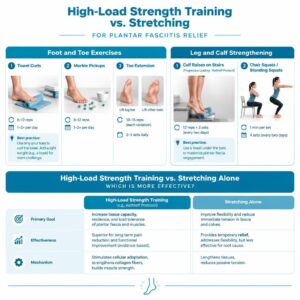
- Toe Curls with Towel:
- Action: Sit in a chair with a small towel laid flat on the floor in front of you. Using only your toes, scrunch the towel towards you, then push it back out.
- Frequency: Repeat 8-12 times, 1-2 times per day.
- Best Practice: Use only your toes to curl the towel. To make it more challenging, place a light weight (e.g., a book) on the far end of the towel.
- Marble Pickups:
- Action: Place several marbles or small objects on the floor next to a cup. Using only your toes, pick up each object and place it into the cup.
- Frequency: Repeat 8-12 times, 1-2 times per day.
- Toe Extension:
- Action: Sit with your foot flat on the floor. Lift only your big toe off the ground while keeping the other toes down. Then, lift the other four toes while keeping the big toe down.
- Frequency: Repeat 10-15 times for each variation, 2-3 sets daily.
Leg and Calf Strengthening:
- Calf Raises on Stairs (Progressive Loading – Rathleff Protocol):
- Action: Stand barefoot on the lowest stair step with the balls of your feet on the edge. Rise onto your toes for 2 seconds, hold for 2 seconds, then slowly lower your heels over 3 seconds until they are below the step. You can use a rolled-up towel under your toes to ensure effective loading of the plantar fascia.
- Frequency: Start with 12 repetitions x 3 sets every two days. As you get stronger, progress to single-leg calf raises. This progressive loading protocol is crucial for strengthening the plantar fascia itself.
- Best Practice: This exercise is particularly effective when performed with a towel under the toes to maximize plantar fascia engagement.
- Chair Squats / Standing Squats:
- Action: Sit on a chair with knees at 90 degrees. Stand up and sit down without using your arms. For standing squats, stand with feet hip-width apart, arms extended, and lower into a squat position.
- Frequency: Perform for 1 minute per set, 4 sets every two days.
High-Load Strength Training vs. Stretching Alone: Which is More Effective?
This is a critical distinction in modern plantar fasciitis treatment. While stretching is beneficial for flexibility, recent research suggests that high-load strength training may be more effective for long-term relief.
- Research Insights: A 2015 Randomized Controlled Trial (RCT) found that patients using high-load strength training scored 29 points lower on the Foot Function Index at 3 months compared to those using stretching alone (P = 0.016). This indicates significantly better pain reduction and functional improvement with strength training.
- APTA Recommendations: The American Physical Therapy Association (APTA) guidelines emphasize that strengthening exercises improve pain and function more effectively than stretching alone. They recommend combining stretching with strengthening rather than using stretching in isolation.
- Why Strength Training? Plantar fasciopathy is a loading issue. Strengthening the plantar fascia and its supporting muscles helps the tissue adapt to load, making it more resilient and less prone to injury. Stretching alone may address flexibility but doesn’t build the necessary load-bearing capacity.
Recovery Timeline and When to Seek Professional Help
Managing plantar fasciitis requires patience and persistence.
How Long Does It Take to See Improvement?
- Realistic Expectations: It can take several months for pain to fully resolve. While some individuals may see improvement within a few weeks of consistent exercise, only about 6% of participants in studies reached a satisfactory symptom state within 12 weeks of high-load strength training. This indicates that most require a longer, multimodal approach.
- Consistency is Key: Continuing exercises even after pain subsides is a best practice to prevent recurrence.
- Long-Term Commitment: Remember the statistic: approximately 80% of people with plantar fasciitis have no pain within one year of treatment. This implies that while recovery is common, it often takes significant time and consistent effort.
When to Seek Medical Evaluation
While self-management with exercises and supportive measures is often effective, there are times when professional medical evaluation is necessary:
- Persistent Pain: If your pain does not improve after several weeks (e.g., 4-6 weeks) of consistent self-care and exercise.
- Severe Pain: If the pain is debilitating or significantly interferes with your daily activities.
- Unusual Symptoms: If you experience numbness, tingling, weakness, or signs of infection (redness, warmth, swelling) in your foot, as these could indicate a different condition.
- Diagnosis Confirmation: A medical professional can confirm the diagnosis of plantar fasciitis and rule out other potential causes of heel pain. Fascial thickness greater than 4 mm on ultrasound can indicate plantar fasciitis.
- Personalized Treatment Plan: A physiotherapist or podiatrist can provide a tailored exercise program, assess your gait and footwear, and recommend specific orthotics or other interventions.
The Role of a Physiotherapist or Doctor
A physiotherapist or doctor can be invaluable in your recovery journey. They can:
- Accurately Diagnose: Differentiate plantar fasciitis from other conditions causing heel pain (e.g., stress fractures, nerve entrapment).
- Develop a Personalized Plan: Create an exercise and stretching routine specifically for your needs, considering your foot mechanics, activity level, and severity of symptoms. Supervised exercise is often more beneficial than home programs alone.
- Provide Manual Therapy: Offer techniques like dry needling, trigger point release, or joint mobilizations that you cannot perform yourself.
- Guide on Other Treatments: Advise on appropriate footwear, orthotics, night splints, and when to consider other interventions like injections.
- Monitor Progress: Adjust your treatment plan as you improve and help you safely return to activities.
Prevention Strategies
Even after your pain resolves, continuing a maintenance stretching and strengthening routine is crucial to prevent recurrence. Other prevention strategies include:
- Supportive Footwear: Always wear shoes with good arch support and cushioning, replacing them regularly.
- Calf Stretching: Make daily calf stretches a habit.
- Activity Modification: Gradually increase activity levels and avoid sudden spikes in high-impact exercises.
- Weight Management: Maintain a healthy body weight to reduce stress on your feet.
- Untucked Bedsheet: Sleeping with your bedsheet untucked can prevent your feet from being forced into a plantarflexed position, reducing morning tightness.
For those managing their health journey, just as businesses seek efficiency, individuals can explore various digital tools and platforms. Understanding and implementing effective online business solutions can offer valuable insights into optimizing processes, whether in a corporate setting or in the careful management of personal well-being and health routines.
Frequently Asked Questions About Plantar Fasciitis Exercises
Can I exercise if it hurts?
Exercises can be slightly painful but still beneficial. You should aim for a “good pain” – a stretch or mild discomfort that doesn’t worsen during or after the exercise. Sharp, increasing, or debilitating pain is a sign to stop and reassess, potentially with a professional.
How do tight calves affect plantar fasciitis?
Tight calf muscles connect to the Achilles tendon, which wraps around the heel and connects with the plantar fascia. If the calves are tight, they pull on the Achilles tendon, which then pulls on the heel bone, increasing tension on the plantar fascia. This added tension can make the plantar fascia more susceptible to micro-tears and pain. Addressing calf tightness is therefore a critical component of treatment.
What activities should be avoided?
High-impact activities like running, jumping, or jogging should generally be avoided during the acute phase of plantar fasciitis. These activities place significant stress on the plantar fascia. Instead, focus on low-impact activities like walking (with appropriate footwear), biking, or swimming, as long as they do not aggravate your symptoms.
Should I continue exercises after pain resolves?
Absolutely. Continuing a regular stretching and strengthening routine even after your pain subsides is one of the best ways to prevent recurrence. Think of it as maintenance for your feet, keeping the tissues flexible and strong.
Conclusion
Plantar fasciitis can be a challenging condition, but with a consistent and informed approach, relief and full recovery are highly achievable. The core of this recovery lies in diligently performing a combination of stretches and strengthening exercises, particularly those focusing on high-load strength training for the plantar fascia and calf muscles.
Patience is a virtue in this journey; it can take several months to see significant improvement. By integrating supportive measures like proper footwear, orthotics, and night splints, and knowing when to seek professional guidance, you empower yourself with a comprehensive strategy for healing. Embrace this multimodal approach, maintain your consistency, and you will be well on your way to enjoying pain-free steps and sustained foot health.