


A simple ankle break is bad enough. But what happens when the bone shatters right at the joint? When the bottom of your shin bone (the distal tibia) breaks into multiple pieces, surgeons have to bring out the heavy-duty hardware. The goal is to piece the puzzle back together and create a fix so stable that you can eventually get back on your feet. For these nasty fractures, surgeons generally have two main weapons of choice: a plate on the outside of the bone or a long ankle nail down the middle. This leads to the big question: which one offers better stability?
The Classic Contender: The Plate
A distal tibia plate is the standard instrument that is usually taken for granted in such cases. If you want to know its operation, you might think of it as an externally added support or a piece of scaffolding that has been attached to the outer side of a building. Once the cut is made, the doctor brings the fragments of the bone back to the proper position very carefully and then attaches a metal plate that has already been conformed to the bone with multiple screws.
For many years, this was the only real option. Its biggest advantage is that it allows the surgeon to directly see and manipulate the bone pieces, especially the all-important joint surface. If the fracture goes right into the ankle joint, you can’t afford to be off by even a millimetre. A plate gives the surgeon the direct access they need to rebuild that surface perfectly.
The Internal Powerhouse: The Nail
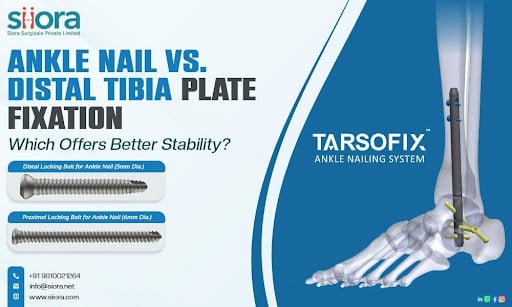
An ankle nail, or more accurately, an intramedullary nail, is a completely different philosophy. Instead of a brace on the outside, this is like putting a column of rebar right down the middle of the bone. The surgeon makes a small incision (often near the knee or just above the ankle) and inserts a long, strong rod down the hollow centre of the tibia. Screws are then passed through the bone and the nail at the top and bottom to lock everything in place.
Biomechanically, a nail is a beast. Because it sits in the centre of the bone, it shares the load naturally and is incredibly resistant to bending forces. It’s a powerful internal splint.
The Showdown: Which is More Stable?
This is the point where things become really intriguing. The solution is not one of the extremes like “the nail is always better” or “the plate is always better.” The firmness of the repair is, in fact, dictated by the fracture pattern and the patient’s bone quality.
Scenario #1: The Bone Quality is Awful
What if it is an old person with a soft, osteoporotic bone? Trying to get screws from a plate to hold tight in weak bone is like putting screws into styrofoam – they can easily pull out.
Advantage: Nail. The nail spreads the weight over the whole length of the bone, and it is fixed in stronger bone up near the knee. Thus, it is a very stable choice in this case, as it depends very little on the weak bone at the ankle.
Scenario #2: The Joint is a Jigsaw Puzzle
What if the fracture shatters the joint surface into many small pieces? The surgeon needs to rebuild this perfectly to prevent arthritis down the road.
Advantage: Plate. A plate allows the surgeon to open up the area, see all the puzzle pieces, and clamp them together precisely before securing the plate. A nail is inserted from a distance, which doesn’t allow for that kind of direct, hands-on reconstruction of the joint line.
Scenario #3: The Soft Tissues are a Mess
What if the open wound was awful, and the skin and muscle around the ankle were severely damaged? In that case, it might not be a good idea to put a big, heavy plate directly under the layer of the skin that is already weak because it can cause a wound that can get infected or cause the skin to break.
Point of difference: Nail. The nail is done through a few small cuts that are quite far from the ankle “war zone”. It supports the bone internally and, at the same time, it gives the skin and soft tissues the maximum possible healing.
The Verdict: It’s Not a Contest
There is no single winner. A plate offers better stability for directly reconstructing a shattered joint surface. A nail offers superior biomechanical stability for fractures in weak bone or when the soft tissues are too damaged to tolerate a plate. The surgeon’s job is to analyze the X-rays, assess the patient’s bone and skin, and choose the right orthopaedic implant that will provide the most stable fix for that specific injury. It’s not about which implant is “better,” but which one is the right tool for the job.