Picture this: a client walks into your office for a scheduled meeting, and you spend three agonising minutes shuffling through stacked papers on your desk, searching for their contract. The awkward silence grows. Your credibility shrinks. This scenario plays out in small business offices every day, and it costs more than just time—it erodes the professional image you’ve worked hard to build.
The connection between an organized workspace and business success isn’t abstract. Studies consistently show that professionals lose up to two hours daily searching for misplaced documents, and cluttered environments increase stress while decreasing focus. The solution often starts with one foundational piece: a well-chosen file filing cabinet paired with a thoughtful organisation system.
This guide walks you through everything from selecting the ideal cabinet type for your space and workflow, to building a document management system that practically runs itself. Whether you’re outfitting a new office or finally tackling years of accumulated paper chaos, you’ll find actionable steps here to create a workspace that works as hard as you do.
Choosing the Right File Cabinet: A Foundation for Efficiency
Before you can organise one single document, you need to know where it’s going—and this is a choice that business owners should give more thought to. A file cabinet is not just a metal box with drawers; it is the foundation of your information management system. Poor choice, and you’ll be fighting it every day. Pick the right one, and finding any file is a five-second task rather than a five-minute hassle.
The substantive issue is more important than the appearance might imply. Steel cabinets are more robust, harder to withstand day-to-day wear and tear and generally can be equipped with more advanced security features. They’re the workhorse solution for many high-volume situations. Wood cabinets, in contrast, are ideal for client-facing offices where warmth and elegance are important – such as law firms, financial advisors, or executive suites. Some manufacturers even provide steel frames with a wood veneer exterior, thus offering you the best of both worlds.
Security should be a consideration if you deal with sensitive client information, financial records or proprietary business papers. Basic lock-and-key mechanisms can be enough to thwart casual would-be thieves, while more complex options include combination locks, keyed-alike systems where one key accesses several units, and even electronic locks capable of producing audit trails. For the industries that must meet compliance requirements—healthcare, legal or financial services—locking mechanisms aren’t optional; they’re required.
Sizing your cabinet right means looking back and forward. Evaluate your existing documents, then add a minimum of 30 percent extra space for future expansion for a three- to five-year period. Outgrowing your space half a year after purchase means you’re forced into a second cabinet too early—burning money and filling up your floor space.
Vertical vs. Lateral vs. Mobile File Cabinets
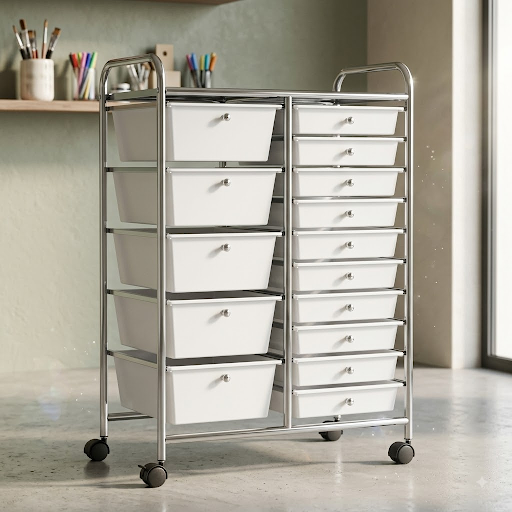
Vertical file cabinets—the tall, narrow units with front-to-back filing—take up very little floor space and are perfect for small offices or for stowing them in tight spaces. However, pulling files in the back of deep drawers can be awkward, and they are top-heavy when loaded in upper drawers. Lateral cabinets are wide and shallow rather than narrow and deep, with side-to-side filing that allows you to view every folder in the cabinet at a glance. They also function as credenza-height space for printers or decorative objects, but they do take up more wall room. For the ever-changing office floor plans where teams are always rearranging, a mobile file cabinet with casters offers a level of flexibility stationary units just can’t touch. These space-saving models sit under desks, wheel between workstations and accommodate professionals who work in multiple locations. Costway-AU and other retailers now stock multiple styles of mobile and vertical cabinet that cater to the home office user dealing with limited space – a mobile tower plus a single vertical cabinet often proves to be the best way to balance capacity and accessibility.
Key Features to Look for in a File Cabinet
Smooth-gliding drawer mechanisms with ball-bearing slides transform daily filing from a chore into an effortless motion—this single feature prevents the frustration of stuck or misaligned drawers that plague cheaper units. Full-extension slides let you access files at the very back without blind reaching. Built-in label holders on drawer fronts eliminate the taped-on paper labels that peel and curl within weeks, keeping your system looking professional long-term. Reinforced construction at stress points—drawer bottoms, rail connections, and cabinet corners—prevents the sagging and warping that occurs when drawers carry their full rated weight over years of use.
For businesses anticipating growth or evolving needs, modular designs that allow stacking or connecting multiple units provide scalability without replacement. Fire-resistant cabinets, while representing a higher investment, protect irreplaceable documents like original contracts, insurance policies, and corporate records from catastrophic loss. Every feature you select should serve one purpose: making efficient document storage so seamless that maintaining organization requires virtually no extra effort.
Beyond the Cabinet: Creating a Smart Document Organization System
Having a good quality filing cabinet but no system for organizing your files is like having a high-end kitchen and never learning how to cook. The cabinet provides shape, but the system you build in it defines whether you’ll really be able to find what you need when your anxiety peaks. Too many professionals buy lovely storage furniture and then pack it with the same chaotic piles that formerly sat on their desktops—now obscured behind a drawer face.
The good news: You do not need to be trained in rocket science or hire rocket science consultants to develop a filing system that works. It takes one whole dedicated afternoon and five simple steps, and after that, they pretty much take care of themselves, with a minimum amount of weekly work. What most small business owners do not understand: a filing system should reflect how you actually think about your work — not how a generic template tells you that you work. An independent graphic designer accesses files differently than an insurance broker, and your system needs to take your particular retrieval styles into account.
Step-by-Step: Implementing Your Filing System
Start with a purge. Remove all the files from where they live now—your desk drawers, random manila folders, that cardboard box under the printer—and sort them into three piles: active (you’ll need the document again in less than 90 days), archive (you must keep the doc, but you rarely reference it), and toss. Be ruthless. That vendor brochure from 2019 is useless. Multiple hard copies of signed contracts, when you have digital copies for the same, are just clutter. The majority of people find that they can purge 30-50% of their volume of paper by doing this one thing.
Then you categorize, which is to take all the survivors and arrange them based on some plan that makes sense in the context of your own (real) business: small businesses, you know, not the idealised business models that seem to circulate. Typical small business categories include financial documents such as tax records, bank statements, and receipts; client files like contracts, correspondence, and project notes; business documents like leases, insurance policies and licenses; and human resources information, including employee records and payroll documents. Don’t create too many categories—8 to 12 primary groupings will usually cover everything and still be manageable.
How you file in each category will determine how quickly you can find individual documents. Alphabetical filing is great for client folders with dozens of accounts. Use chronological filing for financial records when you need, for example, to grab “all invoices from Q3” for tax time. Project-based filing is the right method for marketing agencies or consultants who handle many client projects at once. You can mix techniques within categories—let your clients be alphabetised, and your finances be chronological, for instance—but whatever you decide, each category should have one consistent way of organizing its items.
Finally, establish a maintenance routine that prevents backsliding. Designate a specific time each week—Friday afternoon works well for most—to file accumulated documents from your desk inbox tray into their proper locations. This fifteen-minute habit prevents the gradual pile-up that eventually overwhelms any system. Once quarterly, spend an hour moving completed project files from active drawers to archive storage, freeing prime real estate for current work. The system only fails when filing becomes “something I’ll do later,” so treat your weekly session as a non-negotiable appointment with your own productivity.
Enhancing Your Professional Workspace with Strategic Storage Furniture
A file filing cabinet doesn’t exist in a vacuum—it’s one part of a larger office environment that makes you more or less productive every day. Best of all, the most efficient professional offices approach storage and filing in a way that naturally leads to workflow, reducing up-and-down trips, and place everyone’s key materials where they can easily be reached. When your file cabinets, desk, and other storage solutions function as one unit, staying organized is nearly effortless rather than something you have to constantly remind yourself to do.
The strategy of placement is more important than most professionals know. Make your main filing cabinet within a single swivel of your desk chair – at a distance, filing a paper is a matter of seconds not minutes, having to get up and walk across the room. If you are using a lateral cabinet, you should position it right behind or beside the desk, and place your printer/scanner or reference binders you use daily on top of it. A credenza to the wall behind your desk can serve as another workspace for your project supplies, which is a way to free your main desk to get work done. Above or next to your cabinet, the bookshelves hold stacks of reference volumes, trade publications, and relic binders you use sometimes, but not every day.
The visual coherence of your storage choices communicates professionalism before you say a word to visiting clients. Matching finishes across your cabinet, credenza, and shelving units creates a polished, intentional environment that signals competence and attention to detail. Even modest offices feel elevated when storage furniture shares consistent materials and hardware styles, transforming a functional workspace into one that actively reinforces your brand’s credibility.
From Document Chaos to Lasting Professional Order
The journey from document chaos to professional organisation is simple, though it requires intentional decisions on every level. Choose a file cabinet that fits your space, your security requirements, and your growth expectations. It gets better when you establish a system within that file cabinet — one based on how you really work, not some theoretical ideal. And it runs on all cylinders when you think of your cabinet as one element in a whole storage furniture plan that transforms your entire work area into a productivity machine.
These returns on this investment are compounding daily. Minutes saved searching are hours recaptured each month. Stress melts away when every piece of paper has its own place. Clients see the confidence you exude when their file is in your hand within seconds of them sitting down. Every time you email from a space that shows you know what you are doing, you enhance your professional image.
Don’t wait for the perfect weekend to overhaul everything at once. Pick one action today—schedule that Friday filing session, order color-coded folders, or measure your office for the cabinet style that fits best. A single step forward breaks the inertia that keeps most professionals stuck in paper purgatory, and momentum builds quickly once organization starts working in your favour rather than against it.