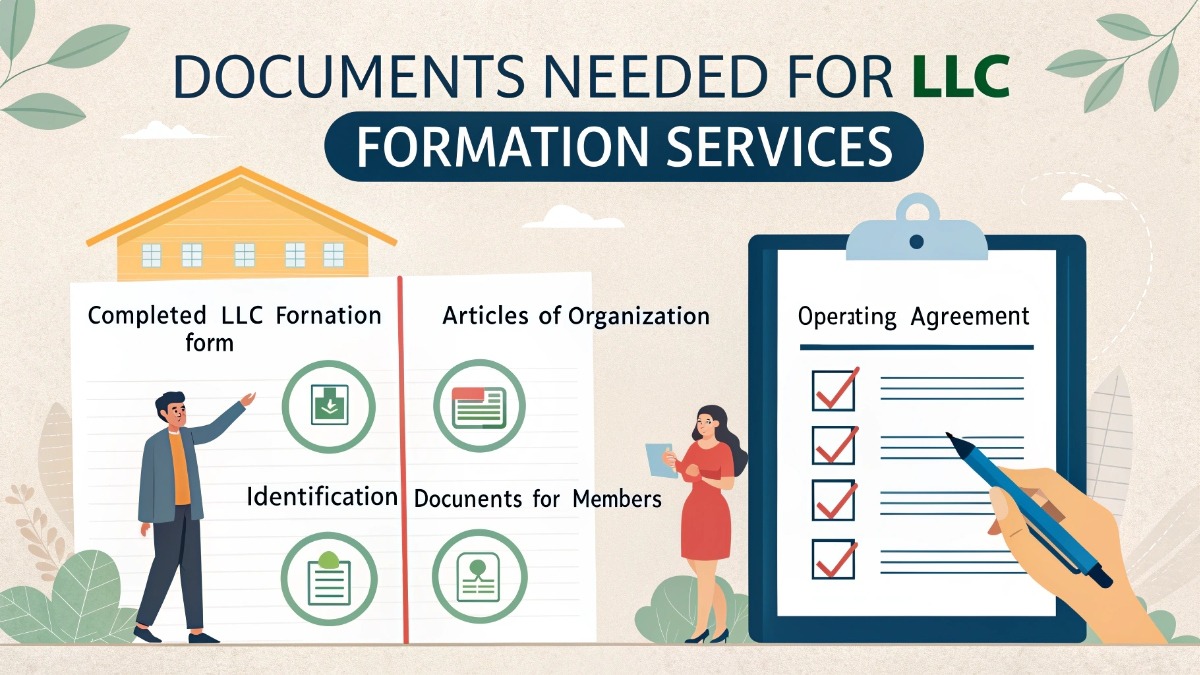
Starting a Limited Liability Company (LLC) is one of the most popular choices for entrepreneurs and small business owners in the United States. An LLC provides personal liability protection, tax flexibility, and a relatively simple operational structure. However, forming an LLC requires careful preparation and submission of various documents to state authorities and potentially federal agencies.
Filing documentation varies for each state for LLC formation, but they all follow similar patterns and require the same core documentation, including Articles of Organization, Operating Agreement, and Employer Identification Number (EIN) application.
According to the Small Business Administration, there are over 20 million LLCs registered in the United States as of 2024, making it the most common business structure chosen by new entrepreneurs. Understanding what documents you need for LLC formation services is crucial to ensuring a smooth and legally compliant business launch. Business formation experts at BusinessRocket note that proper documentation is the foundation of a legally protected LLC. This comprehensive guide will walk you through every document you need to form an LLC, explaining the purpose of each document and when it’s required.
Articles of Organization
The articles of organization (known in some states as a certificate of formation or certificate of organization) is the main formation document for your LLC. This paperwork formally registers your company with your state’s secretary of state office or similar entity. Your LLC isn’t legally formed without filing the Articles of Organization.
The Articles of Organization typically include:
- Company name with LLC designation
- Principal business address
- Registered agent details
- Management structure (member-managed or manager-managed)
- Purpose of business
- Name and address of organizer
The fee for filing Articles of Organization depends on the state. For instance, California has a fee of $70, and Massachusetts has a fee of $500. Filing fee Based on Data from the National Association of Secretaries of State, The median filing fee nationwide is about $132. Turnaround time is 1-2 weeks for standard processing, though expedited service is offered by most states for an additional charge of $50 to $200.
| State | Filing Fee | Processing Time | Expedited Fee |
| California | $70 | 5-7 business days | $350 |
| Delaware | $90 | 7-10 business days | $100 |
| Texas | $300 | 5-7 business days | $25 |
| Florida | $125 | 5-7 business days | $30 |
| New York | $200 | 1-2 weeks | $75 |
| Nevada | $75 | 1-2 weeks | $125 |
| Wyoming | $100 | 7-10 business days | $60 |
Operating Agreement
An Operating Agreement is an internal document that outlines the ownership structure, management procedures, and operational rules of your LLC. While not all states legally require an Operating Agreement, approximately 8 states including California, Delaware, Maine, Missouri, Nebraska, and New York mandate this document. However, business experts recommend every LLC should have one.
The Operating Agreement should detail:
- Percentage of ownership for each member
- Capital contributions made by each member
- Profit and loss distribution methods
- Voting rights and decision-making procedures
- Rules for adding or removing members
- Management responsibilities and meeting requirements
- Dissolution procedures and buyout provisions
Ahsien Siraj, CEO and founder of the Los Angeles–based law firm LegalZoom, said most banks now require it, based on a 2023 survey from LegalZoom that found 73% of banks ask for an Operating Agreement when opening a business bank account. In addition, a thorough Operating Agreement for an LLC adds another layer of protection to your LLC’s limited liability by showing your business is a separate legal entity from you as an owner. The Internal Revenue Service also suggests you keep an Operating Agreement as part of your business records. Though single-member LLCs are not required to have an Operating Agreement, the BusinessRocket team says they ought to as well to help preserve the corporate veil and keep their personal assets protected from business-related liabilities.
Employer Identification Number Application
An EIN, or a Federal Tax Identification Number, is a number that the Internal Revenue Service (IRS) uses to identify your business entity. IRS data show that more than 15 million EINs are assigned each year to new businesses and entities.
You’ll need an EIN to:
- Open a business bank account
- Hire employees
- File federal and state tax returns
- Apply for business licenses and permits
- Establish business credit
| Application Method | Processing Time | Cost | Availability |
| Online (IRS Website) | Immediate | Free | Mon-Fri, 7 AM – 10 PM ET |
| Fax | 4 business days | Free | 24/7 |
| 4-6 weeks | Free | 24/7 | |
| Phone (International) | Immediate | Free | 6 AM – 11 PM ET |
The good news is that getting an EIN is free and fairly easy from the IRS website through the Form SS-4. The IRS states, 80% of EIN applications are filed via the online application method and this has enabled those applicants to obtain their number immediately upon completion. The electronic application may be completed Monday through Friday, 7:00 a.m. to 10:00 p.m. Applications submitted by fax are processed within four business days, while applications sent by mail require four to six weeks.
Registered Agent Consent Form
What is a Registered Agent? Every LLC is required to have a registered agent who is a person or an entity (company) the LLC relies on to accept legal papers, government documents, and service of process for the LLC. An LLC must have a registered agent with a physical address (not a P.O. Box) in the state of formation to do business in all 50 states.
The registered agent must:
- Have a physical street address in the state (not a P.O. Box)
- Be available during normal business hours (typically 9 AM to 5 PM)
- Be at least 18 years old
- Accept the responsibility in writing
The agent’s consent to act as an agent is evidenced by the Registered Agent Consent Form. This consent is frequently a portion of the Articles of Organization or is filed separately based on state regulations. 0 of small LLCs opt for professional registered agent services rather than acting as their own agent according to data from the industry. Registered agent services tend to be in the $100-$300 per year range. BusinessRocket suggests you employ the services of a professional registered agent to protect your privacy and to make sure you never miss important legal documents, especially if you travel frequently or work from multiple locations.
Initial Report or Statement of Information
Several states require LLCs to submit an Initial Report, Statement of Information, or equivalent upon forming the company. The National Association of Secretaries of State reports that 42 states require a report for LLCs either annually or upon formation. This form informs the state about the LLC’s members, managers, and the company’s address, providing them with updated information.
The Initial Report typically includes:
- LLC name and file number
- Principal office address
- Registered agent information
- Names and addresses of members or managers
- Nature of business conducted
Deadlines for filing vary widely by state. For instance, California requires the Statement of Information within 90 days of formation with a $20 fee, but Nevada requires an Initial List of Members within 30 days with a $150 fee. Based on information from state business registries, about 15% of LLCs are fined their first year for missing initial report deadlines, with penalties ranging from $25 to $200 depending on the state.
Business Name Reservation Form
Before filing your Articles of Organization, it’s wise to verify that your desired LLC name is available and complies with your state’s naming requirements. Approximately 35 states offer name reservation services, allowing you to hold a business name for a specific period, typically 30 to 120 days.
State name reservation requirements include:
- Name must include “Limited Liability Company” or abbreviations like “LLC” or “L.L.C.”
- Name cannot be confusingly similar to existing registered businesses
- Certain words like “bank,” “insurance,” or “university” may be restricted
- Some states prohibit certain words without special approval
The fee for the booking is usually between $10 and $50, with most states charging $20 or $25. The International Association of Commercial Administrators reports about 22 percent of initial LLC name filings are rejected for being too similar to an existing name or for not meeting naming requirements. A name search can also be done prior to filing to save on time and money.
Publication Requirements Documentation
Certain states require new LLCs to advertise the LLC formation in a local newspaper. At this time, only Arizona, Nebraska and New York require publication, with New York’s being the most rigorous.
New York publication requirements:
- Publish in two newspapers (one daily and one weekly)
- Publication must run for six consecutive weeks
- Must be in the county where the business is located
- File Certificates of Publication within 120 days of formation
According to data from New York County Clerks, publication costs vary dramatically by county. In Manhattan, publication can cost $1,500 to $2,000, while in rural counties it may cost $300 to $500. Arizona requires publication in a newspaper of general circulation for three consecutive publications, with costs typically ranging from $50 to $200. The New York Department of State reports that approximately 20% of new LLCs fail to complete publication requirements within the 120-day deadline, resulting in suspension of business authority.
Business Licenses and Permits Documentation
The Small Business Administration estimates that depending on your business type and location, you may need anywhere from 2 to 15 different licenses and permits to operate legally. The specific requirements depend on your industry, business activities, and location at federal, state, and local levels.
Common licenses and permits include:
- General business license (cost: $50 to $400 depending on location)
- Professional licenses for regulated professions
- Sales tax permit (usually free to $100)
- Health department permits for food businesses ($100 to $1,000)
- Building permits for construction or renovation
- Federal licenses for specific industries (alcohol, firearms, agriculture)
According to the SBA, the average small business spends approximately $400 in licensing and permit fees during the first year. Some industries face significantly higher costs. For example, restaurants may spend $5,000 to $15,000 on various permits and licenses, while professional services like law firms may need state bar licenses costing $500 to $1,500 annually.
Banking Resolution and Documentation
Opening a business bank account is crucial for maintaining your LLC’s limited liability protection. A 2023 survey by the Federal Reserve found that 86% of small businesses maintain separate business bank accounts, which is essential for proper financial separation.
Banks typically require:
- Filed Articles of Organisation with state filing stamp
- EIN confirmation letter from the IRS
- Operating Agreement showing ownership structure
- Banking Resolution authorizing specific signers
- Government-issued ID for all authorized signers
- Initial deposit (typically $25 to $500)
What we found in industry data: When business owners submit all required documentation, 95% of business bank account applications are approved. However, accounts that do not have the required LLC documentation are rejected at a rate of about 40%. The Banking Resolution, which may be a stand-alone document or included in your Operating Agreement, must state who may execute banking transactions in the name of the LLC. Prioritize separation of finances and building a business credit file by opening your business bank account in the first 30 days of your LLC formation, BusinessRocket says.
State Tax Registration Forms
In addition to the federal tax burden, the Tax Foundation states that businesses in most states are subjected to 3 to 5 state taxes on average. Registration Forms with the State Tax Department can differ widely depending on your state and the type of business you own.
Common state tax registrations include:
- State income tax withholding for employees
- Unemployment insurance tax (rates typically 0.6% to 6% of wages)
- Sales and use tax permits
- State franchise taxes or annual fees
For example, California charges an $800 annual LLC franchise tax, while Texas has no state income tax but does impose a franchise tax on businesses with revenues exceeding $1.23 million. 45 states also tax businesses in some way, on top of the federal requirements, the Federation of Tax Administrators says. The typical small business takes 8 hours to complete initial state tax registration, according to a National Federation of Independent Business poll.
Professional License and Certification Documents
If your LLC is going to be involved in the practice of a profession, you may require the Professional Limited Liability Company (PLLC) status. About 30 states have distinct PLLC laws for licensed professionals. The American Bar Association says there are more than 500,000 professional service firms doing business as PLLCs in the U.S.
Required documentation may include:
- Individual professional licenses for each service provider
- Proof of malpractice insurance ($1,000 to $10,000 annually depending on profession)
- Verification of continuing education credits
- Board certifications where applicable
- Additional filings with professional licensing boards
As an example, medical practices in most states are required to carry medical malpractice insurance in the amount of $1 million per claim and $3 million in the aggregate. Possibly legal firms need similar protection. The average cost of medical malpractice insurance is $7,500 to $12,000 annually, varying by specialty and location, according to the American Medical Association.
Foreign Qualification Documents
Should your LLC be doing business in other states besides the one in which you formed it, you will probably have to file as a foreign LLC. The Council of State Governments has said that nearly 25 percent of LLCs eventually take the step of registering to do business in an additional state.
Foreign qualification typically requires:
- Certificate of Good Standing from home state ($20 to $50)
- Application for Authority in the new state
- Designation of Registered Agent in new state
- Filing fee ($100 to $500 depending on state)
- Copies of Articles of Organization
The timeline of the foreign qualification process is around 2-4 weeks with fees from $200 to $400 per state on average according to data from state business registries. You’re also required to file annual reports and pay taxes in every state where you are qualified. Firms that do business in “multistate” environments spend 40% more time on tax compliance than do companies operating in a single state, according to the multistate Tax Commission.
Ongoing Compliance Documentation
After formation, LLCs are required to keep various compliance documents and meet recurring deadlines. The Small Business Administration estimates that businesses devote about 40 hours a year to paperwork and regulatory compliance. BusinessRocket’s compliance monitoring service keeps LLC owners informed on about such requirements and send automated reminders for annual reports, franchise tax payments, and license renewals.
Key ongoing requirements include:
- Annual or biennial reports (fees: $10 to $300 depending on state)
- Franchise tax payments where applicable
- Business license renewals (typically annually)
- Updated member/manager information
- Tax return filings
The National Small Business Association says 44 percent of small businesses say they spend more than $10,000 a year on compliance with regulations. Skipping compliance due dates can be expensive. For instance, California imposes a $250 fine for late Statement of Information submissions, and further non-compliance may result in suspension or administrative dissolution. The Council on State Taxation also reports that about 12% of LLCs lose good standing status at some point for not filing.
Cost Summary
Knowing the full fee for LLC formation also helps knowing what to expect for financial planning. Based on data from the Kauffman Foundation, the estimated cost to create and hold an LLC for the first year is between $500 and $2,000, with the following breakdown:
Initial Formation Costs
| Expense Category | Cost Range | Average Cost |
| State Filing Fee | $50 – $500 | $132 |
| Operating Agreement (DIY) | $0 – $50 | $25 |
| Operating Agreement (Attorney) | $500 – $1,500 | $800 |
| Initial Report | $0 – $150 | $50 |
| Business Licenses | $50 – $400 | $200 |
| Professional Formation Service | $0 – $300 | $150 |
First Year Ongoing Costs
| Expense Category | Cost Range | Average Cost |
| Registered Agent Service | $100 – $300 | $150 |
| Annual Report | $10 – $300 | $100 |
| State Franchise Tax | $0 – $800 | $200 |
| EIN Application | Free | Free |
| Business Bank Account | $0 – $500 | $100 |
Initial formation costs:
- State filing fee: $50 to $500 (average $132)
- Operating Agreement: $0 to $500 (if using attorney)
- Initial Report: $0 to $150
- Business licenses: $50 to $400
- Professional formation service (optional): $0 to $300
First-year ongoing costs:
- Registered agent service: $100 to $300
- Annual report: $10 to $300
- State franchise tax: $0 to $800
- EIN application: Free
The total cost varies significantly by state. For example, forming an LLC in Wyoming costs approximately $100 in state fees, while Massachusetts charges $500 just for the Articles of Organization filing. According to the Small Business Administration, entrepreneurs should budget approximately $1,000 to $1,500 for first-year LLC formation and compliance costs in most states. BusinessRocket offers comprehensive LLC formation packages that bundle many of these services together, potentially saving business owners both time and money compared to handling each requirement separately.
What documents are absolutely required to form an LLC?
The one formality that every state requires is the Articles of Organization, which you file with your state’s Secretary of State along with the filing fee. Also, all states require the appointment of a registered agent, either within the Articles or by separate document. When you have employees or multiple members, get an EIN from the IRS (not through the secretary of state) – this is free through the IRS site and you don’t file it with the state.
How much does it cost to form an LLC?
Filing fees vary from $50 to $500, according to the National Association of Secretaries of State, with the average being $132. Registered agent service, business licenses and compliance first-year total costs are generally between $500 and $2,000. Other expenses that may be incurred are those related to professional formation services ($100 to $300), attorney fees for Operating Agreements ($500 to $1,500), and state-specific mandates such as publication requirements in New York ($300 to $2,000).
Do I need an attorney to form an LLC?
No, you don’t actually need a lawyer to create an LLC. The Small Business Administration states that about 60% of LLC owners fill out the formation paperwork themselves or use online formation services. That said, an attorney can definitely be helpful even in simple situations and is a must for complex scenarios involving multiple members, large sums of money, or professional services. Attorney fees for LLC formation and initial consultation can be as low as $500 or as high as $2,000 or more, depending on the attorney and location.
How long does LLC formation take?
Standard turnaround times are different by state, ranging from 1-2 weeks up to 6-8 weeks. Based on information from state registries, the average processing time is around 2-3 weeks. Expedited shipping is available in most states for an additional charge of$50 to $200, which shortens the processing time down to 1-3 business days. Same-day processing is available in certain states such as Delaware. Online submission generally has a quicker processing time than mailing.
Can I form an LLC in a different state than where I live?
Yes, you can create an LLC in any state no matter where you live. But if you do business in your home state, you’ll have to register there as a foreign LLC, basically twice the filing fees and compliance headaches. Formation data shows that around 15% of LLC are formed in a state other than the State of their primary business address (State of Inc most often refers to the address where the business is domiciled, but other addresses may be used).
What is a Certificate of Good Standing?
A Certificate of Good Standing, issued by your state, confirms your LLC is properly registered and has met all filing and payment requirements. This document is typically required when registering as a foreign LLC, applying for business loans, or entering major contracts. Most states charge $20 to $50 for this certificate, which is usually valid for 30-90 days from issuance.
Do all states require an Operating Agreement?
Not to mention, only around 8 states actually require an Operating Agreement by law, such as California, New York, Maine, Missouri and Delaware. But business professionals agree that you should have one whatever your state says. A 2023 survey by LegalZoom also revealed most banks — 73% — require a copy of your operating agreement to open a business account, and having one can strengthen your limited liability protection.
What happens if I don’t file required reports?
The late penalty for not filing multiple annual reports or failing to pay fees ranges from $25 to $200 in most states. Ongoing noncompliance could cause your LLC to be administratively dissolved. Some 12% of LLCs are reported to lose good standing status because of missed filings according to data from state business registries, and reinstatement generally runs between $200 to $500 in fees and penalties.
Is an EIN always required for an LLC?
An EIN is necessary if your LLC has more than one member or if there are any employees. Single-member LLCs without employees can use the owner’s Social Security number for tax purposes. Still, the IRS and banking professionals suggest any LLC get an EIN, for privacy, security, and banking professionalism. The form is free and you can complete it online in about 15 minutes.
What is the difference between Articles of Organization and Operating Agreement?
Articles of Organization is the public document you file with the state to legally create your LLC, costing $50 to $500 depending on state. The Operating Agreement is an internal document that outlines ownership, management, and operational procedures and is not filed with the state. Think of Articles as your LLC’s birth certificate and the Operating Agreement as your business’s internal rulebook.