

Key Takeaways
- Invoice financing offers rapid access to working capital by leveraging outstanding invoices, enabling businesses to bridge cash flow gaps without incurring traditional debt.
- Understanding the distinctions between invoice factoring and invoice discounting is crucial, as each option varies in terms of confidentiality, cost, and customer interaction.
- Factoring may be suitable for businesses requiring external credit control support, while discounting is often ideal for companies with robust internal processes and a desire to maintain confidentiality.
- Selecting the right method can streamline operations, enhance cash flow, and better support long-term growth strategies.
Understanding Invoice Financing Options
Cash flow challenges are a common obstacle for businesses of all sizes and industries. To help bridge the gap between issuing an invoice and receiving payment, many companies explore invoice financing for businesses. This solution can unlock capital tied up in your sales ledger, offering immediate access to working capital without the traditional wait for customer payments.
Two of the most popular and accessible strategies in this space are invoice discounting and invoice factoring. While both approaches enable you to tap into outstanding receivables, they differ significantly in terms of their operation, costs, and impact on customer relationships. Selecting the right option can be crucial to achieving smoother operations and ongoing growth.
Understanding the differences is crucial for making an informed choice that aligns with your business goals. By weighing the advantages and challenges of each method, you can determine which structure better aligns with your operational needs and cash flow requirements.
What Is Invoice Factoring?
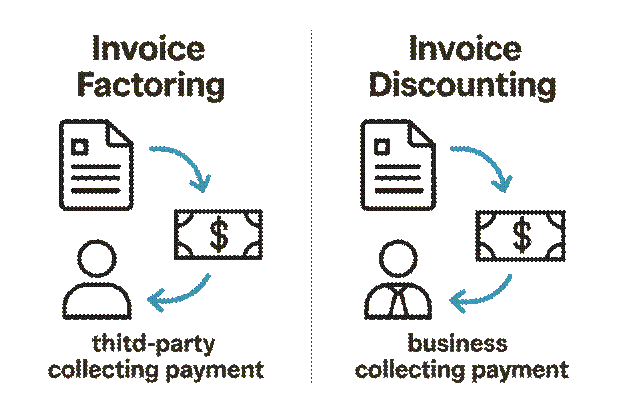
Invoice factoring is a financing solution where you sell your unpaid invoices to a third-party company, known as a factor. The factor usually advances you between 70% and 90% of the invoice’s value straight away. The factor also assumes responsibility for collecting payments directly from your customers, which can ease internal administrative burdens. Once your customer settles their invoice, the factor releases the remaining balance to you after deducting their agreed-upon fees.
This system not only offers quick cash flow relief but can also be valuable for companies lacking in-house credit control resources. However, since the factor communicates directly with your customers to arrange payment, they will know that you are using invoice factoring as a cash flow tool.
What Is Invoice Discounting?
Invoice discounting allows you to borrow money against the value of your unpaid invoices, keeping your financing arrangement confidential. In this set-up, you retain control over collections and all interactions with your customers. Only your business and the lender are aware of the arrangement, preserving your customer relationships and normal business operations.
Clients repay the original invoice value directly to you, and then you reimburse the lender the advanced sum, plus any associated fees and interest. Invoice discounting is best suited for companies with established and reliable internal credit management.
Key Differences Between Factoring and Discounting
- Control Over Collections: Factoring shifts debt collection responsibility to the factor, simplifying your workload but reducing your direct interaction with customers. Discounting means you keep full control over your ledger and customer communications.
- Confidentiality: Discounting is nearly always confidential, so customers remain unaware of third-party involvement. Factoring is typically disclosed, as the factor manages collections directly from your debtors.
- Cost Considerations: Factoring often includes higher service fees due to outsourced credit control and collections, whereas discounting may carry lower costs for businesses equipped to manage receivables internally.
- Eligibility Requirements: Discounting is generally reserved for established businesses with strong credit processes. Factoring can be a more accessible choice for newer or smaller businesses without these internal capabilities.
Pros and Cons of Invoice Factoring
Pros:
- Provides faster cash flow for your business needs.
- Eliminates the need for in-house collections and credit control.
- Can be easier to qualify for, even for smaller firms or those with minimal credit resources.
Cons:
- Can carry higher fees than discounting due to external management and risk.
- You lose some control over how your customer relationships are managed.
- Your customers will generally be notified of the factoring arrangement.
Pros and Cons of Invoice Discounting
Pros:
- Keeps your customer relationships and operations confidential and unaffected.
- Potentially lower cost if you have robust internal processes.
- All collections and communications remain under your control.
Cons:
- Demands efficient and reliable internal credit management systems.
- Your business bears the responsibility of chasing unpaid invoices.
- Lenders may require a track record of reliable customers and established processes for eligibility.
Making the Right Choice for Your Business
The decision between invoice factoring and invoice discounting ultimately hinges on your business’s structure, available resources, and priorities around cost and confidentiality. Factoring is widely used by businesses seeking immediate funds without the overhead of management, while discounting is favored by established companies prioritizing privacy and hands-on customer management.
Carefully review your internal capabilities and growth plans before moving forward. It’s also wise to consult with a financial advisor to ensure the approach you select fully supports your ambitions and working capital needs. For more expert guidance on business finance strategies, the NerdWallet UK guide to business loans provides additional insights for businesses navigating these choices.
Taking the time to evaluate both options ensures you’re equipped to make the most of your working capital and nurture lasting business success.