

The aviation industry is moving toward cleaner ground operations, but the path is not as simple as replacing every diesel unit with an electric alternative overnight. Airports, MROs, airlines, and ground handlers are working under pressure to reduce emissions while still protecting uptime, turnaround performance, and operational flexibility.
Full electrification is an important direction for the industry. It supports airport sustainability targets, reduces local emissions, and helps operators prepare for stricter environmental expectations. But across many airside environments, the infrastructure needed to support full electrification is still uneven. Charging capacity, power availability, stand layout, duty cycles, climate conditions, and capital planning all influence how quickly operators can move. This creates a practical gap between long-term ambition and daily operational reality.
For decision-makers, the question is no longer whether cleaner ground support equipment matters. It clearly does. The more difficult question is how to modernize ground power fleets without creating new operational risks. Aircraft still need reliable power at the gate, in the hangar, at remote stands, and during line maintenance. Ground handling teams still need equipment that can be deployed quickly. MROs still need flexible mobile power that works across different service scenarios. Military and special mission environments still need independence from fixed infrastructure.
In this context, transition solutions deserve more serious attention.
A practical transition solution is not a compromise in the negative sense. It is a way to improve today’s operation while keeping the door open for tomorrow’s infrastructure. In ground power, this can mean lower-emission diesel technology, hybrid utility power capability, compact mobile designs, and equipment that can operate across different environments without forcing the customer into a single operating model.
This is especially important for airports and operators with mixed infrastructure. Fixed 400 Hz systems may cover some gates, but not every stand. Remote positions, overflow areas, construction phases, hangars, and temporary maintenance zones often still require mobile ground power. A strategy that assumes fixed infrastructure can solve every aircraft power requirement may look clean on paper, but it rarely reflects the full complexity of daily airside operations.
The same applies to fully electric mobile GPUs. They are highly relevant in the right environment, particularly where charging infrastructure, duty cycle, climate, and operational planning are aligned. But for many operators, a full battery fleet may not yet be practical across every use case. The better approach is often a staged fleet strategy: introduce electric equipment where it fits, use fixed power where available, and modernize diesel or hybrid mobile GPUs where independence and runtime remain essential.
This is where equipment specification becomes a strategic decision.
Decision-makers should look closely at engine standards, emissions performance, serviceability, footprint, power output, and operating flexibility. A lower-emission diesel unit based on Stage V / Tier 4 Final engine technology, for example, can help operators move away from older diesel platforms while still maintaining the mobility and independence they need. If the unit also offers plug-in hybrid utility power functionality, it can reduce fuel use where grid power is available and continue operating independently where it is not.
That type of flexibility matters because aviation ground operations are rarely uniform. One airport may need a GPU for remote stands. Another may need it for hangar operations. A ground handler may need to support multiple aircraft types during peak hours. An MRO may need equipment that can move easily around tight working areas. In all cases, reliability is not negotiable.
Compact design is also becoming more important. Apron space is under pressure. Equipment congestion affects safety, movement, and turnaround discipline. A smaller mobile GPU that still delivers strong output can provide measurable operational value, especially in constrained airport and maintenance environments. The benefit is not only easier positioning. It is better fit within the wider flow of airside activity.
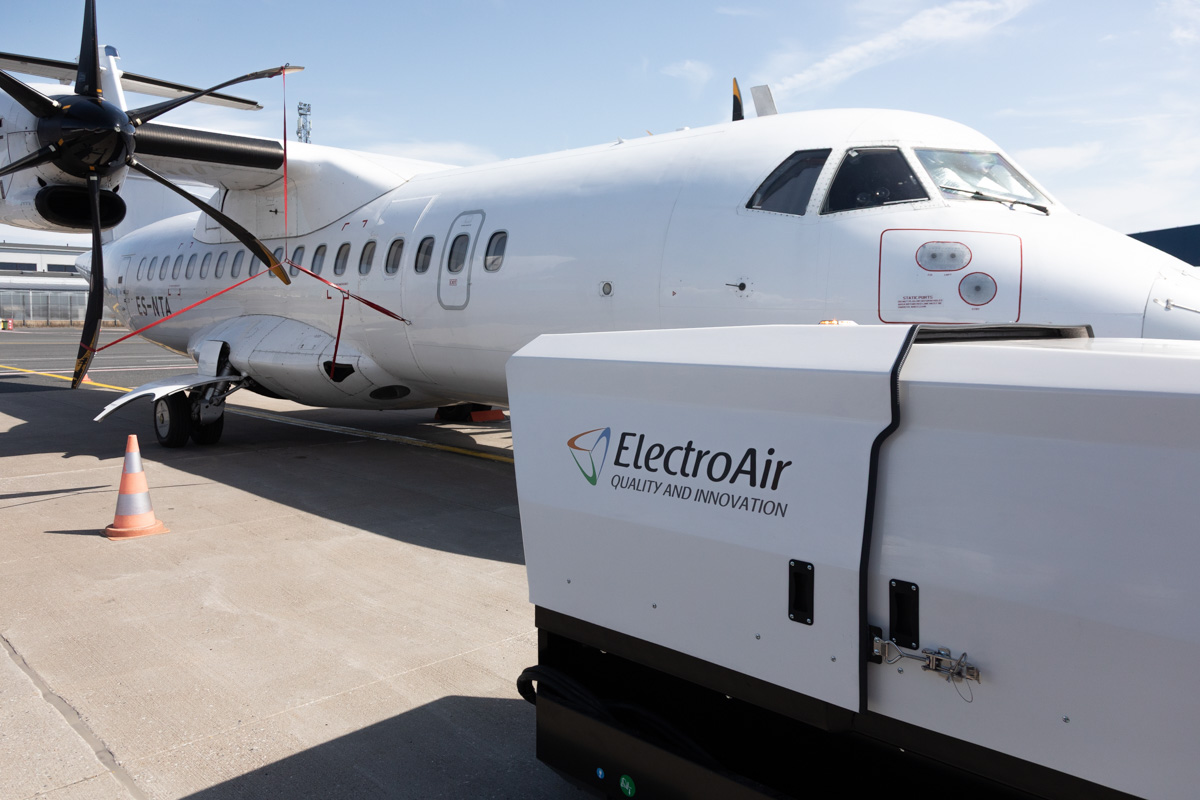
ElectroAir’s work in ground power reflects this more practical view of transition. The company’s APA-100 Ground Power Unit is one example of how manufacturers are responding to the market’s need for lower-emission, compact, and flexible mobile power. It is designed for operators that still require dependable diesel-driven capability, but also want equipment that is better aligned with modern sustainability and procurement expectations.
That distinction is important. The future of ground power will not be defined by one technology alone. It will be shaped by operational fit. Some locations will move quickly toward electric fleets. Others will rely on a combination of fixed power, battery units, lower-emission diesel GPUs, and hybrid concepts. The best strategy will depend on infrastructure, aircraft mix, climate, utilization, service model, and long-term investment plans.
For aviation decision-makers, the priority should be clear: avoid binary thinking. The transition to cleaner ground operations is already underway, but it needs to be managed with the same discipline as any other airside investment. Equipment must support emissions goals, but it must also work in real conditions.
For a deeper look at how this transition logic applies to aircraft ground power, ElectroAir has outlined its view in an article on lower-emission ground power and the role of the APA-100 Ground Power Unit, focusing on compact design, Stage V / Tier 4 Final engine technology, plug-in hybrid utility power, and the practical gap between full electrification goals and daily airside requirements.
Ground power is not only about connecting an aircraft. It is about protecting operational continuity. The winners in this next stage will be the operators who modernize with realism, choose equipment that fits their infrastructure, and build a fleet strategy that can evolve as the industry moves forward.