



Core Roles of Financial and Accounting Services in Modern Business
Every business, regardless of its size or industry, relies on clear financial insights to thrive. Without accurate and reliable data, making informed decisions about growth, investment, and operational efficiency becomes incredibly difficult. This is where professional Financial and Accounting Services become indispensable. They are not merely about meeting compliance requirements; they are strategic assets that provide a foundational understanding of your business’s health.
We understand that the success of any venture hinges on thorough performance reviews. These reviews, however, are only as robust as the financial information supporting them. From evaluating profitability and managing cash flow to controlling costs, precise financial data is paramount.
In this comprehensive guide, we will delve into the critical roles financial and accounting services play in modern business. We will explore how they significantly enhance the accuracy and reliability of your performance reviews. We will also compare various service delivery models, such as virtual accounting versus working with a traditional regional CPA firm. Our aim is to empower you to select the ideal accounting partner to support your strategic goals and long-term business growth.
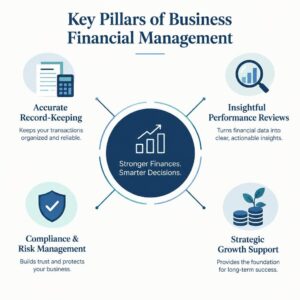 Financial accounting services are the bedrock of operational efficiency and informed decision-making for any business. They provide meticulous record-keeping, ensuring that every transaction is accurately logged and reconciled. This systematic approach to ledger reconciliation guarantees financial transparency, which is crucial for internal governance and robust risk mitigation. Without this foundational accuracy, performance reviews become speculative rather than data-driven.
Accurate financial information transforms performance reviews from subjective assessments into metric-driven evaluations. It allows businesses to understand what truly works, identify areas needing improvement, and pinpoint future opportunities. Business performance reviews are valuable not only for internal management but also for investors, lenders, business partners, and other stakeholders who rely on financial transparency. According to a 2023 Deloitte survey, accurate financial reporting is a top driver of investor confidence.
Here are some essential financial reports that businesses leverage for comprehensive performance evaluation:
- Income Statement (Profit & Loss Statement): This report details revenues, costs, and profits over a period, providing insight into profitability.
- Balance Sheet: A snapshot of a company’s assets, liabilities, and equity at a specific point in time, indicating financial health.
- Cash Flow Statement: Tracks the movement of cash in and out of the business from operating, investing, and financing activities, crucial for liquidity management.
- Budget vs. Actual Reports: Compares planned financial performance against actual results, highlighting variances and areas for adjustment.
- Accounts Receivable Aging Report: Shows outstanding invoices and how long they’ve been due, vital for managing incoming cash.
- Accounts Payable Aging Report: Details unpaid bills and their due dates, helping manage outgoing cash and supplier relationships.
- General Ledger: The complete record of all financial transactions, forming the basis for all other reports.
Measuring Profitability and Cash Flow Through Financial and Accounting Services
Understanding profitability and managing cash flow are two sides of the same coin when it comes to business stability. Financial accounting services provide detailed income statements that dissect revenue and expenses, allowing for a clear analysis of gross profit, operating margin, and net profit. This granular view helps identify where profit is being generated and where it might be eroding. For instance, a tech startup might leverage profitability segmentation to adjust pricing for low-margin products, turning a potential loss into a gain.
Beyond profit, cash flow statements are indispensable. Integrating cash flow analysis with profitability metrics reveals liquidity risks that pure profit figures might miss. A business can be profitable on paper but still face a cash crunch if payments are delayed or expenses are poorly managed. Cash flow statements track the actual movement of money, distinguishing between cash generated from operations, investments, and financing. This clarity is vital for managing working capital, ensuring timely payments, and planning for future investments. For example, a nonprofit might track cash-flow statements diligently to ensure timely grant disbursements and avoid operational disruptions. Businesses with integrated cash-flow statements reportedly experience 20% fewer liquidity crises. Effective cash flow management often goes hand-in-hand with establishing strong relationships with financial institutions that offer reliable banking solutions tailored to business needs, ensuring smooth financial operations.
Strengthening Budget Comparisons and Variance Analysis
Financial accountability is paramount for sustainable growth, and budget comparisons coupled with variance analysis are powerful tools for achieving it. Financial accounting services facilitate the creation of detailed budget forecasts and then meticulously compare them against actual performance. This process highlights discrepancies, known as variances, which can signal both opportunities and challenges.
By regularly creating side-by-side reports comparing actual results to budgeted figures each month, businesses gain a clear picture of their financial discipline. Variance analysis isn’t just about identifying overspending; it’s about understanding why those variances occurred. Was it an unexpected increase in raw material costs? A surge in sales beyond projections? Or perhaps an inefficiency in a particular department? A mid-size manufacturer, for example, used variance analysis to identify and cut unnecessary overhead by 12% after discovering significant deviations in its production budget.
This level of detailed financial scrutiny strengthens departmental discipline and promotes a culture of cost control. When managers understand how their spending impacts the overall budget, they become more accountable. Companies that regularly perform budget variance analysis see a 15% reduction in unexpected expenses, demonstrating its direct impact on overhead management and overall financial health.
Comparing Service Delivery: Virtual Accounting vs. In-Person Support

The landscape of financial and accounting services has evolved significantly, offering businesses more choices than ever before. The decision between virtual accounting services and local, in-person firms often comes down to balancing communication speed, geographical reach, and the desire for cloud integrations versus traditional consultation. Both models offer distinct advantages, and the “best” choice largely depends on a business’s specific needs and operational style.
Feature Virtual Accounting Platforms Local Accounting Firms Cost Often flat-rate, predictable; potentially lower overheads. Can be hourly, variable; higher overheads may be passed on. Accessibility 24/7 access to platforms; remote CPA access; wider talent pool. Limited to office hours; in-person meetings; local talent. Service Depth Can offer comprehensive services, but may lack local nuance. Deep local market knowledge; strong personal relationships. Technology Built on cloud integrations; digital portals; automation. May use cloud, but often more traditional software. Communication Primarily digital (email, chat, video calls); fast. In-person meetings, phone calls; less immediate digital. Geographical Reach Global talent pool; no location constraints. Limited by physical location; serves local community.
Virtual Providers vs. Traditional Firm Delivery Models
Virtual accounting services leverage technology to provide seamless financial management from anywhere. This model often incorporates advanced software integration, digital portals for document sharing, and remote CPA access, making it incredibly convenient for businesses operating across different locations or those with a preference for digital workflows. For a freelance graphic designer in Ann Arbor, a virtual CPA might handle monthly bookkeeping and quarterly tax estimates with ease, communicating primarily through secure online platforms. The advantages include greater flexibility, often more predictable flat-rate pricing, and access to a broader pool of specialized talent regardless of geography.
On the other hand, traditional firms offer localized expertise and the comfort of in-person consultations. While many traditional firms have adopted cloud technologies, their core model often revolves around a physical presence and direct client interaction. This can be particularly beneficial for businesses that require on-site auditing, complex compliance work with local regulations, or simply prefer face-to-face meetings to build rapport. For a construction firm in Grand Rapids needing audit expertise for multistate tax compliance, a local firm might offer the specialized knowledge and hands-on approach they prefer. The choice often boils down to a business’s comfort level with digital interaction versus the desire for a local, tangible presence.
Year-Round Advisory vs. Tax-Season-Only Support
The traditional model of engaging an accountant primarily during tax season is rapidly being superseded by the benefits of year-round advisory support. While tax-season-only services focus on historical data to file annual returns, year-round advisory offers proactive planning and continuous strategic guidance.
Year-round advisory allows for ongoing tax strategy development, quarterly estimates, and continuous cash flow foresight. This proactive approach means that financial decisions are made with tax implications and cash flow in mind before they occur, rather than trying to mitigate issues after the fact. For example, year-round tax advisory typically saves more money than tax-season-only filing because planning happens before decisions are made, not after. This continuous engagement helps businesses capture potential deductions, avoid penalties, and optimize their financial structure throughout the fiscal year.
Feature Year-Round Advisory Tax-Season-Only Filing Engagement Frequency Continuous, ongoing support Annual, typically focused on tax filing period Focus Proactive planning, strategy, optimization Reactive compliance, historical data processing Cost-Effectiveness Often saves more money long-term through planning Can be cheaper upfront, but misses planning savings Service Scope Tax planning, cash flow, budgeting, business advice Tax preparation, basic compliance Decision Support Informed decisions throughout the year Decisions made without ongoing financial guidance Risk Mitigation Continuous identification and mitigation of risks Limited to annual review, potential for missed issues In contrast, tax-season-only services, while potentially more affordable upfront, can lead to missed opportunities for tax savings and greater financial uncertainty. Without continuous support, businesses might make financial decisions that have unintended tax consequences or overlook critical cash flow issues until it’s too late. The shift towards year-round support reflects a broader understanding that financial accounting services are a strategic catalyst for continuous improvement, not just a compliance function.
Evaluating and Selecting the Right Accounting Partner for Small Business
Choosing the right accounting service is a pivotal decision for any small business. It’s not just about finding someone to “do the books”; it’s about finding a partner who understands your business scale, possesses relevant industry experience, and can provide scalable services as you grow. Most small business owners don’t struggle to find an accountant; they struggle to find one built for their size, budget, and situation. A thorough evaluation process that considers credentials, service scope, and client retention is essential.
Key Selection Criteria for Financial and Accounting Services
When vetting potential accounting partners, several key criteria should guide your decision:
- CPA Licensing and Credentials: Always verify that accountants hold valid CPA (Certified Public Accountant) or EA (Enrolled Agent) credentials. The IRS maintains a public directory of credentialed tax professionals, which is an excellent resource for verification. This ensures they meet professional standards and are qualified to handle complex financial matters.
- Sector Specialization: Does the firm have experience in your specific industry? A firm familiar with the nuances of, say, retail or manufacturing will understand industry-specific regulations, tax implications, and performance benchmarks. This specialized knowledge can be invaluable.
- Communication Protocols: How does the firm communicate? Do they offer regular check-ins, or are they only available when you reach out? Clear, consistent, and timely communication is crucial for effective financial management.
- Technology Stack: What accounting software and tools do they use? Compatibility with your existing systems (e.g., POS, CRM) and a preference for cloud-based solutions can streamline processes and improve data accessibility. Data security practices are also paramount; ensure they have robust measures to protect your sensitive financial information.
- Service Scope: Do they offer all the services you need, from basic bookkeeping and payroll to advisory and strategic planning? Ensure they can grow with your business and provide comprehensive support.
Pricing Models and Service Scope Evaluation
Understanding the pricing models is critical for budgeting and managing expectations. The two primary models are flat-rate pricing and hourly billing.
- Flat-Rate Pricing: This model offers a fixed monthly or annual fee for a predefined set of services. It provides budget predictability, which is highly advantageous for small businesses watching overhead carefully. For example, a small retailer in Kalamazoo might prefer a flat-rate service to keep books up-to-date without worrying about fluctuating costs. This model often includes bookkeeping packages, full-service payroll, and even fractional CFO services, making it easier to budget for comprehensive support.
- Hourly Billing: Traditional firms often use hourly billing, where you pay for the actual time spent on your account. While this can be suitable for businesses with sporadic or unpredictable needs, it can also lead to less predictable costs. For small businesses, unexpected hourly charges can strain budgets.
When evaluating service scope, consider your immediate needs and future aspirations. Do you need just tax preparation, or are you looking for a partner who can offer strategic advice, help with investment evaluation, and assist with growth monitoring? Some services now offer year-round advisory support that goes well beyond annual filing, which is a meaningful shift from the tax-season-only model offered by traditional accounting firms. Selecting a partner with a broad service offering ensures you won’t outgrow their capabilities as your business expands.
Driving Strategic Growth, Compliance, and Stakeholder Confidence

Financial accounting services are more than just number crunchers; they are integral to a business’s strategic forecasting, growth monitoring, and capital allocation. By providing accurate and timely financial data, they empower executives to make informed decisions that drive sustainable expansion. This strategic partnership also extends to ensuring robust audit preparedness and cultivating stakeholder trust, which are critical for long-term success.
Enhancing Regulatory Compliance and Governance
Maintaining regulatory compliance is non-negotiable for any business, and financial accounting services play a crucial role in this area. They ensure adherence to complex tax regulations, reporting standards (like GAAP or IFRS), and statutory filings. This includes everything from accurate tax preparation to ensuring payroll compliance and proper classification of expenses. For example, a nonprofit in Lansing relies on a firm with government audit expertise to meet stringent compliance requirements.
Beyond mere adherence, accounting services contribute to strong financial governance. They implement internal controls, conduct regular financial reviews, and prepare businesses for potential audits. This proactive approach helps mitigate financial risks, prevents costly penalties, and builds a reputation for integrity. When stakeholders—be they investors, lenders, or customers—see a business committed to transparent and compliant financial practices, their confidence in the organization naturally increases. This commitment to governance directly improves access to financing and partnership opportunities.
Supporting Long-Term Strategy and Capital Access
The insights provided by financial accounting services are invaluable for long-term strategic planning. They assist with investment evaluation, helping businesses assess the financial viability of new projects or acquisitions. Through scenario modeling, they can project the financial impact of different strategic choices, allowing leadership to make data-driven decisions about resource allocation and market entry.
For businesses seeking capital, robust financial records and clear reporting are essential. Lenders and investors scrutinize financial statements to assess risk and potential returns. Accurate financial reporting, transparent governance, and well-articulated growth projections—all facilitated by professional accounting services—significantly enhance a business’s credibility. This, in turn, improves access to equity financing, favorable loan terms, and strategic partnerships, fueling sustainable expansion. A startup, for instance, might avoid a cash crunch by adjusting payment schedules based on cash-flow analysis, a direct result of effective financial reporting.
Frequently Asked Questions About Accounting and Financial Solutions
How do financial accounting services improve the reliability of business reviews?
Financial accounting services improve the reliability of business reviews by ensuring data integrity, providing objective metrics, and maintaining reconciled records. Performance reviews rely on reliable data to assess profitability, expenses, and operational efficiency; inaccurate data leads to poor decisions. By meticulously tracking every transaction, reconciling accounts regularly, and adhering to consistent accounting standards, these services provide a trustworthy foundation for performance benchmarking and strategic analysis.
Why is year-round advisory more cost-effective than seasonal tax preparation?
Year-round advisory is more cost-effective than seasonal tax preparation because it enables proactive planning and continuous optimization. Planning happens before decisions are made, not after, allowing businesses to capture deductions, optimize tax strategies, and avoid penalties throughout the year. This continuous engagement helps identify opportunities for pre-transaction planning and ensures that financial decisions are always made with tax implications in mind, ultimately saving more money than a reactive, tax-season-only approach.
What key reports are necessary to monitor cash flow and cost control?
To monitor cash flow and cost control effectively, several key reports are necessary. The Cash Flow Statement is crucial for understanding liquidity, revealing the actual movement of money in and out of the business. For cost control, Variance Reports (comparing actual expenses to budgeted figures) are essential, alongside detailed Categorized Expense Ledgers that allow for granular analysis of spending patterns. An Aged Receivables Report also helps manage incoming cash flow by highlighting overdue payments. A regional retailer, for example, discovered a 5% profit leak after reviewing detailed expense reports, demonstrating the power of granular data.
Conclusion
In the dynamic business environment of October 2026, financial and accounting services are undeniably a strategic catalyst for continuous improvement, not merely a compliance function. They provide the critical data and analytical insights necessary for strategic clarity, fostering financial resilience and enabling informed decision-making. By leveraging accurate financial information, businesses can strengthen their performance reviews, enhance operational discipline, and navigate the complexities of regulatory compliance with confidence.
Partnering with the right financial and accounting service empowers your organization to achieve sustainable growth and build unwavering stakeholder confidence. It’s about transforming raw financial data into actionable intelligence that drives your business forward. Contact us today to ensure your financial data is accurate, reliable, and ready to drive smarter performance reviews.