


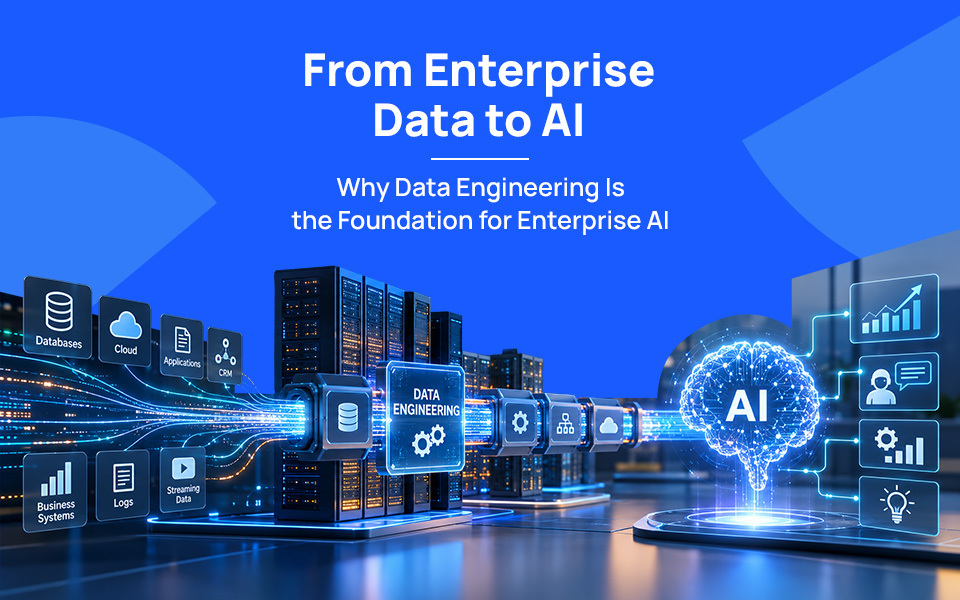
In manufacturing, business information is often scattered across ERP systems, CRM platforms, databases, spreadsheets, applications, and operational equipment. Enterprise AI helps organizations automate workflows, analyze operational data, and make better business decisions. The system requires reliable data. Without reliable information, AI systems can struggle to deliver relevant and consistent results.
This is where Iconflux’s AI data engineering becomes essential. It helps organizations connect, prepare, manage, and deliver enterprise data to use AI applications effectively.
Why Data Engineering Matters for Enterprise AI
Enterprise AI is essential for data that is available, relevant, and sufficiently trustworthy for the intended use case. By combining data from various sources, converting it into formats that are useful, and upholding proper data governance and quality, data engineering establishes the framework.
For instance, a manufacturer may need to integrate machine sensor readings, maintenance logs, equipment specifications, and production schedules to implement predictive maintenance. By connecting these sources, data engineering enables AI models to assess equipment performance using a more comprehensive operational picture.
Even a competent AI model might yield limited or inconsistent results in the absence of this foundation.
The Role of Data Pipelines in AI Applications
Data pipelines transport data from source systems to the platforms where it is utilized, stored, and processed. For example, data extraction, transformation, validation, integration, and delivery.
Data pipelines for LLM applications can prepare enterprise documents and other information for retrieval-based generative AI applications. These pipelines include document parsing, text extraction, chunking, metadata management, indexing, and updates when source data changes.
Building an Enterprise Data Platform for AI
An enterprise data platform is a structured environment for integrating, storing, managing, and accessing information throughout an organization. Depending on the business needs, it may include data lakes, warehouses, lakehouses, integration pipelines, metadata management, and access controls.
This platform is capable of supporting analytics, machine learning, RAG applications, and other Enterprise AI workloads. It also assists organizations in managing data access and ensuring consistency across multiple applications.
For example, a logistics company could combine shipment records, inventory levels, supplier information, and transportation data. AI applications can then use this connected data to help with demand forecasting, inventory planning, and shipment risk analysis.
Connecting Data Engineering with AI Automation
Connecting AI insights to business workflows increases the value of data engineering. While AI workflow automation links those capabilities to current applications and procedures, AI automation can use model outputs to support specified tasks.
For instance, an AI system in manufacturing might use inventory and equipment data to detect a possible production delay. The operations team could be informed, relevant data could be retrieved, and a review task could be created via an integrated workflow.
AI agents can retrieve data, use authorized tools, and carry out specified multi-step tasks within predetermined permissions thanks to more sophisticated agentic workflows. Appropriate data access, monitoring, and human supervision are still necessary for these workflows.
Even though highly automated AI systems are sometimes referred to as “automatic AI,” automation by itself does not ensure dependable results. The evaluation procedures, controls, integrations, and data are still crucial.
Preparing for Scalable Enterprise AI
Before scaling individual use cases, organizations that intend to increase the use of AI should evaluate their data readiness. This entails locating pertinent data sources, enhancing data quality, establishing access guidelines, constructing dependable pipelines, and keeping an eye on data flows.
The objective is to integrate AI applications with business data in a way that meets quantifiable operational requirements. Organizations can strengthen their foundation for production-ready Enterprise AI by investing in data engineering in addition to AI infrastructure, integration, and governance.
Finally, AI generates business value when it can apply the right information to the right workflow. Data engineering enables this by transforming fragmented enterprise information into a reliable foundation for AI-powered operations.