



In the United States, a new lawsuit begins every 30 seconds. This constant legal activity means our financial futures are always at risk. Many of us work diligently to build our wealth. We aim for a secure future and to leave a lasting legacy.
However, without careful planning, just one lawsuit or unforeseen event can destroy years of savings. This exposes our hard-earned assets to significant judgment vulnerabilities. Protecting your financial well-being is key to achieving long-term goals, such as securing reliable retirement income.
This article will guide you through building robust defenses. We will explore essential strategies, from understanding statutory safeguards to creating a multi-layered protection plan. You will learn how to shield your personal estate effectively, especially within the current 2026 economic landscape.
By the end, you will understand how to assess your estate’s current exposure and implement strategies to preserve your wealth.
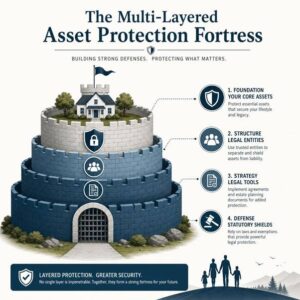
Core Pillars of Financial and Asset Protection
Effective financial and asset protection is not about hiding assets; it’s about smart, proactive structuring that provides risk mitigation, asset segregation, and capital preservation. Our goal is to create a robust framework that insulates your wealth from unforeseen liabilities, ensuring your financial plans remain intact.
Statutory Shields: Exemptions, IRAs, and Homestead Protections
The first line of defense often lies in statutory protections, which are legal provisions designed to safeguard certain assets from creditors. These vary significantly by state and federal law, but understanding them is foundational to any protection plan.
Federally, ERISA-governed retirement accounts, such as 401(k)s, offer strong creditor protection. Individual Retirement Accounts (IRAs) also receive substantial protection under federal bankruptcy law, with an inflation-adjusted cap of $1,711,975 per person (effective April 1, 2025). This means a significant portion of your retirement savings can be shielded from most creditor claims, even outside of bankruptcy.
State laws provide additional layers of protection. Homestead exemptions, for instance, protect a portion of your primary residence’s equity. While some states like Florida offer virtually unlimited homestead protection, others have specific caps. For example, Arizona’s homestead exemption automatically protects up to $425,000 of primary residence equity, and Wyoming’s is up to $100,000 per resident. These exemptions are critical for preserving your family home, but know your state’s specific limits.
Beyond retirement accounts and homesteads, many states also protect the cash value of life insurance policies, certain annuity payments, and even specific types of personal property. By strategically utilizing these statutory shields, we can establish a baseline of protection for some of your most critical assets. This foundational layer is often overlooked but provides a powerful, automatic defense. For those planning their financial future, especially regarding their post-career years, understanding these protections is as crucial as selecting appropriate investment vehicles for reliable retirement income.
Entity Structuring: LLCs and Business Formations for Financial and Asset Protection
Beyond individual exemptions, creating separate legal entities is a cornerstone of asset protection, particularly for business owners and investors. Limited Liability Companies (LLCs) are a popular choice due to their flexibility and the liability protection they offer.
An LLC creates a legal barrier between your personal assets and your business assets. If your business faces a lawsuit, the LLC structure generally protects your personal home, savings, and other personal property from being seized to satisfy business debts. This is known as “limited liability.”
However, the protection an LLC offers isn’t absolute. It primarily shields the owner from business liabilities, not necessarily the LLC’s assets from the owner’s personal liabilities. For this, we look to “charging order protection.” In many states, if a creditor obtains a judgment against you personally, they cannot seize the assets within your LLC. Instead, they can only obtain a “charging order,” which gives them a right to any distributions made from the LLC to you. This makes the LLC interest unattractive to creditors and can encourage settlement.
Series LLCs offer an even more granular level of protection, allowing for the creation of separate “series” or “cells” within a single master LLC, each holding different assets (e.g., individual rental properties) and having its own limited liability. This isolates the risk of one asset from the others. Maintaining the “corporate veil” is paramount; this means adhering to corporate formalities like separate bank accounts, proper record-keeping, and avoiding commingling personal and business funds. Failure to do so can lead to a court “piercing the corporate veil,” exposing personal assets.

Understanding the nuances of different entity structures is vital. Here’s a comparative look at how some common structures function in asset protection:
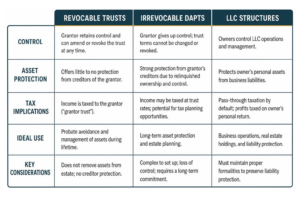
By strategically structuring your investments and businesses through entities like LLCs, we can create robust outer walls for your financial fortress.
Advanced Trusts and Estate Planning for Financial and Asset Protection
For more comprehensive and advanced asset protection, trusts and sophisticated estate planning strategies come into play. While foundational estate planning focuses on wealth transfer, advanced planning integrates creditor protection.
The key distinction for asset protection lies between revocable and irrevocable trusts. A revocable living trust, while excellent for probate avoidance and managing assets during incapacity, offers no creditor protection because the grantor retains control over the assets. Creditors can typically reach assets held in a revocable trust.
Conversely, an irrevocable trust transfers ownership of assets out of your name and into the trust, managed by a trustee for the benefit of designated beneficiaries. Since you no longer legally own the assets, they are generally shielded from your future personal creditors. This “severing of ownership” is the core principle.
Domestic Asset Protection Trusts (DAPTs) are a specialized type of irrevocable trust allowed in over 20 states (including Arizona, Nevada, South Dakota, and Wyoming). DAPTs allow the grantor to be a discretionary beneficiary, meaning they can potentially receive distributions from the trust, while still offering creditor protection after a “seasoning period” (typically 2-4 years). This combines some level of control with strong protection.
For high-net-worth families, dynasty trusts can protect assets across multiple generations, shielding them from beneficiaries’ creditors, divorce, and estate taxes. Spendthrift provisions within trusts prevent beneficiaries from assigning their interest in the trust to creditors, further fortifying the protection.
The federal estate and gift tax exemption of $13.61 million per person is set to sunset on December 31, 2025. This impending change in 2026 creates an urgent window for high-net-worth individuals to consider transferring assets into irrevocable trusts to lock in current exemptions and protect wealth from future estate taxes and creditor claims.
For individuals with extreme liability exposure or those seeking the highest level of creditor deterrence, foreign (or offshore) trusts can be considered. These trusts are established in jurisdictions outside the U.S. with strong asset protection laws, making it significantly more difficult and expensive for U.S. creditors to reach assets. However, they come with increased complexity, reporting requirements, and costs.
Layered Risk Transfer with Insurance Policies
Often overlooked as a primary asset protection tool, insurance is, in fact, the most fundamental layer of defense. It acts as the “moat” around your financial fortress, transferring the financial risk of specific events to an insurance company.
Standard insurance policies (auto, home, business liability) provide basic coverage. However, for most individuals and families, these limits are insufficient to protect against a significant judgment. A single lawsuit resulting in a $2 million judgment could wipe out savings and force the sale of a a home if coverage is inadequate.
This is where umbrella liability insurance comes in. An umbrella policy provides an additional layer of liability coverage above the limits of your primary policies. For high-net-worth individuals, policies offering $5 million to $10 million in coverage are often recommended. This broad coverage extends to various scenarios, from car accidents to incidents on your property, protecting your assets from claims that exceed your underlying policy limits.
For professionals, malpractice insurance is crucial. Business owners also need comprehensive commercial general liability, errors and omissions (E&O), and cyber liability insurance to protect against specific business risks.
The principle here is simple: transfer as much risk as possible to an insurer. While insurance won’t protect against all types of claims (e.g., intentional acts, fraudulent transfers), it’s the most cost-effective way to mitigate common, high-impact liabilities. A well-structured insurance portfolio, tailored to your specific risk profile, is an indispensable component of any asset protection plan. For comprehensive risk assessment and finding the right coverage, consulting with experts who provide personalized insurance solutions is a wise step.
Strategic Implementation: Execution, Order, and Long-Term Maintenance
Building an asset protection plan is not a one-time event; it’s a dynamic process of “fortress planning” that requires careful execution, proper sequencing, and ongoing maintenance. Our approach emphasizes professional coordination and adherence to governance protocols to ensure your defenses remain strong.
The Crucial Role of Timing and Fraudulent Transfer Rules
Timing is arguably the most critical variable in asset protection planning. The effectiveness of many asset protection strategies hinges on when they are implemented relative to a potential creditor claim.
The Uniform Voidable Transactions Act (UVTA), adopted by most U.S. states, allows courts to reverse asset transfers made to “hinder, delay, or defraud” creditors. If you transfer assets into a protective structure after a lawsuit has been filed, or even when a claim is reasonably foreseeable, that transfer can be deemed a “fraudulent conveyance” and unwound by a court. This means the assets would be returned to your estate and made available to creditors.
This is why proactive planning is paramount. Asset protection structures must be established and funded before any threat exists. This “seasoning period” for trusts and entities is essential. For example, Domestic Asset Protection Trusts often have a statutory period (e.g., 2-4 years) during which transfers can still be challenged. Transfers made years in advance, when no specific creditor claim is anticipated, are far more likely to withstand legal scrutiny.
We always advise clients to act when they are solvent and free from current or threatened litigation. Part of this process involves signing solvency affidavits, attesting that the transfer will not render them insolvent. Waiting until you feel exposed or are facing a claim drastically limits your options and increases the risk of any protective measures being voided. The O.J. Simpson matter serves as a stark reminder: while his NFL pension and Florida homestead were protected, transfers made to avoid the wrongful death judgment would have been subject to challenge if not for other statutory protections already in place.
Step-by-Step Asset Protection Roadmap and Common Pitfalls
Implementing a robust asset protection plan requires a systematic approach. Here’s a step-by-step checklist to guide our process, along with common pitfalls to avoid:

Step 1: Identify Your Risk Window. Conduct a thorough assessment of your personal and professional liabilities. Are you a high-risk professional (e.g., physician, lawyer)? Do you own rental properties or businesses with inherent risks? Understanding your exposure is the first step.
Step 2: Inventory What You Own and How It Is Titled. List all your assets (real estate, investments, businesses, intellectual property, cryptocurrency) and meticulously document their current ownership structure. This includes understanding if assets are in your individual name, jointly owned, or held in existing entities or trusts.
Step 3: Rank Assets by Exposure and Importance. Prioritize which assets are most vulnerable and which are most critical to your financial security and legacy. Your primary residence, retirement accounts, and core business assets often fall into the high-importance category.
Step 4: Build from Simple to Complex. Start with foundational protections like adequate insurance and proper asset titling. Then, layer in entities like LLCs for specific assets or businesses. Finally, consider advanced trust structures if your net worth, risk profile, and estate planning goals warrant them.
Step 5: Assemble the Right Team. Asset protection is multidisciplinary. You’ll need a coordinated team including an experienced asset protection attorney, a knowledgeable CPA, a financial advisor, and an insurance professional. Each plays a crucial role in designing and maintaining a comprehensive plan.
Step 6: Review Annually and After Major Life Changes. Your financial situation, family dynamics, and legal landscape evolve. An asset protection plan is not static. We recommend annual reviews and updates after significant life events such as marriage, divorce, birth of a child, starting a new business, or a change in state residency.
Common Pitfalls That Void Asset Protection:
- Waiting Until a Threat Exists: As discussed, this is the biggest mistake, triggering fraudulent conveyance rules.
- Forming an LLC Without Funding It: An empty entity offers no protection. Assets must be legally transferred into it.
- Commingling Personal and Business Funds: This can lead to “piercing the corporate veil,” destroying the limited liability protection of your entities.
- Retaining Too Much Control Over a Trust: For irrevocable trusts to be effective, you must genuinely give up control. Acting as your own trustee or having too many powers can negate protection.
- Using a Revocable Trust for Creditor Protection: Revocable trusts provide zero creditor protection.
- Failing to Coordinate with Your CPA: Tax implications are significant. Your CPA must be involved to ensure compliance and optimize tax efficiency.
- Never Reviewing or Updating the Plan: An outdated plan can become ineffective.
- Relying on a Template or Online LLC Formation: These often lack the specific charging-order protections or state-specific nuances required for robust asset protection.
By meticulously following these steps and avoiding common errors, we can construct a resilient financial fortress designed to safeguard your wealth for generations to come.