


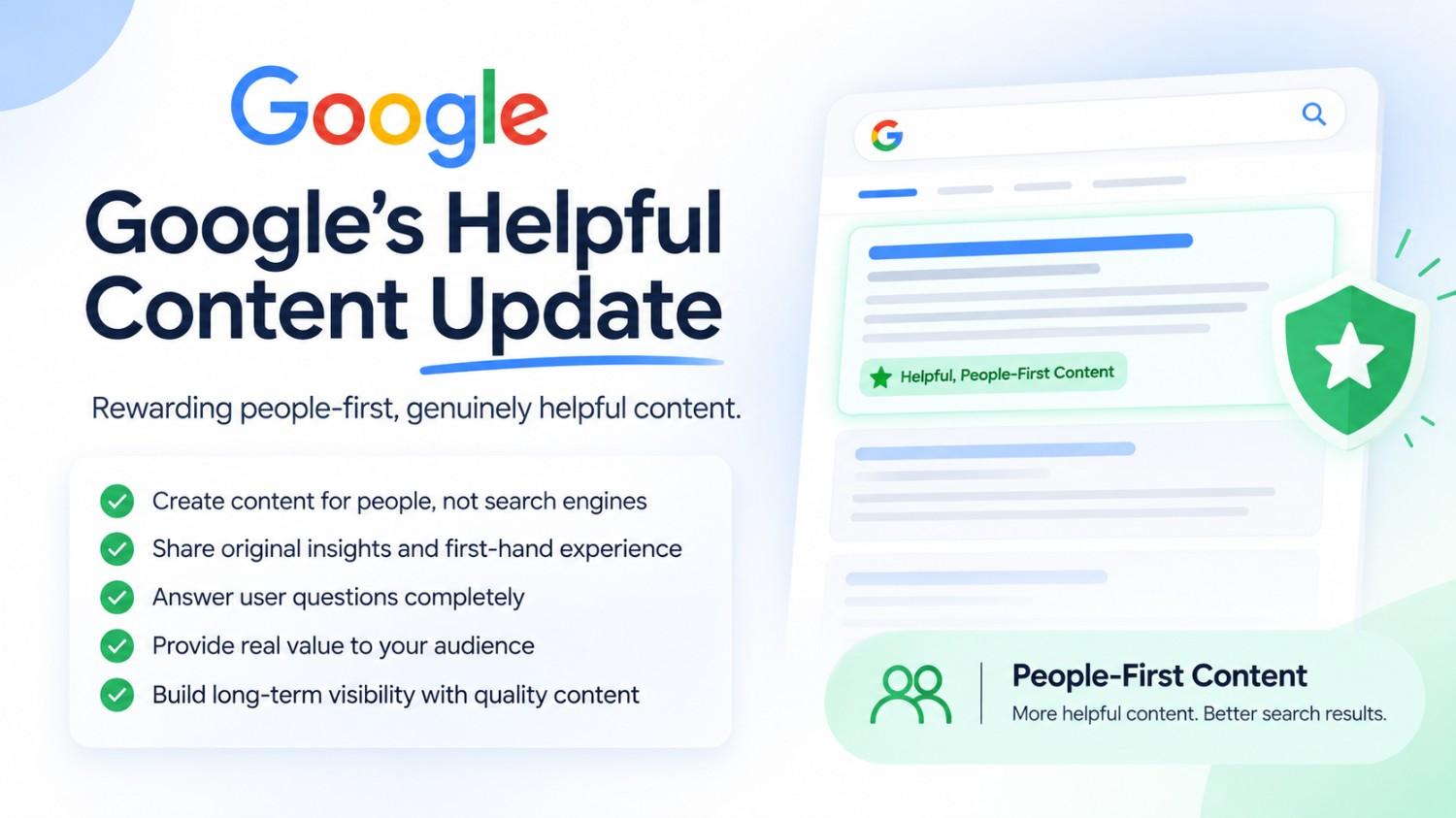
Google’s Helpful Content System Explained: A Deep Guide to People-First SEO
If you work in SEO, content marketing, affiliate publishing, or run a website of any size, you have probably experienced the feeling that Google’s search results are becoming harder to predict.
A page can rank strongly for months and then lose visibility. A content strategy that once produced consistent organic traffic can suddenly become less effective. Publishing more articles does not necessarily produce more traffic, and simply following traditional on-page SEO formulas is no longer enough.
One of the biggest reasons is the evolution of how Google evaluates content quality.
The Helpful Content System, introduced in 2022, was designed to better identify content created primarily to help people rather than content created primarily to attract search-engine traffic. But there is an important historical distinction that many SEO articles now get wrong: the standalone Helpful Content System was incorporated into Google’s broader core ranking systems in March 2024.
Google’s current documentation lists the Helpful Content System as a retired system because it evolved and became part of the core ranking systems.
Google Search ranking systems guide
That change matters.
Understanding the original 2022 Helpful Content Update is useful for historical context, but modern SEO requires understanding the broader principles that Google now applies through its ranking systems: originality, usefulness, first-hand experience, expertise, satisfying search intent, trust, page experience, and the absence of manipulative or scaled content practices.
We built a 50-question self-assessment around those concepts. The goal isn’t to test whether someone remembers obscure Google terminology. It is to test whether they can apply Google’s documented principles to the kinds of content decisions SEO professionals make every day.
Why Helpful Content Became Such an Important SEO Concept
For years, SEO practitioners learned to think in terms of keywords, links, crawlability, technical optimization, and search intent.
Those things still matter.
But Google has increasingly emphasized a different question:
Was this content created primarily to help the person who visits it?
Google’s current guidance explicitly distinguishes people-first content from search-engine-first content. People-first content is designed for an existing or intended audience and should leave visitors feeling that they have learned enough to accomplish their goal.
Google’s official guidance on
Creating Helpful, Reliable, People-First Content
provides a detailed self-assessment framework covering originality, expertise, first-hand experience, audience, page experience, and whether content genuinely satisfies the visitor.
That changes how content strategy should be approached.
Consider two websites targeting the same keyword.
Website A publishes 300 articles because keyword research identified 300 variations with search volume. Many articles repeat information already available elsewhere. The site has little original research, limited first-hand experience, and no particularly strong reason for the audience to choose it over another result.
Website B publishes fewer articles but focuses on a clearly defined audience. Its content includes original examples, practical experience, useful comparisons, expert commentary, data, photographs, testing, and information that helps readers make decisions.
Both websites can perform traditional SEO correctly.
But they are fundamentally different content products.
The second approach is much closer to what Google’s people-first guidance describes.
The Helpful Content System Has Changed
One of the most important facts covered by our assessment is the evolution of the system itself.
Google introduced the Helpful Content Update in 2022. At that time, it was described as a system intended to better ensure that people encountered original, helpful content created for people rather than content primarily created to gain search traffic.
That historical system was subsequently integrated into Google’s core ranking systems in March 2024.
Google’s current Guide to Google Search Ranking Systems explains that the Helpful Content System was announced in 2022 and, in March 2024, evolved and became part of Google’s core ranking systems.
This distinction is important because SEO articles often continue to describe the Helpful Content System as though Google still runs a separate periodic “helpfulness filter.”
That is no longer the best way to understand Google’s documentation.
The better mental model is:
Helpful-content principles → incorporated into Google’s broader ranking systems → evaluated alongside many other signals and systems.
Google also explains that its ranking systems operate at the page level while using site-wide signals and classifiers as part of understanding pages. A site’s overall quality therefore matters, but it would be inaccurate to reduce ranking to a simple site-wide “helpfulness score.”
What Does “Helpful Content” Actually Mean?
Helpful content is not simply content that is long.
It is not content that contains a certain keyword density.
It is not content that has exactly 2,000 words.
And it is not necessarily content written by a human without any AI assistance.
Google’s own self-assessment questions focus on whether content provides original information, substantial coverage, insightful analysis, useful sourcing, expertise, and a satisfying experience.
A useful way to think about helpfulness is through five questions:
1. Does the page solve the visitor’s actual problem?
A page should move the reader toward an outcome.
For example, someone searching:
“best accounting software for a small business”
probably does not want 2,500 words explaining what accounting software is.
They may want:
- pricing
- important features
- limitations
- comparisons
- screenshots
- suitability for different business sizes
- implementation considerations
- real-world experience
- a recommendation based on specific use cases
The page becomes more useful when it helps the visitor make the decision they came to Search to make.
2. Does it provide something beyond what everyone else already says?
This is where originality and information gain become important.
A page that simply rewrites the top ten Google results may technically be well written, but rewriting existing information does not automatically make it valuable.
Google specifically asks creators whether their content provides original information, research, analysis, or substantial additional value compared with other pages.
Originality can come from:
- first-hand testing
- proprietary data
- interviews
- original research
- unique photographs
- experiments
- expert interpretation
- case studies
- new analysis
- practical examples
The objective isn’t to make content artificially different.
It is to make it genuinely useful.
First-Hand Experience Is More Than Saying “I Tested It”
One of the most misunderstood concepts in modern content SEO is first-hand experience.
Adding a sentence such as “We personally tested this product.” does not magically establish first-hand experience.
Readers should be able to understand what was actually done.
For a product review, that might include:
- how long the product was tested
- testing conditions
- what features were evaluated
- photographs of the testing process
- measurements
- observed strengths and weaknesses
- comparisons with alternatives
- problems encountered
- who the product is and isn’t suitable for
For a travel article, genuine experience could include:
- when the location was visited
- what was actually observed
- transportation details
- photographs
- unexpected problems
- practical costs
- accessibility information
- recommendations based on experience
The difference is evidence.
A claim of experience is easy to manufacture.
Demonstrating experience is much harder.
Expertise, Experience, Authority and Trust
The broader concept of E-E-A-T—Experience, Expertise, Authoritativeness and Trustworthiness—is also relevant.
However, one important distinction should be kept clear:
E-E-A-T is not a single public ranking score that a website receives.
Google’s documentation explains that E-E-A-T itself isn’t a specific ranking factor. Instead, Google’s automated systems use a mix of factors that can identify qualities associated with experience, expertise, authoritativeness and trustworthiness.
For publishers, the practical lesson is straightforward.
Make it easier for readers to understand:
- who created the content
- why that person is qualified
- what experience they have
- where important claims came from
- whether the information is current
- how the information was produced
- why the publisher should be trusted
This is particularly important for topics where incorrect information can cause significant harm.
Search Intent Is Still Fundamental
Helpful content cannot be separated from search intent.
Imagine someone searches:
“how much does a website cost?”
There are many possible interpretations.
They might want:
- a basic website
- an ecommerce website
- a custom web application
- an agency quote
- a freelancer’s pricing
- hosting costs
- domain costs
- ongoing maintenance
A page that provides a generic definition of “website” is unlikely to satisfy that searcher.
A useful page would recognize the decision behind the query and provide the information needed to make that decision.
This is why simply matching keywords is not enough.
The question isn’t:
“Did I mention the keyword enough?”
It is:
“Did I actually satisfy the reason someone searched for this?”
Word Count Is Not a Quality Signal by Itself
One of the easiest SEO myths to identify is the idea that Google prefers a particular word count.
Google explicitly addresses this in its people-first guidance and asks publishers whether they are writing to a particular word count because they have heard Google has a preferred number.
The answer is no.
A 700-word article can be dramatically more useful than a 4,000-word article.
The correct question is not:
“How long should this article be?”
It is:
“How much information does the reader need to accomplish the goal?”
If the answer requires 500 words, write 500.
If it requires 5,000 words of genuinely useful information, write 5,000.
Adding paragraphs merely to reach a supposed SEO word-count target can make the page worse.
What About AI-Generated Content?
This is one of the most important areas for modern publishers.
A simplistic statement such as:
“Google penalizes AI content.”
is not an accurate representation of Google’s published guidance.
Google’s guidance focuses on the quality, usefulness and purpose of the resulting content, rather than treating the production method alone as the deciding factor.
Google’s documentation on
Google Search’s Guidance on Generative AI Content
emphasizes accuracy, quality and relevance when creating automatically generated content.
The distinction is therefore not simply:
Human = good
AI = bad
A more useful distinction is:
Useful, original, reviewed content = potentially valuable
Mass-produced, unoriginal content created primarily to manipulate rankings = risky
For example, AI might legitimately help a publisher:
- brainstorm an outline
- organize research
- summarize internal notes
- generate code
- identify questions that need investigation
- improve readability
- create a first draft that is then heavily researched and edited
But publishing thousands of lightly edited AI pages that repeat information already available across the web is a completely different strategy.
Scaled Content Abuse: Quantity Can Become the Problem
The emergence of AI has made scaled publishing dramatically easier.
A publisher can theoretically create thousands of pages targeting:
- every city
- every product variation
- every keyword variation
- every question
- every long-tail query
- every combination of attributes
But scale itself is not the fundamental issue.
The important question is whether those pages provide genuine value.
Google’s
Spam Policies for Google Web Search
define scaled content abuse as creating many pages primarily to manipulate Search rankings rather than help users. Google’s documentation makes clear that this can apply regardless of whether the content is produced by AI, humans, automation, or a combination of methods.
That creates an important strategic distinction:
Programmatic SEO can be useful.
Programmatic SEO whose primary purpose is mass-producing low-value search pages can become spam.
A database containing genuinely useful local information, for example, can produce thousands of pages if every page offers unique and useful information.
The problem isn’t simply the number of URLs.
The problem is the value those URLs provide.
Site Reputation Abuse Also Matters
Another concept publishers need to understand is site reputation abuse.
The basic problem occurs when third-party content is published on a site primarily to exploit the host site’s existing ranking signals or reputation rather than to serve the site’s audience.
Google introduced site reputation abuse as one of the new spam policies announced alongside its March 2024 core update.
For publishers, the broader lesson is that a website should have a coherent reason for existing.
If a website is known for one subject and suddenly publishes large amounts of unrelated commercial content solely because the domain has accumulated search authority, that deserves scrutiny.
The question becomes:
Does this content genuinely belong on this website for its audience?
That is a much better strategic question than simply asking whether the page has enough backlinks.
Thin Content Is Not Just “Short Content”
“Thin content” is another phrase that gets used too loosely.
A short page isn’t automatically thin.
A 300-word page that completely answers a narrowly defined question may be excellent.
A 3,000-word article can still be thin if most of those words simply repeat generic information.
The real problem is lack of meaningful value.
Ask:
- Does the page add anything new?
- Does it answer the actual question?
- Does it provide evidence?
- Does it demonstrate experience where experience matters?
- Does it help the visitor take the next step?
- Does it leave important questions unanswered?
- Would the reader still need to search again immediately?
Content Pruning Is Not a Magic Recovery Button
Another common SEO misconception is:
“Delete lots of old pages and Google will reward the site.”
Google’s guidance does not support such a simplistic formula.
Removing content can be appropriate when pages are genuinely obsolete, duplicative, misleading, irrelevant, or provide little value.
But mass deletion simply to make a website appear “fresh” is not a guaranteed ranking strategy. Google’s people-first documentation specifically warns against adding or removing large amounts of content primarily because you believe it will make the site seem fresh to search engines.
Content decisions should therefore be based on usefulness and business purpose.
Instead of asking:
“How many pages should we delete?”
ask:
“Which pages are failing our audience, and why?”
That produces a much better audit.
What Should You Do After a Ranking Drop?
A ranking decline after a core update can be alarming, but the correct response is not necessarily to start changing everything.
Google’s core-update guidance emphasizes continuing to focus on satisfying, people-first content rather than looking for a special optimization specifically for a particular update.
Step 1: Identify the affected pages
Look at:
- clicks
- impressions
- queries
- rankings
- traffic trends
- affected content categories
- pages that remained stable
Don’t assume the entire site has the same problem.
Step 2: Look for patterns
Did the largest declines occur among:
- AI-assisted articles?
- affiliate pages?
- location pages?
- product reviews?
- informational articles?
- programmatic pages?
- outdated content?
- pages without original research?
Patterns are more informative than isolated ranking changes.
Step 3: Compare the content with competing results
Ask:
- What does the competitor provide that you don’t?
- Is their information more current?
- Do they have first-hand experience?
- Do they show original evidence?
- Are they more comprehensive?
- Is their page easier to use?
- Does their content better match the searcher’s intent?
Step 4: Improve the actual content
Don’t merely change:
- title tags
- headings
- keyword density
- publication dates
- word count
Improve the substance.
Step 5: Evaluate the site as a whole
Look beyond individual pages.
Does the website have a clear purpose?
Is the content coherent?
Are there large amounts of low-value material?
Does the site demonstrate genuine expertise?
Would a first-time visitor understand why this site deserves to exist?
Page Experience Still Matters
Helpful content does not mean ignoring usability.
A brilliant article can still create a poor experience if the visitor arrives at a page that is:
- overloaded with intrusive elements
- difficult to navigate
- slow
- poorly formatted
- difficult to read on mobile
- dominated by advertising
- unclear about the main content
Google’s current people-first documentation includes page experience among the broader considerations for creating helpful content.
The content and the experience should therefore be considered together.
A useful article should also be usable.
Our 50-Question Assessment
The assessment is divided into five difficulty levels.
Beginner — Questions 1–10
These questions establish the foundation:
- What does people-first content mean?
- What is search intent?
- Why does first-hand experience matter?
- What separates readers-first content from search-engine-first content?
- Why isn’t keyword optimization enough?
The goal is to establish the central philosophy behind Google’s guidance.
Easy / Intermediate — Questions 11–20
These questions move into practical content-quality evaluation:
- demonstrating expertise
- comprehensive coverage
- originality
- page usability
- trust
- site reputation abuse
- identifying content that looks optimized primarily for search engines
At this level, the challenge becomes less about definitions and more about recognizing quality signals in realistic examples.
Intermediate — Questions 21–30
These questions cover issues publishers encounter in real-world SEO:
- scaled content abuse
- AI-assisted content
- thin content
- content pruning
- unsatisfying pages
- mass-produced content
- content that ranks but fails to satisfy the visitor
These scenarios require understanding the difference between a tactic and its underlying purpose.
Advanced — Questions 31–40
The advanced section focuses on Google’s system-level evolution:
- the 2022 Helpful Content Update
- the March 2024 transition
- core ranking systems
- site-wide signals and classifiers
- recovery analysis
- broader content-quality evaluation
This section is particularly useful for SEO professionals who learned about Helpful Content several years ago and have not revisited the underlying documentation.
Expert — Questions 41–50
The final section focuses on judgment.
Topics include:
- information gain
- authentic first-hand experience
- AI-assisted publishing
- scaled content
- originality
- content strategy
- site-wide quality
- distinguishing useful automation from search manipulation
There often isn’t a simple “SEO trick” that solves these questions.
The challenge is deciding what would actually help a visitor.
We Also Designed the Quiz to Test Knowledge, Not Guessing
A multiple-choice quiz can accidentally become a pattern-recognition exercise.
If the correct answer is always option B, someone can score surprisingly well without understanding the subject.
That’s why we included an answer-distribution check behind the scenes.
The questions are also scenario-oriented wherever possible.
Instead of asking:
“What is helpful content?”
a stronger question might present two publishing strategies and ask which one is more consistent with Google’s people-first guidance.
That reflects how SEO decisions actually work.
In practice, you rarely encounter a pop-up saying:
“This page has failed the Helpful Content Test.”
You have to evaluate the evidence and make a judgment.
What We Deliberately Did Not Claim
There is a lot of misinformation surrounding Google’s algorithms.
We deliberately avoided turning uncertain concepts into fake certainties.
“Google gives every site a helpfulness score.”
There is no publicly documented score that publishers can look up and optimize against.
Google describes many ranking systems, signals, and classifiers rather than a single public “helpfulness score.”
“Longer articles rank better.”
Google explicitly says it does not recommend writing to a particular word count simply because someone claims Google has a preferred word count.
“AI content is automatically penalized.”
That is an oversimplification.
Google’s guidance focuses on the value and purpose of the content. AI-assisted content can be useful, while large-scale automated content created primarily to manipulate rankings can violate spam policies.
“Delete 50% of your website to recover.”
There is no universal recovery formula like this.
Content removal should be based on actual content quality, relevance, duplication, usefulness, and audience needs.
“Every ranking drop means you received a penalty.”
Not necessarily.
A core update can change the relative performance of many pages because Google’s systems have changed their assessment of search results. A decline should therefore be investigated rather than automatically interpreted as a manual penalty.
The Bigger Lesson: Start With the Audience, Not the Keyword
The most important principle behind the entire assessment is simple:
Helpful content is not something you add after writing an SEO article. It is the reason the article exists.
If the process starts with:
“What keyword can we rank for?”
the strategy can easily become search-engine-first.
A stronger process starts with:
“Who is this for, what are they trying to accomplish, and what can we provide that genuinely helps?”
Then SEO becomes an amplifier rather than the purpose.
That means researching the audience, understanding the problem, finding unanswered questions, adding original experience, performing real research, providing evidence, making the information easy to use, and being honest about what the publisher actually knows.
How to Think About Your Content Strategy in 2026
The modern content strategy is less about producing the maximum number of URLs and more about maximizing the value of each useful page.
Before publishing, ask:
- Audience: Who specifically needs this?
- Intent: What are they trying to accomplish?
- Experience: What can we add from genuine experience?
- Originality: What information, research or analysis isn’t already everywhere?
- Evidence: Can important claims be supported?
- Expertise: Who created or reviewed the content?
- Completeness: What would the visitor still need to search for afterward?
- Usability: Can the information be understood and acted upon easily?
- Purpose: Would we still create this page if Google did not exist?
That final question is particularly powerful.
If the answer is yes, you’re probably thinking in the right direction.
If the answer is no, and the only reason for creating the page is to capture a keyword, generate traffic, or exploit a ranking opportunity, it is worth reconsidering the strategy.
How to Read Your Quiz Results
90–100% — Expert
You understand both the historical development of Google’s Helpful Content approach and the modern principles surrounding people-first content, originality, experience, AI-assisted publishing, and core ranking systems.
75–89% — Advanced
You have a strong understanding of the fundamentals and practical SEO implications, but some of the more nuanced system-level scenarios may need additional study.
60–74% — Intermediate
You understand the basic philosophy and terminology. The advanced scenario questions are likely to be the most valuable part of the review process.
Below 60% — Beginner
This is a starting point rather than a failure.
The review section is designed to make every incorrect answer useful. Instead of simply showing which option was correct, each question explains the underlying concept so you can understand why the answer matters.
Final Takeaway
Google’s Helpful Content System is best understood not as an old standalone algorithmic filter, but as part of the broader evolution of Google’s ranking systems toward identifying useful, reliable, original and people-first content.
The historical timeline matters:
- 2022: Google introduced the Helpful Content Update.
- 2023: Google expanded its guidance around helpful content, experience, AI-generated content and page experience.
- March 2024: Helpful-content-related capabilities evolved into and became part of Google’s core ranking systems.
- Today: Publishers should focus less on optimizing for a standalone “Helpful Content score” and more on creating content that satisfies users, demonstrates appropriate experience and expertise, provides original value, and avoids manipulative or scaled publishing practices.
The practical lesson is straightforward:
Don’t ask only, “Can this page rank?”
Ask:
“If Google sent me no traffic at all, would I still be proud that this page exists for my audience?”
If the answer is yes, you’re building something with genuine value.
If the answer is no, changing the title, adding keywords, increasing the word count, or publishing ten more similar pages probably isn’t going to solve the underlying problem.
The strongest SEO strategy is increasingly the same strategy that produces the strongest website:
Understand the audience. Solve the problem. Add something original. Demonstrate real expertise. Make the information trustworthy and usable.
That’s what people-first content is ultimately about.
Authoritative Google Resources
-
Creating Helpful, Reliable, People-First Content
— Google’s guidance on content quality, first-hand experience, E-E-A-T, audience focus and search-engine-first content. -
A Guide to Google Search Ranking Systems
— Google’s documentation explaining the evolution of its ranking systems and the transition of the Helpful Content System into core ranking systems. -
Spam Policies for Google Web Search
— Google’s official policies covering scaled content abuse, site reputation abuse and other practices that can violate Search policies.
This is an independent educational resource and is not affiliated with, endorsed by, or sponsored by Google. The article is based on Google’s publicly available Search Central documentation and guidance. Google’s documentation can change over time; readers should consult the official sources above for the latest information.