


When a Boston medical device startup needed functional prototypes for FDA submission, injection molding quotes shocked them: $85,000 tooling, 8-week lead time, 500-piece minimum. Their timeline allowed 3 weeks maximum, budget capped at $15,000, and they needed only 12 test units.
They switched to custom CNC parts. Results: 12 functional prototypes delivered in 11 days at $9,600 total cost ($800/piece), enabling on-schedule FDA submission. Six weeks later, design iteration required modifying wall thickness—CAD update completed overnight, revised parts delivered in 8 days at $8,400 (no tooling penalty). Total investment: $18,000 vs $85,000+ injection molding, 19 days vs 56+ days timeline.
This pattern repeats across hardware development where custom CNC machining enables rapid iteration, design flexibility, and faster market entry without tooling constraints. This guide uses February 2026 industry data, cost comparisons, and strategic frameworks explaining how custom machining accelerates product development.
What Custom Machined Parts Are and Why They Matter
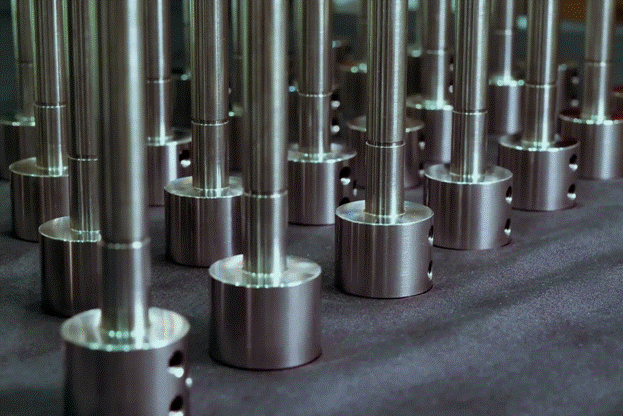
Custom CNC parts are components manufactured using computer numerical control machines that precisely remove material from solid stock following digital CAD models. Unlike molding/casting requiring dedicated tooling, CNC machining produces parts directly from CAD files through subtractive manufacturing.
Process types: 3-axis milling (face milling, contouring, drilling), 4-axis machining (rotary indexing), 5-axis machining (simultaneous multi-axis motion for complex geometry), CNC turning (cylindrical parts, shafts, bushings), Swiss-type machining (precision small parts).
Key advantage: Zero tooling investment enables design changes without cost/time penalties—critical for iterative development, low-volume production, and specialized components.
How Custom CNC Machining Accelerates Product Development
1. Rapid Prototyping Without Tooling Delays
Traditional development cycle (injection molding):
- Week 1-2: Design completion, tooling quote approval
- Week 3-8: Mold manufacturing
- Week 9-10: First shots, dimensional verification
- Week 11-12: Mold corrections if needed
- Total: 12+ weeks to first functional prototype
Custom CNC machining cycle:
- Day 1: CAD submission, quote approval
- Day 2-3: Programming, material procurement
- Day 4-8: Machining, inspection
- Day 9-10: Delivery, assembly
- Total: 10 days to functional prototype
Iteration advantage: Design change requires CAD update only (1-2 days new parts) vs mold modification (3-6 weeks, $15K-$40K).
Case study: Automotive sensor housing development (November 2025)
Application: Electric vehicle thermal sensor housing, aluminum 6061-T6, 15 prototypes for validation testing Traditional approach estimate: $42,000 tooling, 9-week lead time Custom CNC approach: $18,900 (15 parts @ $1,260/piece), 12-day delivery Mid-development change: Wall thickness optimized after thermal testing
- Traditional cost: $8,500 mold modification, 4-week delay
- CNC cost: $0 tooling, $17,400 revised parts (15 @ $1,160), 9-day delivery Total savings: $42,000 + $8,500 – $36,300 = $14,200 plus 7-week timeline advantage
2. Design Flexibility Enabling Optimization
Tooling-based manufacturing constraints:
- Draft angles required (1-5° typical for mold release)
- Uniform wall thickness preferred (avoiding sink marks)
- Undercuts expensive/impossible (require complex cores)
- Sharp internal corners prohibited (stress concentration in molds)
CNC machining freedom:
- Zero draft angle requirement (features parallel to axis)
- Variable wall thickness achievable (weight optimization)
- Complex internal geometry possible (5-axis machining)
- Sharp corners, deep pockets, intricate features standard
Performance impact: Aerospace bracket redesigned for CNC manufacturing achieved 34% weight reduction through internal lightening pockets impossible with casting—direct fuel savings over component lifetime exceeded manufacturing cost difference.
3. Precision Tolerances Improving Product Performance
Tolerance capability comparison:
- Standard CNC machining: ±0.005″ (±0.13mm)
- Precision CNC machining: ±0.001″ (±0.025mm)
- Ultra-precision (climate controlled): ±0.0002″ (±0.005mm)
Application examples requiring tight tolerances:
- Medical surgical instruments: ±0.001″ for mating surfaces
- Aerospace structural components: ±0.002″ for assembly alignment
- Semiconductor equipment: ±0.0005″ for optical positioning
- Automotive transmission parts: ±0.001″ for bearing fits
Performance benefits: Precise tolerances reduce vibration, friction, wear; improve assembly reliability; extend component lifespan; eliminate secondary fitting operations.
4. Material Versatility Supporting Innovation
Machinable materials enabling application-specific optimization:
Metals: Aluminum (6061, 7075 aerospace), stainless steel (303, 316 corrosion resistance), titanium (Ti-6Al-4V strength/weight), brass (electrical/thermal), copper (conductivity), tool steel (hardness).
Engineering plastics: PEEK (high temperature, biocompatible), Delrin (low friction), UHMW (wear resistance), polycarbonate (impact strength), ABS (prototyping).
Exotic alloys: Inconel (high temperature), Hastelloy (corrosion), beryllium copper (conductivity + strength).
Strategic advantage: Material selection optimized for actual requirements vs limited options in molding/casting.
Choose custom CNC machining when:
- Volume <200 pieces annually
- Design iteration expected (product development phase)
- Multiple part variations required
- Time-to-market critical (weeks matter)
- Tight tolerances essential (±0.001-0.005″)
- Complex geometry requires 5-axis capability
- Material flexibility needed
Strategic Partnership for Development Success
Custom CNC machining effectiveness depends heavily on supplier expertise. Superior partners provide:
Design for manufacturability analysis: Identifying features increasing cost/time, suggesting optimizations maintaining performance while reducing manufacturing complexity.
Material recommendations: Matching alloy/grade to application requirements (strength, corrosion, weight, cost).
Tolerance rationalization: Applying tight tolerances only where functionally critical, relaxing non-critical dimensions reducing cost 20-40%.
Production planning: Transitioning from prototyping through low-volume production to high-volume manufacturing methods when volumes justify tooling investment.
Companies like FastPreci exemplify this integrated approach, combining advanced multi-axis CNC capabilities with engineering expertise guiding material selection, tolerance optimization, and development strategy—particularly valuable when complex parts require both precision machining and strategic manufacturing planning accelerating market entry.
Lead Time Expectations and Planning
Typical custom CNC timelines (Feb 2026):
- Simple parts (2-3 operations): 5-8 business days
- Moderate complexity (4-6 setups): 8-14 days
- Complex geometry (5-axis, multiple setups): 12-20 days
- Exotic materials (titanium, Inconel): +3-7 days material procurement
- Rush service (expedited): 3-5 days at 60-100% premium
Planning recommendation: Request quotes for both standard and expedited timelines—premium often justified by market timing value.
FAQs: Custom CNC Parts for Product Development
What are custom machined parts?
Components produced via CNC machines from CAD models by removing material, enabling prototypes and low-volume production without tooling costs.
How much do custom CNC parts cost?
Costs vary widely: simple parts $25–$150, complex parts $500+. Larger quantities significantly reduce per-piece pricing.
How long does custom CNC machining take?
Typical lead time is 5–15 business days depending on complexity, with expedited services available in about 3–5 days.
What tolerances can custom machining achieve?
Standard tolerances are around ±0.005″. Precision machining can reach ±0.001″ or tighter with advanced equipment.
What is minimum order quantity for custom parts?
No minimum order. CNC machining allows single prototypes up to small production runs efficiently.
How do I get quote for custom machined parts?
Submit CAD files, material, quantity, tolerances, finish requirements, and timeline. Suppliers usually provide quotes within 24–48 hours.
Custom Machining as Competitive Advantage
Custom CNC parts transform product development from linear tooling-constrained process into agile iterative optimization enabling faster innovation, design flexibility, and confident market entry. Zero tooling investment, rapid turnaround (days vs months), and design change freedom allow companies to prototype extensively, validate thoroughly, and launch successfully.
Custom CNC machining suits development phases, specialized applications, and volumes where flexibility and speed outweigh per-piece cost considerations. Strategic suppliers guide material selection, tolerance optimization, and manufacturing planning maximizing both development efficiency and product performance.
What product development challenge is preventing confident progress—tooling cost barriers, iteration timeline constraints, or design flexibility limitations?