

Best College Football Prediction Market Apps and Platforms
College football markets now trade on several regulated U.S. platforms, and each one lists them a little differently.
Some lead with game-day markets on the winner, the margin and the combined score. Others lean on season-long contracts such as playoff spots and conference titles.
Following a season one result at a time, the way fans tracked a local high school team’s early-season turnaround this fall, maps neatly onto how these markets reprice week to week.
This guide covers five platforms that list college football event contracts, starting with how those contracts are priced and settled. Each entry follows the same format so the platforms can be compared side by side. Details reflect each platform’s public pages and published reporting as of October 2026.
Key Takeaways
- A college football event contract is a yes/no position priced below $1 that settles at $1 if correct and $0 if not, under the market’s stated rules.
- Game markets usually cover the winner, the margin of victory and the combined score. Season markets cover playoff spots, conference titles and the national championship.
- Profit is the $1 settlement minus the purchase price and fees, so a settlement value is not the same as a gain.
- Availability, fees and market menus differ by platform and by state, so check each one before placing an order.
How College Football Event Contracts Are Priced
Every contract asks a yes/no question about a defined outcome. If the outcome happens, the YES side settles at $1 and the NO side settles at $0. Before settlement, the price moves between those two values as traders buy and sell.
A price works as the market’s estimate of an outcome’s chances. A YES contract at 62 cents implies roughly a 62% chance. That estimate can be wrong, and the two sides together can add up to slightly more than $1 because of the gap between buying and selling prices.
Here is the math on a hypothetical order of 100 YES contracts at 62 cents:
- Cost: $62, plus trading fees
- If correct: the position settles at $100, a gain of $38 before fees
- If incorrect: the position settles at $0, and the $62 plus fees is lost
College football game boards usually group contracts into three types:
- Moneyline: the team that wins the game outright, whatever the margin.
- Spread: whether a team wins by more than a set number of points. A contract on Team A at -6.5 settles YES only if Team A wins by 7 or more.
- Total: whether the combined score finishes over or under a set number. At 53.5, the over needs 54 or more combined points.
Half-point numbers leave no room for an exact tie. Whole-number spreads and totals can land exactly on the number, and each platform’s rules decide how that case settles.
Five Platforms That List College Football Event Contracts
Each entry covers the same three points: what the platform lists, one detail worth knowing, and what to confirm before trading.
1. Fanatics Markets
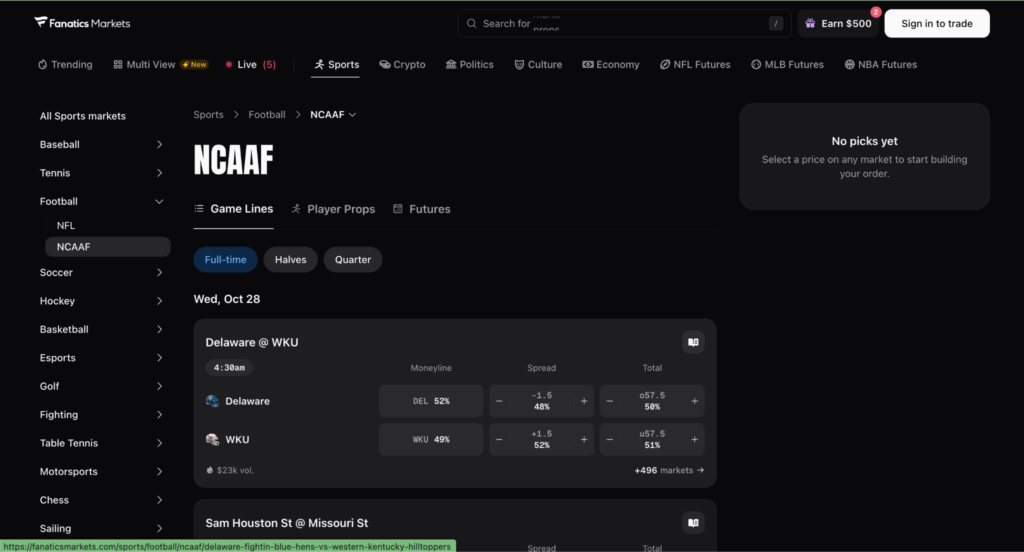
Coverage: The Fanatics Markets college football betting lines page organizes NCAAF markets under Game Lines, Player Props and Futures, with full-game, half and quarter views. Each game card carries Moneyline, Spread and Total markets. On October 27, 2026, the board ran from midweek games through a Saturday slate that included Florida vs. Georgia and Ohio State vs. USC.
Worth knowing: Game cards frame each side around a $100 position rather than a per-contract price. Combo orders are priced through a request-for-quote process that sends the order to liquidity providers.
Check first: Open the market rules to confirm how halves, quarters and overtime are treated before choosing a period.
2. Kalshi
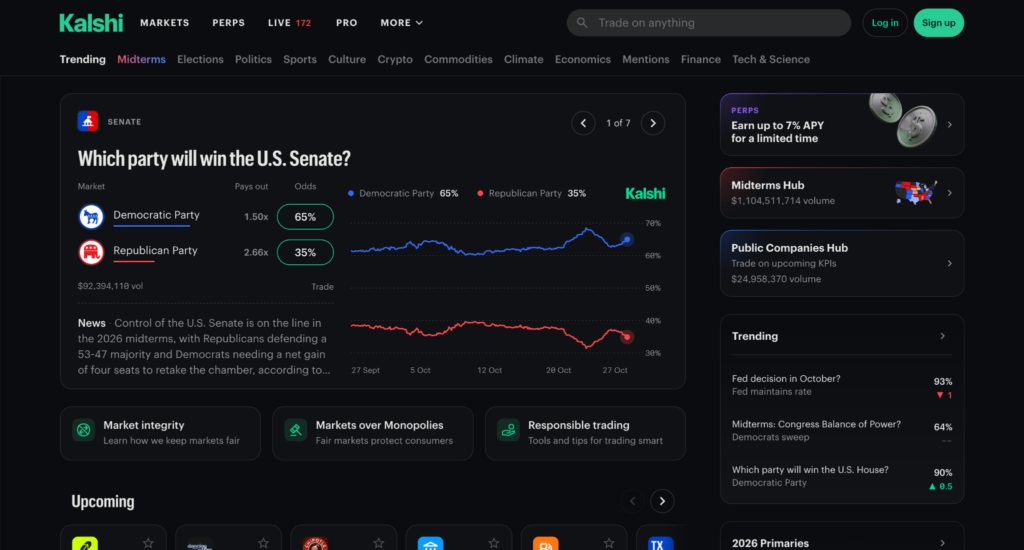
Coverage: Kalshi lists individual game contracts alongside season-long boards. Its College Football Playoff qualifier event carries 50 separate yes/no team contracts, each paying $1 if that team earns a spot in the 12-team field.
Worth knowing: Prices display as bid and ask in cents. Aldrin Research data reported by Covers showed Kalshi handling $582.1 million of college football volume across the four days of Week 1 in 2026.
Check first: Thinly traded contracts can show a wide gap between bid and ask, so compare both before placing an order.
3. Polymarket
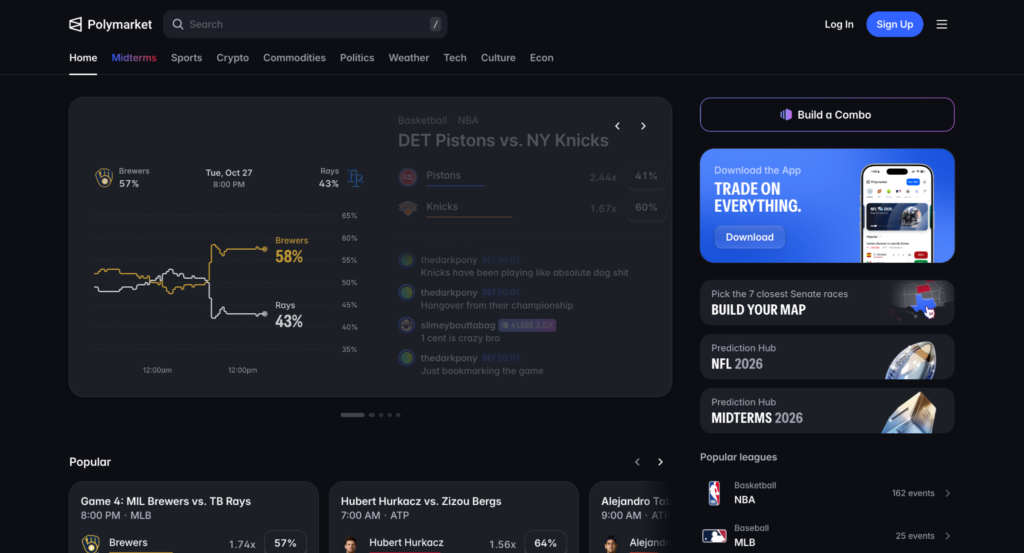
Coverage: Polymarket serves U.S. users through an app tied to its CFTC-regulated U.S. exchange and clearing organization, and it lists college football game markets during the season.
Worth knowing: Its U.S. return followed the $112 million acquisition of QCEX, a CFTC-registered exchange and clearinghouse. Covers reported $58.7 million in Polymarket college football volume across Week 1, second among the platforms tracked.
Check first: Access varies by state, so confirm availability in the app before funding an account.
4. FanDuel Predicts
Coverage: FanDuel Predicts launched on December 22, 2025 with CME Group and lists college football contracts this season. Sports contracts are offered only in states where online sports wagering is not yet legal.
Worth knowing: Contracts trade between $0.01 and $0.99. FanDuel has said it will stop offering sports contracts in a state once that state legalizes online sports wagering.
Check first: Because the sports menu depends on state law, confirm which markets appear for your location.
5. Robinhood
Coverage: Robinhood added pro and college football markets to its prediction markets hub on August 19, 2025, through Robinhood Derivatives and its partnership with Kalshi.
Worth knowing: The launch covered all Power 4 schools and independents, and the hub sits inside the same app many customers use for stocks and crypto.
Check first: Confirm the current list of covered games, since the launch announcement named only Power 4 schools and independents.
What to Check Before Placing an Order
Market wording. Read the named outcome before the price. Confirm whether the contract covers the full game or a single half or quarter, whether overtime counts, and what happens if the game is postponed or canceled.
Settlement source. Contracts settle on the official result under each market’s rules. In Week 1 of 2026, Covers reported that one platform paid out Western Michigan positions before the market was officially settled, then had to reimburse Michigan traders after a final-second touchdown decided it.
Fees on both sides. Trading fees apply when buying and can apply again when selling before settlement. Some platforms charge per contract and others a percentage, and schedules change, so check the estimate in the order window each time.
Location. Sports contracts are available in some states and not others, and the list can change. Confirm access for your location before depositing.
Personal limits. Set a spending limit before the first order. Platforms in this space commonly offer deposit limits, timeouts and self-exclusion settings, and any contract can settle at $0.
Conclusion
College football event contracts follow one core structure across these five platforms: a yes/no price below $1 that settles at $1 or $0. What changes from one platform to the next is the market menu, how prices are displayed, how fees are charged and where sports contracts are offered.
Start with the outcome you want to follow, read the contract wording, and compare the full cost including fees. Then confirm the platform serves your state before placing the first order.
FAQ
What does a college football event contract price mean?
It is the market’s current estimate of an outcome’s chances, shown as a price below $1. A 40-cent YES contract implies roughly a 40% chance and settles at $1 if the outcome happens.
How does a spread contract settle?
It settles on the final margin. A contract on a team at -3.5 settles YES only if that team wins by 4 or more points.
Can a position be sold before the game ends?
On most platforms, yes, if another trader takes the other side at an acceptable price. Selling early can lock in a gain or limit a loss, and a fee may apply.
Are these platforms available in every state?
No. Each platform publishes its own list of states, and some restrict sports contracts in states with licensed online sports wagering. Check the platform’s availability page for your location.