


A written policy has two audiences with incompatible requirements, and most policies are optimised for only one of them.
The first audience is whoever examines the document after something goes wrong: an inspector, an insurer, a solicitor, a client’s procurement team. That reader wants precision, completeness and unambiguous wording, and rewards a document that anticipates every edge case. The second audience is the person who has to follow the policy on a Tuesday morning. That reader wants to know what to do, and stops reading somewhere in the second paragraph.
Almost every policy in circulation is written for the first reader, because the consequences of failing that reader are immediate and expensive. The consequences of failing the second reader show up later and get attributed to something else.
The gap is structural, not a writing problem
This is not solved by writing more clearly. The two purposes genuinely conflict.
Precision requires qualifying clauses. A sentence stating that a permit is required for work above a specified height, except where a proprietary access system is in use and the manufacturer’s inspection record is current, is precise and defensible. It is also close to unreadable at the point of use.
Completeness requires covering rare cases. A document that spends equal space on the common situation and the situation that arises twice a year gives the reader no sense of what usually matters.
Formal register signals seriousness to the first reader and creates distance for the second. A document that reads as though it were drafted for a tribunal is one the workforce treats as an artefact rather than as instructions.
Organisations respond by producing a summary, a toolbox talk or a poster. Those work, and they introduce a maintenance problem: the derived version drifts from the policy, and nobody notices until the drift matters.
What a video version actually changes
The change worth understanding is not that video is more engaging. It is that video forces a decision the written policy avoids.
Narration is linear and has a duration, so producing it requires deciding what comes first, what gets three sentences and what gets one. A written policy can defer all of that by using headings and letting the reader sort it out. Anyone converting a policy into narration has to state the priority explicitly, and that act frequently reveals that nobody had agreed on it.
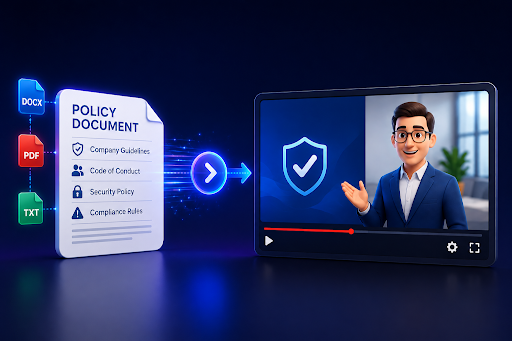
Platforms that turn written policies into video take the document as the source, generate an outline and narration from it, and produce a sequence of scenes. Leadde accepts Word, PDF, PowerPoint and plain text, and exposes three context fields that change the output substantially: the audience, the speaker’s background and the training objective. Left blank, the narration addresses nobody in particular. Filled in specifically, for example a subcontractor on their first day at a site who does not yet know the internal terminology, the narration defines terms before it uses them.
Register is also selectable. Leadde offers Formal, Neutral, Objective, Structured, Analytical, Explanatory, Narrative and Persuasive, and policy content is usually served by Explanatory or Structured. Formal reproduces exactly the distance that made the original document hard to use.
The approval chain does not get shorter
A generated script is a paraphrase of an approved document, and paraphrase is where the risk sits.
Automatic summarisation strips conditions before it strips anything else, and in policy text the condition frequently carries the obligation. A sentence specifying that authorisation is required above a threshold can lose the threshold and become a blanket requirement, or lose the requirement and become a general permission. Both versions read fluently. Both are wrong, and the second is worse than having no video.
The practical consequence is that whoever approved the policy has to approve the script, in writing, before generation. Organisations that skip this because the tool made the first draft cheap end up with an approved document and an unapproved recording that contradicts it.
The document remains the authoritative version
This needs stating inside the video itself, not only in an internal procedure.
The video is a derived output. When the policy changes, the video is wrong, and nothing about the video announces that. A confident recording describing a superseded procedure is more damaging than a stale paragraph, because recorded speech attracts less scepticism than text with an old revision date.
Two practices contain this. The policy stays the single source, so corrections are made once and the video is regenerated rather than edited. A review interval is set before a library is built rather than after, since an unreviewed library becomes a set of assured recordings that are quietly out of date.
Version handling is worth setting up early. Duplicating an existing video to produce an amended version, rather than editing the original, keeps the superseded recording available for the period during which someone may have acted on it. Where a policy applies to staff working in more than one language, a finished video can be translated with the on screen text translated alongside the script, which keeps the versions aligned instead of spawning separate productions.
Captions belong on the first version rather than being retrofitted. Much internal viewing happens on a phone with the sound off, and captions for prerecorded video are a WCAG success criterion.
Completion data describes the policy, not the audience
Analytics on a policy video are usually read as a compliance record. They are more useful read as a critique of the document.
Where viewers stop matters far more than how many finish. A consistent drop at the same point across a workforce is unlikely to be an attention problem. It is usually the point where the policy stopped being about the viewer, or where a definition arrived that nobody understood, or where the document changed subject without saying so.
That signal is available from the written policy in principle and never in practice, because nobody can see where a reader abandoned a PDF. Completion rate, average watch time and the drop-off point give an operations lead something they can take back to the drafter.
Three kinds of content that should stay written
Clauses requiring signed acknowledgement should stay written, because the signature attaches to specific wording and a paraphrase is not that wording.
Provisions with genuine interpretive latitude, where the exact phrasing determines the outcome of a disagreement, should stay written. Narration commits to one reading and forecloses the others.
Frequently revised appendices, such as contact schedules, threshold tables and approved supplier lists, should stay written, and ideally should not be inside the policy at all. They are reference material, and reference material is consulted rather than watched.
Convert the parts people are meant to act on
The case for a video version rests on a specific claim: the policy contains a sequence of actions that someone is expected to perform, and the written form obscures that sequence behind qualifications the actor does not need at the moment of acting.
Where that holds, conversion is worth doing, provided the original stays authoritative and the script passes the same approval as the document. Where it does not hold, and the policy exists mainly to define liability, the written version is already doing its job. UK organisations working out which of their material falls into which category will find the practical guidance published by the Health and Safety Executive a reasonable starting point for separating what must be recorded from what must be understood.
This article describes document and training practice. It is not legal or compliance advice, and specific obligations should be checked against the requirements applicable to the organisation.