



Facing a criminal charge can be an overwhelming experience, particularly when it involves a first-degree misdemeanor in Ohio. These serious charges can lead to significant penalties, including jail time, substantial fines, and long-term consequences that affect your future.

Understanding the initial steps after an arrest, especially the bail bond process, is essential for anyone seeking to navigate the legal system effectively and secure release while awaiting trial. We aim to demystify this complex journey. In this guide, we will explore the specifics of Ohio’s first-degree misdemeanors, detail the bail process, and highlight how local knowledge is invaluable. This includes understanding the various options for funding bail services when securing release.
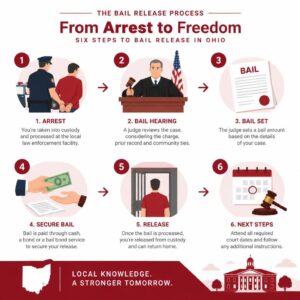
When an individual is arrested in Ohio for a misdemeanor, the legal process begins with a series of procedures designed to uphold both public safety and the rights of the accused. The Ohio Revised Code outlines the framework for these actions, from the initial arrest to the setting of bail and subsequent court appearances. Judicial discretion plays a significant role in how these cases proceed, particularly concerning bail decisions, where judges weigh factors like the alleged offense’s severity, the defendant’s criminal history, and their ties to the community.

Ohio’s legal system categorizes offenses into misdemeanors and felonies, with misdemeanors being less severe but still carrying notable consequences. Misdemeanors themselves are further divided into different degrees, with first-degree misdemeanors (M1) representing the most serious class. These cases are primarily handled in municipal courts, which have jurisdiction over local ordinances and state misdemeanor offenses. Understanding the specific court that will hear your case is crucial, as local rules and procedures can vary. Bail schedules, which are pre-determined amounts for specific offenses, often guide initial bail decisions, though a judge always retains the authority to adjust these amounts based on individual circumstances.
First-Degree Misdemeanor Classifications
A first-degree misdemeanor in Ohio is the most serious classification among misdemeanor offenses, indicating a higher level of culpability or potential harm compared to other misdemeanor degrees. The penalties associated with an M1 charge are significant, reflecting its gravity within the state’s legal framework. A person convicted of a first-degree misdemeanor faces a maximum jail sentence of 180 days, which is equivalent to six months, and a maximum fine of $1,000. These penalties can be imposed individually or in combination, depending on the specifics of the case and the judge’s sentencing decision.
Common examples of charges that frequently fall under the first-degree misdemeanor classification in Ohio include offenses like petty theft, especially when the value of the stolen property is between $1,000 and $7,500. Assault, which involves knowingly causing or attempting to cause physical harm to another, is another frequent M1 charge. Domestic violence, particularly when it involves physical harm or threats, is also often categorized as a first-degree misdemeanor. Furthermore, certain acts of criminal mischief, especially those that create a risk of physical harm to a person or involve specific types of property like computer systems within certain value thresholds, can be elevated to an M1. Driving Under the Influence (DUI) or Operating a Vehicle while Impaired (OVI) for a first offense is also typically charged as a first-degree misdemeanor, carrying specific mandatory minimum penalties beyond the general M1 guidelines.
To better illustrate the distinctions, here is a comparison of Ohio’s misdemeanor classifications:
Misdemeanor Classification Maximum Jail Time Maximum Fine Examples (non-exhaustive) First-Degree (M1) 180 days 1,000OVI(1stoffense),PettyTheft(1k-$7.5k), Assault, Domestic Violence, Criminal Mischief (risk of harm) Second-Degree (M2) 90 days $750 Resisting Arrest, Disorderly Conduct (serious) Third-Degree (M3) 60 days $500 Public Indecency, Criminal Trespass Fourth-Degree (M4) 30 days $250 Unauthorized Use of Property, Public Urination Minor Misdemeanor (MM) None $150 Jaywalking, Minor Traffic Violations, Open Container Critical Stages of the Bail Bond Process
The bail bond process in Ohio typically unfolds through several critical stages, beginning immediately after an arrest. The first step is the booking procedure, where law enforcement officially records the arrest. This involves collecting personal information, taking fingerprints and photographs, and documenting the alleged charges. During this stage, a preliminary bail amount might be set based on a pre-established bail schedule, if one exists for the specific offense.
Following booking, the individual will have an initial appearance or arraignment hearing. This is a crucial court proceeding where the defendant is formally informed of the charges against them and advised of their constitutional rights, including the right to an attorney. It is also at this hearing that the judge will make a formal decision regarding bail. The judge will consider factors such as the severity of the alleged crime, the defendant’s criminal history, their ties to the community, and whether they pose a flight risk or a danger to others.
Based on these considerations, the judge may set bail in various forms:
- Recognizance Bonds (OR Bonds): In less serious cases, or for defendants deemed low-risk, a judge might release the individual on their “own recognizance.” This means they are released without having to pay any money, simply on their promise to appear for all future court dates.
- Cash Bonds: This requires the full bail amount to be paid directly to the court in cash. If the defendant appears for all court dates, the money is typically returned at the conclusion of the case.
- Surety Bonds: This is the most common type of bail for more significant charges. It involves a bail bond agent, who acts as a surety, guaranteeing the defendant’s appearance in court. The defendant or their family typically pays a non-refundable premium (usually 10-15% of the total bail amount) to the bail bond agent. The agent then posts the full bail amount with the court.
Understanding these stages and the types of bonds available is fundamental to securing release from custody while navigating a first-degree misdemeanor charge in Ohio.
Determining Bail and Managing Pre-Trial Conditions
The determination of bail in Ohio is a multifaceted process, with judges carefully balancing the defendant’s right to liberty against the interests of public safety and ensuring court appearances. Several key factors influence a judge’s decision regarding the bail amount and any associated pre-trial conditions.
One primary consideration is public safety. If the court believes the defendant poses a significant threat to the community or specific individuals, bail may be set very high or even denied in extreme circumstances, though denial of bail for misdemeanors is rare. Another critical factor is the flight risk assessment. Judges evaluate the likelihood that a defendant will fail to appear for future court dates. This assessment often takes into account the defendant’s community ties, such as stable employment, family in the area, and homeownership. Strong community ties can indicate a lower flight risk. Conversely, a lack of local connections might lead to higher bail.
The defendant’s criminal history also plays a substantial role. A history of previous arrests, convictions, or failures to appear in court can significantly impact the bail decision, often resulting in a higher bail amount. In some cases, judges may impose pre-trial supervision as a condition of release, even if bail is posted. This can involve regular check-ins with a probation officer, electronic monitoring, restrictions on travel, or prohibitions on contact with certain individuals. These conditions are designed to monitor the defendant’s behavior and ensure compliance with court orders while awaiting trial. The goal is to strike a balance that allows the accused to prepare their defense while minimizing risks to the community and the integrity of the judicial process.
Common M1 Charges and Mandatory Minimums
While all first-degree misdemeanors carry the potential for up to 180 days in jail and a $1,000 fine, some specific M1 charges in Ohio come with additional, often mandatory, minimum penalties. These minimums are designed to address the particular nature and societal impact of certain offenses.
One of the most prominent examples is a first-offense OVI (Operating a Vehicle while Impaired), commonly known as DUI. Even for a first offense, which is typically an M1, Ohio law mandates specific penalties. These include at least 3 days in jail or, as an alternative, participation in a 72-hour driver intervention program. In addition, fines typically range from roughly $565 to $1,075, and the offender will face a mandatory license suspension. These minimums highlight the state’s serious approach to impaired driving, even for first-time offenders.
Another area where M1 charges often involve specific considerations is domestic violence. While the general M1 penalties apply, domestic violence cases frequently involve the issuance of Temporary Protection Orders (TPOs). These orders, issued by the court, prohibit the accused from having contact with the alleged victim and may require them to vacate a shared residence. Violating a TPO can lead to immediate re-arrest and additional charges, often escalating the legal consequences. The courts take domestic violence allegations very seriously, and the focus extends beyond just punitive measures to include victim protection.
Understanding these mandatory minimums and specific consequences is vital for anyone facing an M1 charge, as they can significantly impact the immediate and long-term legal strategy.
Alternative Sentencing and Pre-Trial Diversion
For individuals facing first-degree misdemeanor charges in Ohio, navigating the legal system often involves exploring avenues beyond traditional jail sentences. Plea bargaining is a common and critical mechanism where the prosecution and defense negotiate a resolution to the case. Through effective plea negotiations, an experienced attorney can often work to achieve a charge reduction to a lesser misdemeanor degree or even a minor misdemeanor, significantly reducing potential penalties. This can be a strategic move to avoid the maximum jail time and fines associated with an M1 conviction.
Beyond charge reduction, pre-trial diversion programs offer another alternative, especially for first-time offenders or those whose charges stem from underlying issues like substance abuse or mental health. These programs typically involve a period of supervision, counseling, community service, or educational courses. If the defendant successfully completes the program, the original charges may be dismissed or reduced, preventing a criminal conviction from appearing on their record. This can be an invaluable opportunity to avoid the long-term collateral consequences of a conviction.
Judges also have the discretion to impose alternative sentencing options at the time of conviction. Instead of or in addition to jail time, these can include community control, which is a form of probation requiring regular reporting, adherence to specific conditions, and potentially electronic monitoring. Rehabilitative counseling, such as anger management, drug and alcohol treatment, or mental health therapy, is frequently mandated, particularly in cases involving domestic violence or substance-related offenses. The goal of these alternatives is often to promote rehabilitation and reduce recidivism, offering a path for individuals to address underlying issues and avoid future legal troubles.
Securing Release and Navigating Local Courts
Once bail has been set, the immediate priority for an individual facing a first-degree misdemeanor in Ohio is securing release from custody. This process involves working with the appropriate authorities and often a bail bond agent to post the required bond. The specifics of this process can vary slightly depending on the jurisdiction, as Ohio’s court system includes municipal courts, county courts, and even some mayor’s courts. Municipal and county courts handle the vast majority of misdemeanor cases, while mayor’s courts, typically found in smaller villages, have limited jurisdiction and cannot conduct jury trials, requiring defendants to request a transfer to a municipal or county court if they desire a jury.
After bail is posted, the jail discharge procedures begin. This involves processing the release paperwork, which can sometimes take several hours. It’s important for family members or the bail bond agent to understand the local jail’s specific procedures to ensure a smooth and timely release. Prompt communication and readiness to complete necessary forms are key during this stage.
Navigating these local court systems and jail procedures effectively requires a nuanced understanding of the specific rules and practices in place. Each court may have its own preferred methods for scheduling, filing, and managing cases, making local expertise invaluable.
Role of Local Expertise in the Bail Bond Process
Navigating the bail bond process in Ohio for a first-degree misdemeanor requires more than just understanding the law; it demands an intimate knowledge of local court systems and their operational nuances. This is where local expertise becomes indispensable. Experienced bail bond agents, deeply familiar with the specific practices of municipal courts and county courts across Ohio, can significantly streamline the release process.
For instance, while the Ohio Revised Code provides a general framework, each county’s court system may have distinct procedural requirements. Local agents are often adept at utilizing county court portals for case information, understanding the typical bond processing times for different jails, and knowing the unwritten rules that can affect how quickly someone is released. This localized knowledge allows for fast turnaround times, which can be critical for someone awaiting release.
Furthermore, local experts are often skilled in resolving complex situations, such as outstanding warrants or non-standard court rules that might complicate a release. They understand the specific documentation required by each court and jail, ensuring that all paperwork is correctly submitted the first time. When it comes to managing the financial aspects, they can guide individuals through the various options for securing release, including funding bail services through payment plans or collateral arrangements. Their insights into the local judicial landscape can be a significant advantage, helping defendants and their families navigate a stressful situation with greater efficiency and confidence.
Long-Term Impact and Record Sealing
A conviction for a first-degree misdemeanor in Ohio can have significant collateral consequences that extend far beyond the immediate penalties of jail time and fines. These impacts can profoundly affect an individual’s life, often for many years. One of the most common concerns is the effect on employment. Many employers conduct background checks, and a criminal conviction, even for a misdemeanor, can make it difficult to secure new jobs or maintain existing ones. Certain professions, especially those requiring licenses, may be particularly sensitive to criminal records.
Professional licenses, such as those for nursing, teaching, real estate, or various trades, can be jeopardized by a first-degree misdemeanor conviction. Licensing boards often review criminal histories and may deny, suspend, or revoke licenses based on the nature of the offense. Similarly, housing opportunities can be impacted, as landlords often run background checks and may be hesitant to rent to individuals with criminal records.
Fortunately, Ohio law provides options for individuals to mitigate these long-term impacts through record sealing or expungement. While a first-degree misdemeanor conviction will remain on a public record permanently unless a court orders otherwise, it can often be sealed. Eligibility for sealing typically begins after a one-year waiting period from the date of the final discharge of the case, meaning one year after all sentencing requirements (like probation, fines, and community service) have been completed.
The process involves filing an application for record sealing with the court. If granted, sealing restricts public access to the record, making it invisible to most background checks. Certain offenses, such as OVI convictions and traffic offenses, are generally not eligible for sealing or expungement under Ohio law. Understanding these long-term implications and the potential for record sealing is crucial for anyone facing an M1 charge.
Frequently Asked Questions About Ohio Bail and Misdemeanors
What is the maximum penalty for a first-degree misdemeanor in Ohio?
In Ohio, a first-degree misdemeanor (M1) carries the most severe penalties among all misdemeanor classifications. The statutory limits for an M1 conviction include a maximum jail sentence of 180 days, which is equivalent to six months, and a maximum fine of $1,000. These are maximums; a judge has considerable discretion when sentencing. Depending on the specifics of the case, the defendant’s criminal history, and any mitigating factors presented, the judge may impose a combination of these penalties, or opt for alternative sentencing options such as probation, community service, or enrollment in a diversion program. While jail time is a possibility, it is not an automatic outcome for every M1 conviction.
Can a first-degree misdemeanor conviction be removed from a criminal record?
Yes, in many cases, a first-degree misdemeanor conviction in Ohio can be sealed or expunged, though the term “expunged” is often used colloquially while “sealing” is the precise legal term in Ohio. A conviction will remain on a public record permanently unless a court orders it sealed. Eligibility for record sealing typically begins after a one-year waiting period from the date of the final discharge of the case. This means all conditions of the sentence, such as jail time, probation, fines, and community service, must be completed, and one full year must pass without any new criminal charges.
The process involves filing a formal application for record sealing with the court that handled the conviction. The court will then review the application, potentially hold a hearing, and decide whether to grant the sealing. If granted, the record is removed from public view, meaning it generally won’t appear on most background checks. However, it’s crucial to remember that certain types of convictions, notably first-offense OVI (DUI) and many traffic offenses, are typically excluded from eligibility for sealing under Ohio law.
How does posting bond differ across Ohio municipal and mayor’s courts?
Posting bond can indeed differ between Ohio’s municipal and mayor’s courts due to their distinct jurisdictions and operational procedures. Municipal courts are courts of record, handling a wide range of misdemeanor cases, including first-degree misdemeanors, and have the authority to conduct jury trials. They typically have established bail schedules and more standardized processes for bond posting, often allowing for cash bonds, surety bonds through licensed agents, or release on own recognizance.
Mayor’s courts, on the other hand, are not courts of record and have limited jurisdiction, usually handling minor misdemeanors and certain traffic offenses. They generally do not have the authority to conduct jury trials. If a defendant in a mayor’s court wishes to have a jury trial, they have the right to request a transfer of their case to the appropriate municipal or county court. This distinction can affect how bond is handled; while mayor’s courts can set and accept bond, the process might be less formal or have different hours of operation compared to a larger municipal court. Local bond processing times and specific rules can vary significantly.
When posting bail, regardless of the court, you will typically need to provide certain documents. Here is a general list of documents and information often required for bail posting:
- Defendant’s full legal name and date of birth.
- Case number or citation number.
- Arresting agency and date of arrest.
- Bail amount set by the court.
- Identification for the person posting the bond (e.g., driver’s license, state ID).
- Proof of address for the person posting the bond.
- Payment method (cash, credit card, or agreement with a bail bond agent).
- Any specific court orders or conditions related to the bond.
Understanding these differences and having access to local expertise can significantly ease the process of securing release.
Conclusion
Navigating a first-degree misdemeanor charge in Ohio is a serious undertaking that demands a rapid response and a thorough understanding of the legal landscape. From the moment of arrest through the bail bond process and subsequent court proceedings, every step is critical. We’ve explored the gravity of M1 charges, the maximum penalties involved, and the various stages of securing release through bail.
Effective navigation of the Ohio legal system requires not only an understanding of procedural compliance but also the ability to protect constitutional rights at every turn. The complexities of different court jurisdictions, the nuances of bail determination, and the potential for long-term collateral consequences underscore the importance of informed action. Securing release and building a strong defense hinges on diligent efforts and, crucially, local legal navigation. With the right guidance, individuals can face these challenges with greater confidence and work towards the most favorable outcome possible.