



A hospital administrator and a law firm partner both told me the same thing last year, almost word for word: “We just want outsourcing that actually understands our world.” That single sentence sums up where business process outsourcing in the UK has landed. It’s no longer just a cost-cutting exercise.it’s a strategic decision shaped heavily by which industry you’re in. Healthcare and professional services face wildly different regulatory pressures, data sensitivities, and client expectations, which means the same outsourcing model rarely fits both. Here’s where those differences actually matter, and how to choose an approach that fits your sector rather than a generic template.
What Is Business Process Outsourcing, Really?
BPO, or Business Process Offshoring, simply put, is about handing the operational activities like accounting, payrolls management, human resources administration or provision of IT services to a third party. This is essentially not about doing these tasks internally in your business. Still, Note that this can also mean, when done well, a reduction in the time required to do your day-to-day work, an increase in your productivity, and even higher customer satisfaction.
Of course, the biggest mistake companies make on BPO is Really all BPO arrangements are the same regardless of the business area concerned. In the real world, they aren’t.
Why Does Industry Shape the Right Outsourcing Strategy?
A GP clinic and an advisory consultancy are subject totally different types of risk if something goes wrong during the process. One is dealing with the privacy of patient records under UK GDPR and where relevant, NHS Data Security and Protection Toolkit. The other is dealing with the client financial records and the professional standards set by regulatory bodies like the ICAEW.
Compliance obligations, sensitivity of data and expectations of the customer change completely from one sector to another which is also what causes the ‘one-stopshopping’ type of outsourcing to be ineffective.
Healthcare vs Professional Services: Where the Priorities Diverge
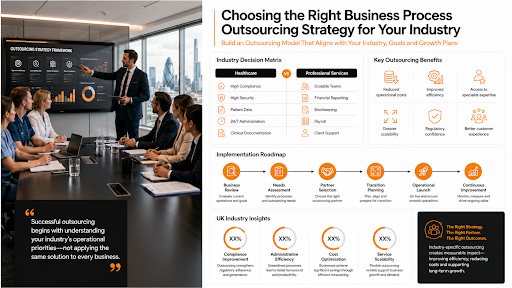
| Factor | Healthcare | Professional Services |
| Primary compliance concern | Patient confidentiality, NHS DSPT | Client confidentiality, financial record protection |
| Data sensitivity | Very high (health records) | High (financial/legal records) |
| Service expectations | Continuity of care, minimal disruption | Responsiveness, accuracy under deadline pressure |
| Typical outsourced functions | Payroll, scheduling, admin, IT helpdesk | Bookkeeping, CRM admin, accounts payable |
| Functions kept in-house | Clinical decisions, diagnosis | Legal advice, strategic consulting |
The table looks simple, but the operational reality behind it is anything but. A missed appointment reminder in a healthcare setting affects patient care. A late invoice in a professional services firm affects cash flow and client trust. Different stakes, different priorities.
What Should Each Industry Actually Outsource?
Healthcare organisations mainly gain the most benefit from externalising tasks related to payroll, finance and bookkeeping, HR administration, management of medical appointments, and technical support (like an IT helpdesk). These are typically high-volume, process-oriented types of work that can reduce clinical staff workload, enabling them to focus on patients rather than paperwork.
Professional services firms (e.g. law firms accountants, consultants) usually choose to outsource their bookkeeping payroll, accounts payable, CRM administration, and document management. What is their main similarity? These are repetitive tasks that can be handled in the background and which require less, if any, industry-specific or specialist-level professional expertise.
What should stay in-house is just as important. Clinical decision-making and patient diagnosis obviously never leave a healthcare provider’s walls. Legal advice, strategic consulting, and high-value client relationships stay firmly with professional services teams too outsourcing these would strip away the exact expertise clients are paying for.
Where the Real Differences Live?(Compliance)
The rules they have to play by are stricter in the healthcare industry, which means besides following UK GDPR, they have to comply with information governance standards too. If it’s a healthcare setting, they need to also make sure the Data Security and Protection Toolkit is followed. Professional service firms are also regulated by UK GDPR as well as healthcare providers
Compliance for professional firms depends mainly on client confidentiality and industry-specific professional standards. Both sectors rely heavily on their outsourcing partners, so it’s quite natural that they expect their security credentials to be up to standard; recognised Cyber Essentials and having the ISO 27001 certificate are actually very minimum, the barest expectations, not nice-to-havens.
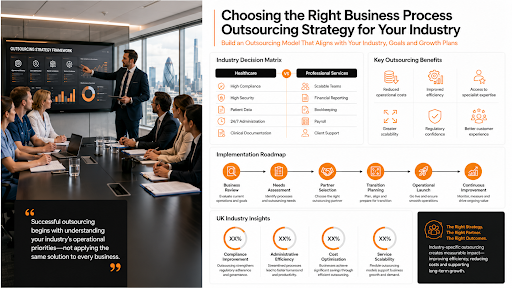
Is Your Organisation Actually Ready to Outsource?
Before signing with any provider, check for a few basics: clearly defined objectives, documented workflows, internal stakeholder support, and a realistic budget. If your processes aren’t documented and nobody’s agreed on what success looks like, outsourcing will expose that gap rather than solve it.
Choosing the Right Partner for Your Sector
Industry experience should be your top criterion for evaluating any outsourcing business process provider in the UK healthcare sector or related fields. Following close behind industry experience should be the assessment of the provider’s knowledge of rules, regulations, and verifiable security credentials. Ask providers: do you work with healthcare compliance models, or confidentiality standards in professional services? It is better if they give you straight answers.
Unverifiable and general replies here can only mean one thing: a provider that is very much in the dark will never come to the front as a good one. Well-written performance metrics, response times, reporting frequency, and exit clauses are the ingredients of a good Service Level Agreement. Should a provider be reluctant to set these terms in writing, the lack of a willingness to do so reveals an important issue before actually concluding the agreement.
Busting a Few Common Myths
Healthcare providers are allowed to outsource some of their operations without any restrictions as many do in fact outsource successfully; their provider being the key figure in the knowledge of the compliance area. Besides professional services, firms will not need to have their entire operations conducted internally. In many cases, a clean outsourcing of back-office functions is possible without compromising client-facing expertise at all. Contrary to popular perceptions, outsourcing correctly, when all steps are followed, won’t result in poor data security, most of the time, because it’s the contrary, the specialists’ providers should spend more money on security measures than an internal team of a generalist company could even think.
Frequently Asked Questions
Why do healthcare and professional services require different outsourcing strategies?
The two sectors face different regulatory pressures and risk profiles. Healthcare organisations manage patient confidentiality under UK GDPR and, where applicable, the NHS Data Security and Protection Toolkit, while professional services firms focus more on client confidentiality and financial record protection. A provider built for one doesn’t automatically understand the other.
What business processes should healthcare organisations outsource?
Payroll, finance and bookkeeping, HR administration, appointment scheduling, and IT help desk support tend to outsource well. These are high-volume, repeatable tasks that free up clinical staff to focus on patient care rather than administrative work without touching anything involving direct patient treatment.
What functions should professional services firms outsource?
Bookkeeping, payroll, accounts payable, CRM administration, and document management are the most common candidates. These back-office tasks don’t require the specific professional judgement clients are actually paying for, which makes them safe to hand off to a specialist provider.
Which business functions should remain in-house regardless of industry?
In healthcare, clinical decision-making, diagnosis, and treatment planning stay firmly internal, no exceptions. In professional services, legal advice, strategic consulting, and high-value client relationships stay in-house too, since outsourcing these would strip away the core expertise the firm is built on.
What security standards should a BPO provider meet for regulated industries?
At minimum, look for Cyber Essentials and ISO 27001 certification as baseline credentials, not optional extras. Healthcare-focused providers should also demonstrate familiarity with the NHS Data Security and Protection Toolkit where relevant, while professional services providers should show a clear grasp of client confidentiality obligations tied to their specific sector.
Key Takeaways
Healthcare and professional services organisations face different operational, compliance, and security demands, which means the right outsourcing strategy looks different for each. Evaluate any partner on industry expertise, regulatory knowledge, and security credentials not cost alone.
This is the gap Eco Outsourcing was built to close tailored support for regulated healthcare providers and professional services firms alike, backed by transparent SLAs and security standards that hold up under scrutiny.
Get that match right, and outsourcing becomes a long-term strategic advantage rather than a risk you’re managing after the fact.