


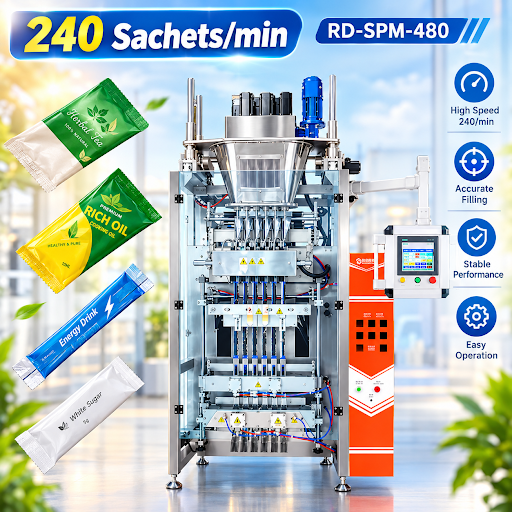
Sachets are everywhere in daily life. From shampoo samples and ketchup packets to instant coffee, spices, and pharmaceutical powders, these small, sealed pouches are one of the most practical packaging formats used across industries. They are affordable, portable, and easy to use, which is why manufacturers of food, cosmetics, personal care, and pharmaceutical products rely on them so heavily. But have you ever wondered how these tiny, precisely sealed pouches are actually made?
This article walks through the sachet packaging process, step by step, so you can understand the technology and precision behind this common yet often overlooked product.
The Role of a Sachet Filling Machine in Modern Packaging
At the heart of the entire sachet production process is the sachet filling machine, a piece of equipment designed to measure, fill, and seal products into small pouches with speed and accuracy. Before this technology became widely available, filling and sealing sachets was largely a manual task, which was slow, inconsistent, and prone to contamination. Today, a sachet filling machine automates nearly the entire process, allowing manufacturers to produce thousands of uniform sachets per hour with minimal human intervention.
These machines are built to handle a wide range of products, including liquids, powders, granules, pastes, and gels. Depending on the industry, a sachet filling machine may be configured differently, but the core function remains the same: it takes a roll of packaging film, forms it into a pouch, doses the exact amount of product required, and seals the pouch before it moves on to cutting and finishing. This automation not only speeds up production but also ensures that every sachet contains the same quantity of product, which is essential for quality control, regulatory compliance, and consumer trust.
Step One: Selecting and Preparing the Packaging Film
Sachet production starts with the packaging material. Sachets are usually made from flexible packaging materials such as polyethene (PE), polypropylene (PP), aluminium foil laminate, or a mixture of these materials. The kind of film is a function of what is being packed.
Items that are sensitive to moisture, light, or air, for example, certain pharmaceuticals or food products, frequently need a foil laminate that provides a higher barrier to these substances. The film typically comes to the factory in rolls. Before processing, keep these rolls away from packaging material. Once the packaging material is loaded onto the packaging machinery, to be taken off to be formed into a single sachet in the next step.
Step Two: Forming the Pouch
The film is then taken up, passing through a series of rollers and guides that form it into either a tube or a pouch. The film is folded vertically in vertical form-fill-seal systems, which are the most popular configurations, and sealed along one edge, forming a continuous tube. For horizontal machinery, the film is fed flat and folded over from the side, commonly used for four-side-sealed sachets that form a shape when closed.
At this point, heat sealing bars are used to exert heat and force along the film’s edges to seal it together, creating the walls of the sachet without even adding the product.
Step Three: Dosing and Filling the Product
Once the shape of the pouch is formed, the next process is filling. That’s where precision dosing systems come in. Liquid volumetric or piston fillers measure a precise volume and dispense in one cycle. For powders and granules, the auger filler or weight-based systems deliver a uniform quantity from sachet to sachet.
This is the key detail and precision which must be guaranteed at this level. Overfilling the containers wastes product and adds to cost; underfilling could result in a regulatory mess and unhappy customers. State-of-the-art equipment employs sensors and digital controls to ensure a high level of accuracy in long production runs as line speeds increase.
Step Four: Sealing the Sachet
Once the product has been filled into the formed pouch, the sachet needs to be sealed at the top to close it completely. This is usually achieved by means of heat sealing, ultrasonic sealing and/or hot air sealing, depending on the packaging material and the product enclosed.
Good sealing is not only important to avoid leakage but also to keep product freshness, hygiene and shelf life. Seal strength is a parameter that manufacturers routinely test to ensure their packages do not unintentionally open in shipping, storage, or handling.
Step Five: Cutting and Finishing
After sealing, the sachets go to the cutting process, which is to separate the individual pouches from the film strip. Clean edges are formed by precision cutting blades or rotary knives, and a lot of machines are configured to make features such as easy tear notches that allow consumers to open the sachet without scissors or too much force.
At this point, the sachets are basically done and ready for the end-of-line process.
Step Six: Quality Control and Packaging
Sachets usually undergo quality control inspections before they are shipped out from the factory. This may involve visual examinations to ensure proper sealing, weight tests to verify that the filling is correct, and leak detection tests. To ensure the quality of the products is maintained, any defective sachets are also rejected from the line.
When approved, sachets are bundled, counted, and packed in boxes, cartons or sacks of jute/pp for shipping. After this, they are sent to retailers, distributors, or straight to the consumer, good for daily use.
Conclusion
The sachet packaging may seem very straightforward to someone who does not look beneath the surface, but in reality, it involves a series of well-planned steps of forming, filling, sealing, and finishing, which rely heavily on precision engineering. Starting from picking the proper type of film to getting flawless metering and reliable seams, each bit of the process is essential in making sure that the customer always has a product that is safe, consistent, and easy for them to consume. In most cases, the sachet filling machine is the device that integrates all the necessary steps with speed, precision, and automation to make the mass production of sachets feasible. Learning about this entire line of events will help you understand the great extent to which our daily products get wrapped and distributed in a practical and user-friendly manner.